
 Arizona Cardinals Flag
 Atlanta Falcons Flag
 Baltimore Ravens Flag
 Buffalo Bills Flag
 Carolina Panthers Flag
 Chicago Bears Flag
 Cincinnati Bengals Flag
 Cleveland Browns Flag
 Dallas Cowboys Flag
 Denver Broncos Flag
 Detroit Lions Flag
 Green Bay Packers Flag
 Houston Texans Flag
 Indianapolis Colts Flag
 Jacksonville Jaguars Flag
 Kansas City Chiefs Flag
 Las Vegas Raiders Flag
 Los Angeles Chargers Flag
 Los Angeles Rams Flag
 Miami Dolphins Flag
 Minnesota Vikings Flag
 New England Patriots Flag
 New Orleans Saints Flag
 New York Giants Flag
 New York Jets Flag
 Philadelphia Eagles Flag
 Pittsburgh Steelers Flag
 San Francisco 49ers Flag
 Seattle Seahawks Flag
 Tampa Bay Buccaneers Flag
 Tennessee Titans Flag
 Washington Commanders Flag
 Arizona Diamondbacks Flag
 Atlanta Braves Flag
 Baltimore Orioles Flag
 Boston Red Sox Flag
 Chicago Cubs Flag
 Chicago White Sox Flag
 Cincinnati Reds Flag
 Cleveland Guardians Flag
 Colorado Rockies Flag
 Detroit Tigers Flag
 Houston Astros Flag
 Kansas City Royals Flag
 Los Angeles Angels Flag
 Los Angeles Dodgers Flag
 Miami Marlins Flag
 Milwaukee Brewers Flag
 Minnesota Twins Flag
 New York Mets Flag
 New York Yankees Flag
 Oakland Athletics Flag
 Philadelphia Phillies Flag
 Pittsburgh Pirates Flag
 San Diego Padres Flag
 San Francisco Giants Flag
 Seattle Mariners Flag
 St. Louis Cardinals Flag
 Tampa Bay Rays Flag
 Texas Rangers Flag
 Toronto Blue Jays Flag
 Washington Nationals Flag
 Atlanta Hawks Flag
 Boston Celtics Flag
 Brooklyn Nets Flag
 Charlotte Hornets Flag
 Chicago Bulls Flag
 Cleveland Cavaliers Flag
 Dallas Mavericks Flag
 Denver Nuggets Flag
 Detroit Pistons Flag
 Golden State Warriors Flag
 Houston Rockets Flag
 Indiana Pacers Flag
 LA Clippers Flag
 Los Angeles Lakers Flag
 Memphis Grizzlies Flag
 Miami Heat Flag
 Milwaukee Bucks Flag
 Minnesota Timberwolves Flag
 New Orleans Pelicans Flag
 New York Knicks Flag
 Oklahoma City Thunder Flag
 Orlando Magic Flag
 Philadelphia 76ers Flag
 Phoenix Suns Flag
 Portland Trail Blazers Flag
 Sacramento Kings Flag
 San Antonio Spurs Flag
 Toronto Raptors Flag
 Utah Jazz Flag
 Washington Wizards Flag
 Anaheim Ducks Flag
 Arizona Coyotes Flag
 Boston Bruins Flag
 Buffalo Sabres Flag
 Calgary Flames Flag
 Carolina Hurricanes Flag
 Chicago Blackhawks Flag
 Colorado Avalanche Flag
 Columbus Blue Jackets Flag
 Dallas Stars Flag
 Detroit Red Wings Flag
 Edmonton Oilers Flag
 Florida Panthers Flag
 Los Angeles Kings Flag
 Minnesota Wild Flag
 Montreal Canadiens Flag
 Nashville Predators Flag
 New Jersey Devils Flag
 New York Islanders Flag
 New York Rangers Flag
 Ottawa Senators Flag
 Philadelphia Flyers Flag
 Pittsburgh Penguins Flag
 San Jose Sharks Flag
 Seattle Kraken Flag
 St. Louis Blues Flag
 Tampa Bay Lightning Flag
 Toronto Maple Leafs Flag
 Vancouver Canucks Flag
 Vegas Golden Knights Flag
 Washington Capitals Flag
 Winnipeg Jets Flag
News
The 10 Best Baseball Players of All Time in Baseball History
Ranking the 10 best baseball players of all time is challenging because the sport has evolved dramatically. This FlagOh guide uses data, advanced metrics, and historical context to highlight the greatest legends and the modern stars rising toward that tier.
How We Ranked the Greatest Baseball Players in History
To build a fair list of the greatest baseball players in history, FlagOh looks beyond big moments and reputation, focusing instead on three core pillars that combine advanced stats, era context, and total career impact.
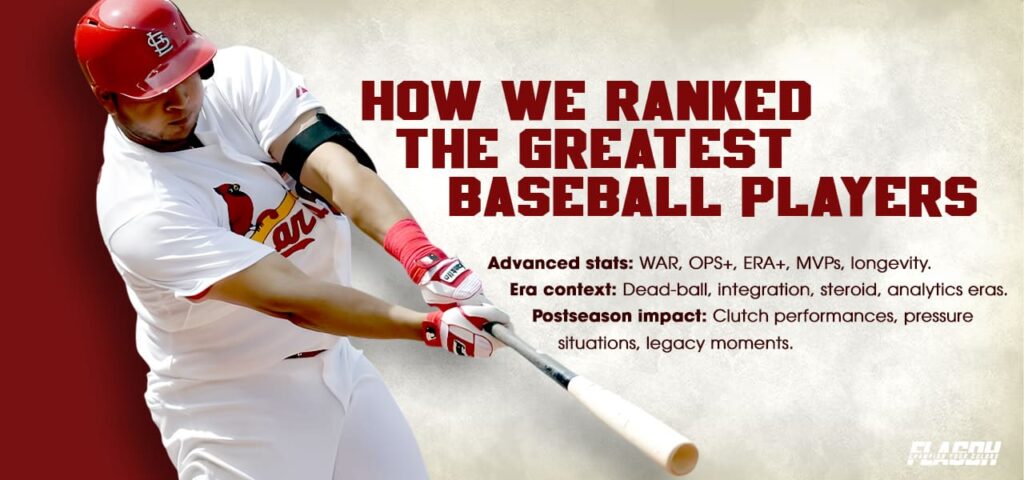
Core Metrics (WAR, OPS+, ERA+, MVPs & Longevity):
- WAR (Wins Above Replacement): The gold standard for measuring a player’s total value in runs and wins, combining offense, defense, and baserunning into one comparable number.
- OPS+/ERA+: Adjusts a hitter’s on-base plus slugging (OPS) or a pitcher’s earned run average (ERA) to league and ballpark context, so a 160 OPS+ or 150 ERA+ clearly shows how far above average a player truly was in their era.
- MVP Awards & Major Milestones: Capture peak dominance and how often a player was recognised as the best in the league, while milestones like 500 home runs, 3,000 hits, or 300 wins signal sustained greatness rather than one or two hot seasons.
- Longevity: Reflects how long a player maintained star-level performance, rewarding those who stayed elite for a decade or more instead of burning out after a short peak.
These metrics together make cross-era comparisons more balanced and meaningful, instead of relying only on raw totals or nostalgia.
Era Adjustments:
- Dead-ball era: Low-scoring games, heavier balls, bigger ballparks, and a focus on bunting, speed, and contact hitting meant even elite sluggers posted modest home run totals compared to today.
- Integration era: As Black and Latino players entered MLB, the overall talent pool and competition level rose sharply, making dominance in this period arguably more impressive from a depth-of-talent standpoint.
- Steroid era: Smaller parks, livelier balls, and performance-enhancing drugs contributed to historic offensive spikes, forcing analysts to separate raw numbers from context and era-specific conditions.
- Statcast/Analytics era: Velocity, spin rate, launch angle, and defensive positioning are tracked in detail, reshaping how value is created and measured on the field.
Because each era operates under its own conditions, any meaningful all-time ranking must evaluate players within the context of their environment rather than relying on box-score totals alone.
Postseason & World Series Impact:
While not every star played on a dynasty, postseason performance still reveals key layers of greatness, such as:
- Clutch value: How often a player delivers in high-leverage plate appearances or critical innings when every pitch can swing a series.
- Adaptability under pressure: The ability to adjust to elite pitching, hostile road crowds, and short-series volatility where weaknesses are exposed quickly.
- Legacy-defining moments: Iconic home runs, shutdown starts, or defensive plays that become part of baseball history and often shape how a player is remembered compared with their regular-season stats.
The 10 Best Baseball Players of All Time
Identifying the 10 best baseball players of all time means looking past highlight reels to the few stars who truly shaped the sport. The legends below changed how baseball is played and understood through dominant hitting, transformative pitching, and complete all-around games, forming the core of the game’s history and its highest standard of greatness.
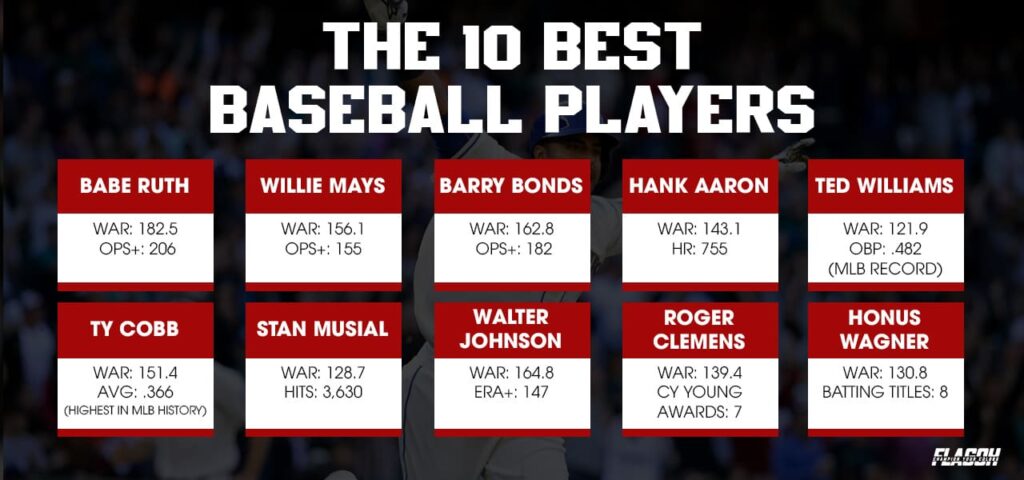
Babe Ruth
WAR: 182.5
OPS+: 206
Babe Ruth transformed baseball with unmatched power and on-base ability, reshaping offensive strategy and becoming the sport’s first global icon. His dominance as both a pitcher and hitter sets the foundation for nearly every modern comparison.
Willie Mays
WAR: 156.1
OPS+: 155
Willie Mays is widely seen as the most complete player in history, combining elite defense with explosive speed and consistent power. His famous over-the-shoulder catch symbolizes the instincts and athleticism that defined his career.
Barry Bonds
WAR: 162.8
OPS+: 182
Barry Bonds redefined hitter intimidation. His combination of plate discipline, power, and run production forced teams to change how they pitched in key moments. Despite controversy, his statistical impact is among the most significant ever recorded.
Hank Aaron
WAR: 143.1
HR: 755
Hank Aaron exemplified steady excellence, delivering elite production without dramatic ups and downs. His 755 home runs became the standard for power hitters, and his durability helped him build one of the strongest offensive résumés in baseball history.
Ted Williams
WAR: 121.9
OBP: .482 (MLB record)
Ted Williams’ unmatched plate discipline made him the blueprint for modern hitting theory. Even with multiple seasons lost to military service, he produced historic offensive numbers that remain benchmarks of pure hitting ability.
Ty Cobb
WAR: 151.4
AVG: .366 (highest in MLB history)
Ty Cobb dominated through precision and relentless competitiveness. His career batting average still stands as the highest ever, capturing how thoroughly he controlled the offensive side of the game during his era.
Stan Musial
WAR: 128.7
Hits: 3,630
Stan Musial built his career on balance and reliability. With consistent production in every setting and exceptional on-base skills, he became a model of durability and steady excellence across decades.
Walter Johnson
WAR: 164.8
ERA+: 147
Walter Johnson’s combination of velocity, command, and stamina made him the most overpowering pitcher of his time. His numbers continue to rank among the best, confirming his place as a foundational figure in pitching history.
Roger Clemens
WAR: 139.4
Cy Young Awards: 7
Roger Clemens sustained elite performance through adaptability and power. His league-leading ERA seasons and extended dominance make him one of the most accomplished pitchers of the modern era.
Honus Wagner
WAR: 130.8
Batting Titles: 8
Honus Wagner helped define the shortstop position with his strength, athleticism, and defensive intelligence. His all-around abilities allowed him to excel in every phase of the game, shaping early expectations for the role.
Key Stats of the 10 Best Baseball Players of All Time
Numbers help explain why these legends belong among the 10 best baseball players of all time. Looking at WAR, OPS+/ERA+, MVP awards, championships, and signature records side by side gives a clearer view of how each player dominated his era and how their careers stack up in baseball history, which is exactly the comparison FlagOh highlights in this breakdown.
| Player | WAR | OPS+ / ERA+ | MVPs | Championships | Notable Record |
| Babe Ruth | 182.5 | 206 OPS+ | 1 | 7 | OPS+ all-time leader |
| Willie Mays | 156.1 | 155 OPS+ | 2 | 1 | Iconic 5-tool profile |
| Barry Bonds | 162.8 | 182 OPS+ | 7 | 0 | HR record holder |
| Hank Aaron | 143.1 | 155 OPS+ | 1 | 1 | 755 career HR |
| Ted Williams | 121.9 | 191 OPS+ | 2 | 0 | .482 OBP record |
| Ty Cobb | 151.4 | 168 OPS+ | 1 | 0 | .366 AVG record |
| Stan Musial | 128.7 | 159 OPS+ | 3 | 3 | 3,630 hits |
| Walter Johnson | 164.8 | 147 ERA+ | 1 | 1 | 417 career wins |
| Roger Clemens | 139.4 | 143 ERA+ | 7 | 2 | 7 Cy Young Awards |
| Honus Wagner | 130.8 | 151 OPS+ | 1 | 1 | 8 batting titles |
Modern Stars Who Could Become All-Time Greats
Today’s game features a handful of active stars whose production already hints at all-time status. They have not finished their careers yet, but their tools, advanced metrics, and impact suggest they could eventually force their way into future versions of any list of the 10 best baseball players of all time.
Shohei Ohtani
Shohei Ohtani has completely changed what a modern superstar can look like. He hits like a middle-of-the-order slugger and pitches like a true staff ace, generating value on both sides of the ball in a way that advanced metrics struggle to fully capture. His rising WAR reflects a player doing two demanding jobs at an exceptional level, positioning him as one of the most singular talents the sport has ever seen.
Mike Trout
Mike Trout has spent most of his career playing at a level that hardly dips below MVP form. Season after season, he combines power, on-base ability, speed, and solid defense, which is why his WAR per year sits near the top of MLB history. If he can stay on the field over the long term, his overall résumé has a realistic chance to place him alongside the game’s very highest tier of all-time greats.
Mookie Betts & Aaron Judge
Mookie Betts and Aaron Judge highlight two different paths to modern dominance. Betts brings elite WAR totals through a mix of contact, patience, power, and standout defense at multiple positions, giving his team value in almost every phase of the game. Judge shifts the spotlight with towering home runs and MVP-level peaks, changing how opposing pitchers game-plan whenever he’s in the lineup. Together, they represent the kind of complete, impact-heavy stars who can shape an era.
Frequently Asked Questions About the Greatest Baseball Players in History
These quick answers address common debates about all-time rankings, from evaluating longevity to understanding the role of defense and postseason success.
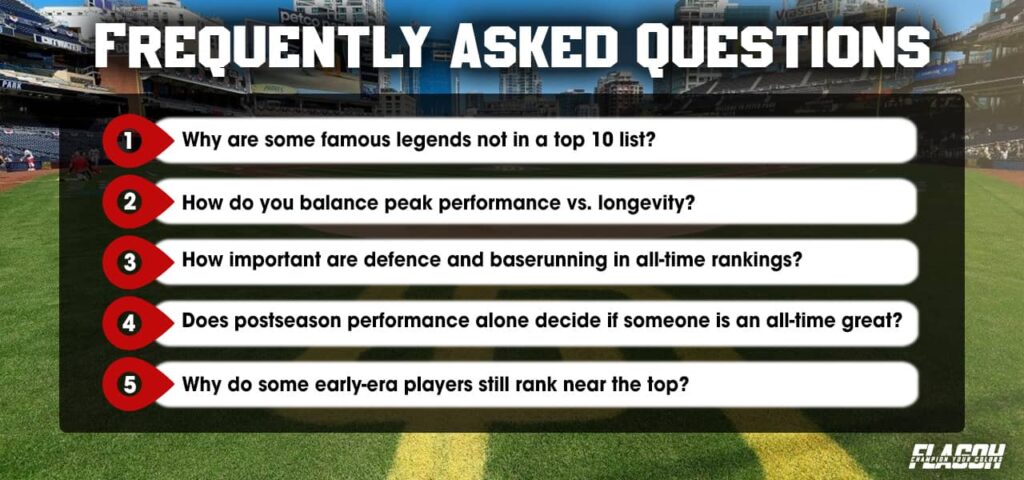
Why are some famous legends not in a top 10 list?
Some stars had exceptional peaks but lacked the longevity or total value required for all-time placement.
How do you balance peak performance vs. longevity?
All-time rankings weigh both, rewarding players who sustained elite performance over long careers.
How important are defense and baserunning in all-time rankings?
They add considerable value, especially for complete players whose contributions go beyond power hitting.
Does postseason performance alone decide if someone is an all-time great?
No. It matters, but full-career value carries greater weight.
Why do some early-era players still rank near the top?
Era-adjusted stats reveal how far they exceeded the competition in their time.
Greatness in baseball blends dominance, consistency, and lasting impact, and the legends often mentioned among the 10 best baseball players of all time set the standard everyone else chases. If you enjoy rich baseball history and smart sports storytelling, explore more deep-dive articles and heritage-inspired gear from the FlagOh sports heritage collections.