
 Arizona Cardinals Flag
 Atlanta Falcons Flag
 Baltimore Ravens Flag
 Buffalo Bills Flag
 Carolina Panthers Flag
 Chicago Bears Flag
 Cincinnati Bengals Flag
 Cleveland Browns Flag
 Dallas Cowboys Flag
 Denver Broncos Flag
 Detroit Lions Flag
 Green Bay Packers Flag
 Houston Texans Flag
 Indianapolis Colts Flag
 Jacksonville Jaguars Flag
 Kansas City Chiefs Flag
 Las Vegas Raiders Flag
 Los Angeles Chargers Flag
 Los Angeles Rams Flag
 Miami Dolphins Flag
 Minnesota Vikings Flag
 New England Patriots Flag
 New Orleans Saints Flag
 New York Giants Flag
 New York Jets Flag
 Philadelphia Eagles Flag
 Pittsburgh Steelers Flag
 San Francisco 49ers Flag
 Seattle Seahawks Flag
 Tampa Bay Buccaneers Flag
 Tennessee Titans Flag
 Washington Commanders Flag
 Arizona Diamondbacks Flag
 Atlanta Braves Flag
 Baltimore Orioles Flag
 Boston Red Sox Flag
 Chicago Cubs Flag
 Chicago White Sox Flag
 Cincinnati Reds Flag
 Cleveland Guardians Flag
 Colorado Rockies Flag
 Detroit Tigers Flag
 Houston Astros Flag
 Kansas City Royals Flag
 Los Angeles Angels Flag
 Los Angeles Dodgers Flag
 Miami Marlins Flag
 Milwaukee Brewers Flag
 Minnesota Twins Flag
 New York Mets Flag
 New York Yankees Flag
 Oakland Athletics Flag
 Philadelphia Phillies Flag
 Pittsburgh Pirates Flag
 San Diego Padres Flag
 San Francisco Giants Flag
 Seattle Mariners Flag
 St. Louis Cardinals Flag
 Tampa Bay Rays Flag
 Texas Rangers Flag
 Toronto Blue Jays Flag
 Washington Nationals Flag
 Atlanta Hawks Flag
 Boston Celtics Flag
 Brooklyn Nets Flag
 Charlotte Hornets Flag
 Chicago Bulls Flag
 Cleveland Cavaliers Flag
 Dallas Mavericks Flag
 Denver Nuggets Flag
 Detroit Pistons Flag
 Golden State Warriors Flag
 Houston Rockets Flag
 Indiana Pacers Flag
 LA Clippers Flag
 Los Angeles Lakers Flag
 Memphis Grizzlies Flag
 Miami Heat Flag
 Milwaukee Bucks Flag
 Minnesota Timberwolves Flag
 New Orleans Pelicans Flag
 New York Knicks Flag
 Oklahoma City Thunder Flag
 Orlando Magic Flag
 Philadelphia 76ers Flag
 Phoenix Suns Flag
 Portland Trail Blazers Flag
 Sacramento Kings Flag
 San Antonio Spurs Flag
 Toronto Raptors Flag
 Utah Jazz Flag
 Washington Wizards Flag
 Anaheim Ducks Flag
 Arizona Coyotes Flag
 Boston Bruins Flag
 Buffalo Sabres Flag
 Calgary Flames Flag
 Carolina Hurricanes Flag
 Chicago Blackhawks Flag
 Colorado Avalanche Flag
 Columbus Blue Jackets Flag
 Dallas Stars Flag
 Detroit Red Wings Flag
 Edmonton Oilers Flag
 Florida Panthers Flag
 Los Angeles Kings Flag
 Minnesota Wild Flag
 Montreal Canadiens Flag
 Nashville Predators Flag
 New Jersey Devils Flag
 New York Islanders Flag
 New York Rangers Flag
 Ottawa Senators Flag
 Philadelphia Flyers Flag
 Pittsburgh Penguins Flag
 San Jose Sharks Flag
 Seattle Kraken Flag
 St. Louis Blues Flag
 Tampa Bay Lightning Flag
 Toronto Maple Leafs Flag
 Vancouver Canucks Flag
 Vegas Golden Knights Flag
 Washington Capitals Flag
 Winnipeg Jets Flag
Team History & Fan Culture
10 Best Baseball Players of All Time Ranked
Ranking the 10 best baseball players of all time is not as simple as counting home runs, hits, or awards. A serious all-time list has to balance peak dominance, career length, era context, historical impact, and how clearly each player stood above the competition of his time. This ranking uses that broader standard to separate legendary names from the strongest overall cases in baseball history.
How We Ranked the 10 Best Baseball Players of All Time
Before the final order, the criteria need to be clear. This ranking is built around a few core questions: how high each player’s peak reached, how long that greatness lasted, how strong the era context was, and how much each player changed the shape of the sport.
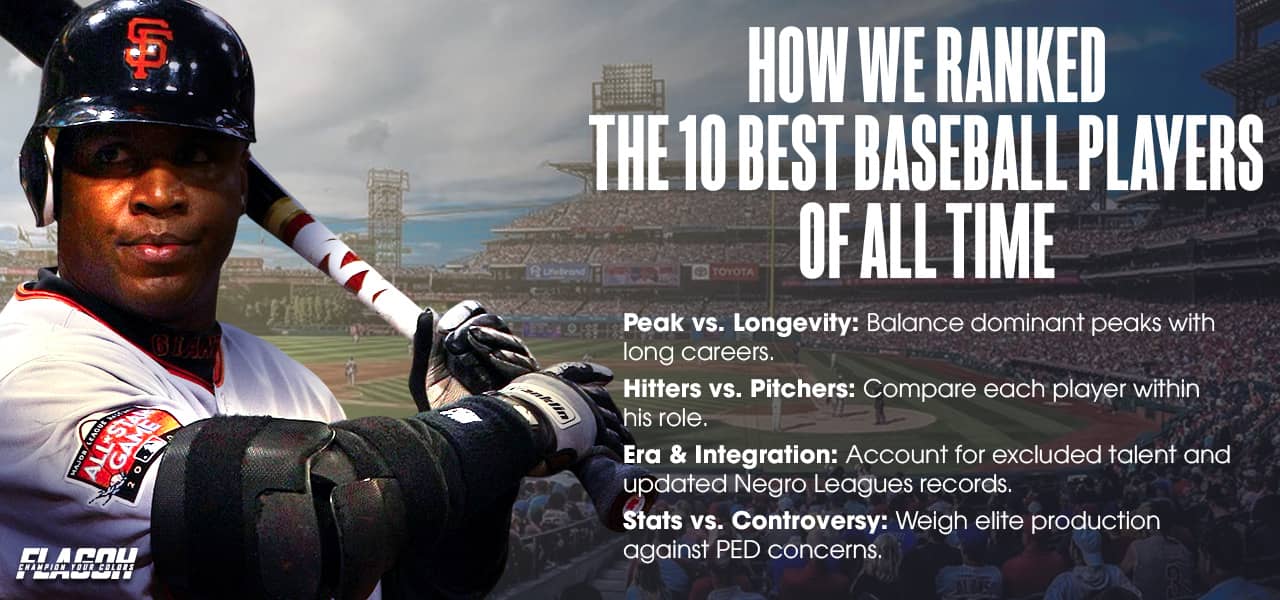
Peak vs. longevity
A serious all-time ranking has to separate short-lived brilliance from sustained greatness. Some players built their case through a peak so dominant that it changed how baseball was discussed. Others stayed near the top of the sport for well over a decade. The strongest names on this list usually did both, which is why Ruth, Mays, Bonds, and Aaron still appear near the top even when the order changes.
How we compared hitters and pitchers
Comparing hitters and pitchers is where all-time rankings usually get more complicated. They create value in different ways, so the goal is not to force them into the same mold. The better question is how dominant each player was within his role, how long he sustained that dominance, and how far above his peers he stood. That is why Walter Johnson and Roger Clemens still deserve top-10 consideration even in a list dominated by hitters. Johnson’s 417 wins and 110 shutouts remain enormous markers of pitching excellence, while Clemens still stands alone with seven Cy Young Awards.
How we handled era context and integration
Era context matters because baseball did not always draw from the full talent pool. In 1947, Jackie Robinson broke MLB’s modern color line, but that only highlights how many elite Black players had been excluded before him. MLB formally added seven Negro Leagues from 1920 to 1948 to its official historical record in 2024 and released further updates in 2025, which means any modern all-time ranking has to take that correction seriously.
How controversy affected players like Bonds and Clemens
Controversy cannot be waved away, but it also cannot erase on-field production. Barry Bonds and Roger Clemens both have top-tier performance cases, and pretending otherwise would make the ranking less honest, not more. At the same time, PED-related questions are real and remain the strongest argument against placing either one even higher. In this list, controversy counts as a meaningful counterargument, not an automatic disqualification.
The 10 Best Baseball Players of All Time Ranked
Now that the ranking criteria are clear, here is the full top 10 and the case for why each player earned his place.
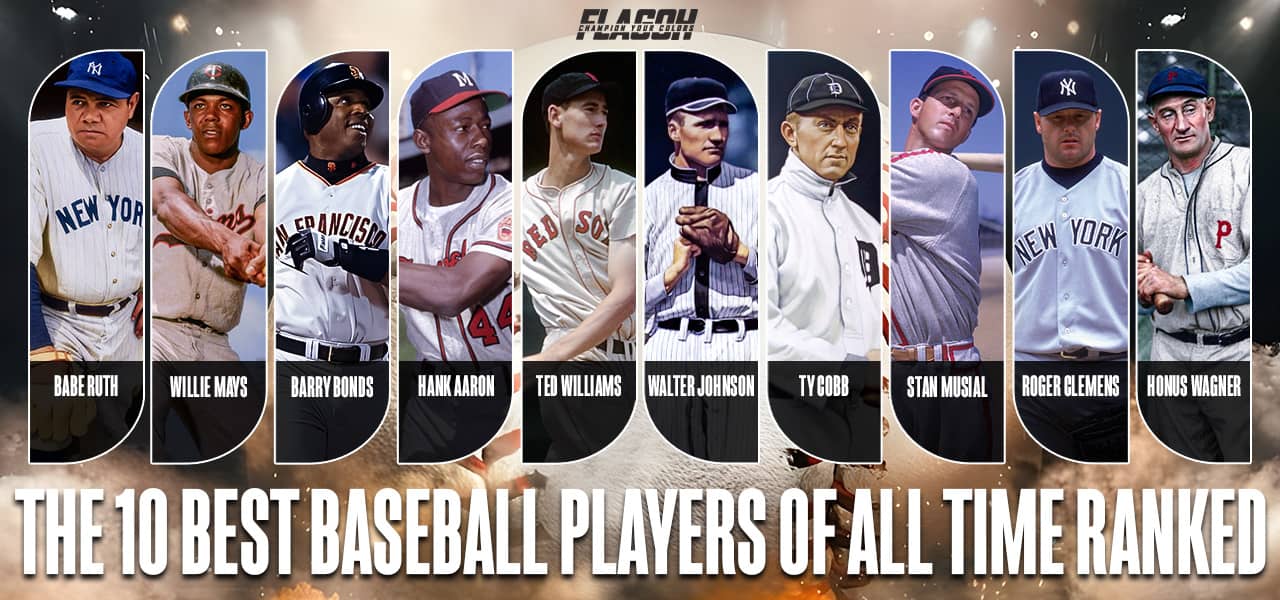
Babe Ruth
Ruth belongs at No. 1 because he did more than dominate his time. He changed what baseball looked like. Power hitting existed before him, but he turned it into the center of the sport and made the home run the game’s defining spectacle. He also finished with 714 home runs, and his influence on baseball strategy and public imagination lasted far beyond his career.
Why he made the list: unmatched blend of peak, résumé, and cultural impact
Best case for ranking him here: no one separated himself from his era more dramatically while also changing the game itself
Best stat: 714 career home runs
Fair counterargument: his career came before full integration
Legacy in one sentence: Ruth is still the easiest answer when the question is “Who set baseball’s all-time standard?”
Willie Mays
If Ruth has the strongest No. 1 argument, Mays has one of the clearest cases as the most complete player in baseball history. He could impact the game with power, defense, baserunning, range, and instincts, and he sustained that value for an unusually long time. That all-around excellence is what keeps him so high in nearly every serious all-time debate.
Why he made the list: the strongest all-around player profile baseball has ever seen
Best case for ranking him here: he brought elite value in every phase of the game, not just at the plate
Best stat: 660 home runs, 339 stolen bases, and premium defensive value in center field
Fair counterargument: Ruth and Bonds reached louder offensive peaks
Legacy in one sentence: Mays remains the gold standard for complete greatness.
Barry Bonds
At his peak, Bonds forced pitchers and managers into decisions no other hitter consistently created. He finished with 762 career home runs, a single-season record of 73, and a record seven MVP awards. Even before the steroid-era controversy became inseparable from his public legacy, he already had an all-time case built on patience, power, and all-around value.
Why he made the list: his combination of power, patience, and run creation overwhelmed modern pitching like almost no one else
Best case for ranking him here: his offensive pressure changed the way opponents planned entire games
Best stat: 762 career home runs
Fair counterargument: PED controversy will always shape how many people rank him
Legacy in one sentence: Bonds may be the most terrifying offensive player baseball has ever seen.
Hank Aaron
Aaron’s greatness came from never giving the game a weak version of himself for very long. He finished with 755 home runs, passed Ruth in 1974, and kept building one of the most durable offensive résumés the sport has ever seen. He may not have had the theatrical peak of Ruth or Bonds, but his combination of consistency and elite production is exactly why he belongs this high.
Why he made the list: elite production across a very long career
Best case for ranking him here: his case has very few weak points
Best stat: 755 career home runs
Fair counterargument: his peak was steadier than it was explosive
Legacy in one sentence: Aaron proved that sustained greatness can be every bit as powerful as spectacle.
Ted Williams
When the question becomes “Who was the best pure hitter?” Williams is almost impossible to place anywhere but near the top. Britannica still notes that his .482 on-base percentage is the highest of all time, and his case becomes even stronger when you remember how much of his prime he lost to military service. He did not bring the same all-around profile as Mays, but as a hitter, he remains one of the cleanest answers baseball has ever produced.
Why he made the list: few players ever matched his blend of plate discipline, contact quality, and offensive efficiency
Best case for ranking him here: few hitters ever combined plate discipline and damage more elegantly
Best stat: .482 career OBP
Fair counterargument: less defensive and baserunning value than some others in the top five
Legacy in one sentence: Ted Williams remains the benchmark for pure offensive skill.
Walter Johnson
Pitchers often get pushed down in all-time debates because it is harder to compare their value directly to everyday players. Johnson resists that problem better than almost anyone. He won 417 games, still holds the shutout record at 110, and spent years functioning as a level of durable ace that modern baseball barely resembles. If a pitcher belongs in this tier, Johnson is one of the strongest cases.
Why he made the list: overwhelming dominance and workload
Best case for ranking him here: he is one of the clearest reminders that pitchers belong in the top layer of baseball history
Best stat: 417 wins
Fair counterargument: cross-era pitcher evaluation is always complicated
Legacy in one sentence: Walter Johnson is one of the foundations of pitching greatness.
Ty Cobb
Cobb’s case is built on pressure. He was not just a batting champion; he was a player who put relentless strain on defenses with contact, speed, aggression, and volume. Britannica notes that he led the American League in batting 12 times, though the modern record-book picture changed when Josh Gibson’s Negro Leagues numbers entered MLB history. That makes Cobb an interesting example of a legend whose greatness remains obvious even as the historical frame around him evolves.
Why he made the list: his contact ability, speed, aggression, and sustained offensive control made him one of the defining forces of his era
Best case for ranking him here: few players ever controlled run creation in their environment the way Cobb did
Best stat: 12 AL batting titles
Fair counterargument: the sport’s context and official leaderboards look different now than they did a few years ago
Legacy in one sentence: Cobb remains one of baseball’s defining offensive forces, even in a more updated historical record.
Stan Musial
Musial is the kind of all-time great who can be underrated simply because his case was built through excellence without much noise. He finished with 3,630 hits and won three MVP awards, but the bigger point is how rarely his value dipped. He did not need one giant myth to stay in the conversation. The body of work alone keeps him here.
Why he made the list: one of the cleanest long-term offensive résumés in baseball
Best case for ranking him here: consistency at that level is its own form of greatness
Best stat: 3,630 career hits
Fair counterargument: players above him produced stronger iconic peaks
Legacy in one sentence: Musial is one of baseball’s best examples of sustained superstar value.
Roger Clemens
Clemens has one of the most decorated pitching résumés in baseball history, and seven Cy Young Awards still anchor that case. His career stretched across multiple baseball environments, and he kept finding ways to remain elite. The reason he is not higher is not a lack of dominance. It is the same controversy that clouds Bonds.
Why he made the list: modern-era pitching greatness with real staying power
Best case for ranking him here: few pitchers ever combined peak and longevity as well
Best stat: 7 Cy Young Awards
Fair counterargument: PED questions complicate his historical standing
Legacy in one sentence: Clemens is one of the most accomplished pitchers ever, even if his case remains polarizing.
Honus Wagner
Wagner’s résumé still matters because he was not just a great player for his time. He was ahead of his time in the way he combined offense, athleticism, and premium-position value. Britannica still describes him as one of the greatest shortstops in baseball history, and eight batting titles explain why his name survives every era shift in the debate.
Why he made the list: dead-ball era dominance at shortstop
Best case for ranking him here: stars at premium positions with that kind of offensive profile are rare in any era
Best stat: 8 batting titles
Fair counterargument: his era makes modern comparison harder
Legacy in one sentence: Wagner helped define what an all-time shortstop could look like.
The Strongest Cases Outside the Top 10
No serious top-10 baseball ranking ends cleanly. The moment the final name goes in, the real debate shifts to who was left out and whether older all-time lists still hold up under modern record corrections.
Those debates are part of what keeps baseball culture active beyond the box score. Fans argue about legends, eras, franchises, uniforms, and even which teams have the most iconic caps, making resources like the best MLB hats by team a natural extension of that conversation.
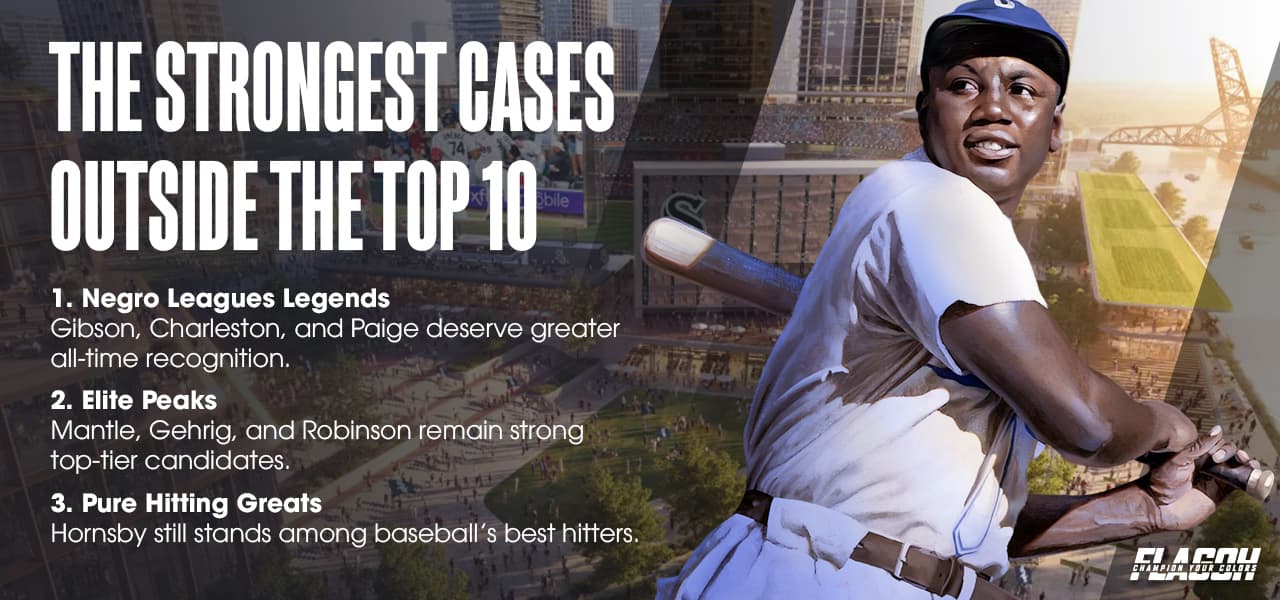
Josh Gibson is the most obvious omission once modern record corrections are taken seriously. MLB’s official updates elevated him to the top of several all-time categories, including career batting average, slugging percentage, and OPS, which alone forces a harder look at any traditional top 10.
Oscar Charleston may be the strongest “why isn’t he here?” question of them all. Britannica describes him as one of the best all-around ballplayers in baseball history, and ESPN’s long-form work on the subject shows how central he has become to modern greatest-ever debates.
Mickey Mantle and Lou Gehrig both have easy top-15 or top-20 arguments, especially if you value peak heavily. Jackie Robinson matters not only because of what he changed in 1947, but because his playing peak itself is stronger than many casual rankings admit. Satchel Paige is another name who suffers when major-league-only framing narrows the conversation too much. Rogers Hornsby, meanwhile, still owns one of the best pure hitting résumés ever, with a .358 career average that trails only Cobb among traditional AL/NL career marks.
Why Modern Record Updates Changed This Debate
What changed is not just the data, but the way baseball history is now being framed. When MLB officially integrated Negro Leagues statistics into its historical record in 2024 and updated them again in 2025, old all-time lists stopped feeling complete by default. Josh Gibson now sits atop several career rate categories, and other Negro Leagues stars such as Oscar Charleston, Buck Leonard, and Turkey Stearnes entered the all-time conversation with much stronger official footing.
That does not erase Ruth, Mays, Aaron, or Williams. It simply forces older rankings to answer tougher questions: who was excluded, what context was missing, and how much of baseball history was treated as secondary because it sat outside the American and National League structure of its time? That is why all-time rankings feel more open today than they did even a few years ago.
Could Shohei Ohtani or Mike Trout Break Into the Top 10?
Updated: April 14, 2026
Shohei Ohtani clearly has the more realistic path. MLB’s 2026 coverage already frames him as the likely top designated hitter in the game, and early-season reporting noted that he opened the year with the longest active on-base streak in MLB while also extending a scoreless-innings run as a starting pitcher. That kind of two-way value is rare enough to keep the all-time conversation open if he continues stacking elite seasons.
Mike Trout still has a real peak argument, but his path is narrower now because durability has become the central question. MLB’s 2026 season predictions still pointed to a possible Trout bounce-back, which tells you the talent is still respected. The issue is no longer whether he was good enough at his best. It is whether he can add enough healthy, high-level seasons to rebuild the length of the résumé.
If one active player forces a rewrite of this list in the next few years, Ohtani is the clearest bet.
Common Questions About the Greatest Baseball Players
A few questions come up almost every time fans debate baseball’s all-time greats, so it makes sense to answer them directly before closing the list.
Who is the greatest baseball player ever?
Babe Ruth still has the clearest claim because he combines peak dominance, career achievement, and historical influence better than anyone else. Even people who would rank Mays first usually have to start by explaining why Ruth is not.
Why is Babe Ruth still ranked so high?
Because he was not only great in raw terms. He towered over his own era and helped reshape baseball into a power-driven sport. That level of separation still matters in any serious all-time ranking.
Should Bonds and Clemens be in an all-time top 10?
If the ranking is based strictly on on-field production, both have very strong top-10 cases. If the ranking is partly moral or Hall-of-Fame-based, many readers will rank them lower or leave them out.
Do Negro Leagues stars belong in the same conversation?
Yes. That is no longer a fringe view. MLB’s official record integration and later updates made that even harder to deny.
Who is the biggest snub from this list?
Oscar Charleston and Josh Gibson are the two strongest answers, especially if you want an all-time ranking that reflects the fuller historical record rather than only the traditional AL/NL frame.
The 10 best baseball players of all time will never be settled for good, and that is part of what keeps the debate alive across generations of fans. In this ranking, Babe Ruth still holds the strongest case for No. 1, but every player behind him represents a different kind of greatness shaped by era, competition, and historical context. For readers who enjoy both baseball history and the culture around the game, FlagOh also covers MLB-inspired fan gear and baseball-themed accessories.