
 Arizona Cardinals Flag
 Atlanta Falcons Flag
 Baltimore Ravens Flag
 Buffalo Bills Flag
 Carolina Panthers Flag
 Chicago Bears Flag
 Cincinnati Bengals Flag
 Cleveland Browns Flag
 Dallas Cowboys Flag
 Denver Broncos Flag
 Detroit Lions Flag
 Green Bay Packers Flag
 Houston Texans Flag
 Indianapolis Colts Flag
 Jacksonville Jaguars Flag
 Kansas City Chiefs Flag
 Las Vegas Raiders Flag
 Los Angeles Chargers Flag
 Los Angeles Rams Flag
 Miami Dolphins Flag
 Minnesota Vikings Flag
 New England Patriots Flag
 New Orleans Saints Flag
 New York Giants Flag
 New York Jets Flag
 Philadelphia Eagles Flag
 Pittsburgh Steelers Flag
 San Francisco 49ers Flag
 Seattle Seahawks Flag
 Tampa Bay Buccaneers Flag
 Tennessee Titans Flag
 Washington Commanders Flag
 Arizona Diamondbacks Flag
 Atlanta Braves Flag
 Baltimore Orioles Flag
 Boston Red Sox Flag
 Chicago Cubs Flag
 Chicago White Sox Flag
 Cincinnati Reds Flag
 Cleveland Guardians Flag
 Colorado Rockies Flag
 Detroit Tigers Flag
 Houston Astros Flag
 Kansas City Royals Flag
 Los Angeles Angels Flag
 Los Angeles Dodgers Flag
 Miami Marlins Flag
 Milwaukee Brewers Flag
 Minnesota Twins Flag
 New York Mets Flag
 New York Yankees Flag
 Oakland Athletics Flag
 Philadelphia Phillies Flag
 Pittsburgh Pirates Flag
 San Diego Padres Flag
 San Francisco Giants Flag
 Seattle Mariners Flag
 St. Louis Cardinals Flag
 Tampa Bay Rays Flag
 Texas Rangers Flag
 Toronto Blue Jays Flag
 Washington Nationals Flag
 Atlanta Hawks Flag
 Boston Celtics Flag
 Brooklyn Nets Flag
 Charlotte Hornets Flag
 Chicago Bulls Flag
 Cleveland Cavaliers Flag
 Dallas Mavericks Flag
 Denver Nuggets Flag
 Detroit Pistons Flag
 Golden State Warriors Flag
 Houston Rockets Flag
 Indiana Pacers Flag
 LA Clippers Flag
 Los Angeles Lakers Flag
 Memphis Grizzlies Flag
 Miami Heat Flag
 Milwaukee Bucks Flag
 Minnesota Timberwolves Flag
 New Orleans Pelicans Flag
 New York Knicks Flag
 Oklahoma City Thunder Flag
 Orlando Magic Flag
 Philadelphia 76ers Flag
 Phoenix Suns Flag
 Portland Trail Blazers Flag
 Sacramento Kings Flag
 San Antonio Spurs Flag
 Toronto Raptors Flag
 Utah Jazz Flag
 Washington Wizards Flag
 Anaheim Ducks Flag
 Arizona Coyotes Flag
 Boston Bruins Flag
 Buffalo Sabres Flag
 Calgary Flames Flag
 Carolina Hurricanes Flag
 Chicago Blackhawks Flag
 Colorado Avalanche Flag
 Columbus Blue Jackets Flag
 Dallas Stars Flag
 Detroit Red Wings Flag
 Edmonton Oilers Flag
 Florida Panthers Flag
 Los Angeles Kings Flag
 Minnesota Wild Flag
 Montreal Canadiens Flag
 Nashville Predators Flag
 New Jersey Devils Flag
 New York Islanders Flag
 New York Rangers Flag
 Ottawa Senators Flag
 Philadelphia Flyers Flag
 Pittsburgh Penguins Flag
 San Jose Sharks Flag
 Seattle Kraken Flag
 St. Louis Blues Flag
 Tampa Bay Lightning Flag
 Toronto Maple Leafs Flag
 Vancouver Canucks Flag
 Vegas Golden Knights Flag
 Washington Capitals Flag
 Winnipeg Jets Flag
House Divided & Rivalry Ideas
Who Will Win the Super Bowl? Seahawks vs Patriots Odds
Every Super Bowl week, the same question takes over: Who will win the Super Bowl—and most answers are louder than they are useful. In this FlagOh guide, you’ll read Seahawks vs Patriots moneylines the right way by turning them into clean percentages, checking no-vig fair chances, and knowing which late-week updates actually matter. The goal isn’t a “lock,” it’s a quick, defensible lean you can explain in one breath. We treat Super Bowl odds as a live market signal, not a guarantee. For consistency, we track one timestamped odds feed (so we’re not mixing books) and only react to confirmed updates—especially official injury designations and credible roster reports. This guide is for understanding market pricing, not betting advice
The Fast Read On Super Bowl Odds And Fair Chances
If you want a quick, defensible read on the Seahawks vs Patriots market, start here. This section shows what the moneyline is actually pricing, why implied percentages can be misleading, and how no-vig fair chances give you a cleaner comparison—so your “lean” is based on math, not noise.
What The Odds Are Really Saying
Moneyline odds are not a “ranking of who’s better.” They’re a market price that reflects how bettors and sportsbooks are currently valuing each team’s chance to win—based on available information, risk, and the sportsbook’s built-in margin. In American odds, a negative number (like a -price) typically indicates the market favorite, while a positive number (a +price) indicates the underdog. Because odds can differ by sportsbook and can move quickly as new information arrives, the most reliable way to interpret them is to treat them as a live estimate tied to a timestamp, not a permanent truth about the matchup. The cleanest “fast read” comes from comparing fair (no-vig) chances rather than relying on raw implied chances that include margin.
Implied Chance Vs No-Vig Fair Chance
Example only (for the math): The numbers below are illustrative to show the conversion and no-vig normalization. Always use your current source and timestamp, since prices can vary by sportsbook and change quickly.
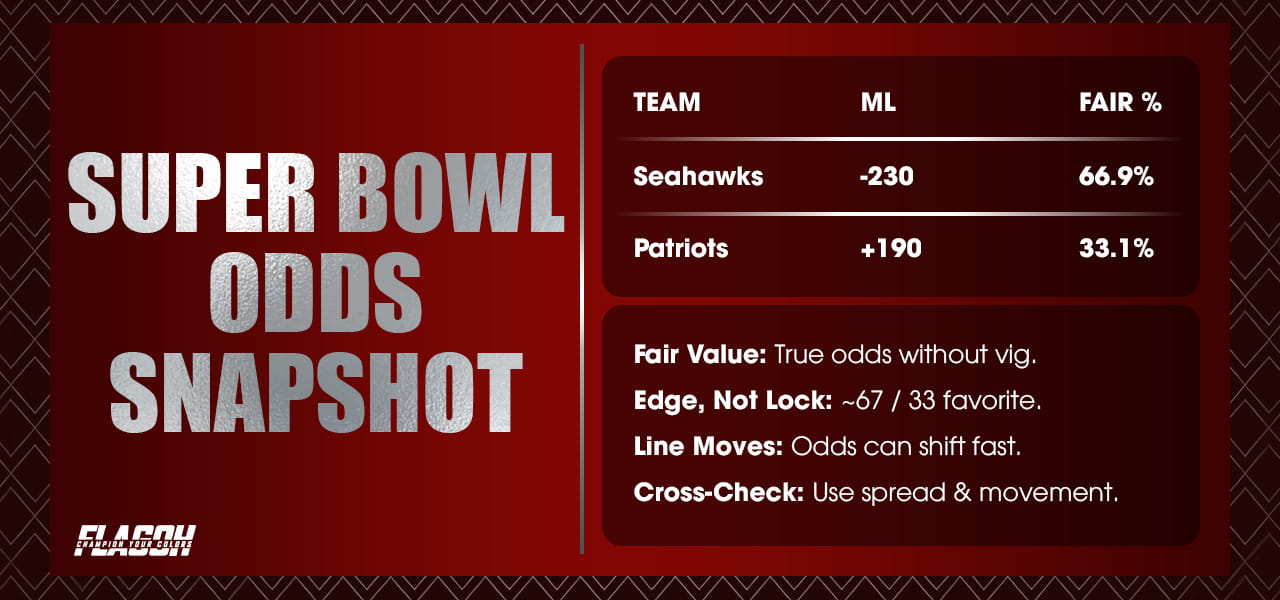
| Team | Moneyline (Example Only) | Implied Chance (With Margin) | No-Vig Fair Chance |
| Seattle Seahawks | -230 | 69.7% | 66.9% |
| New England Patriots | +190 | 34.5% | 33.1% |
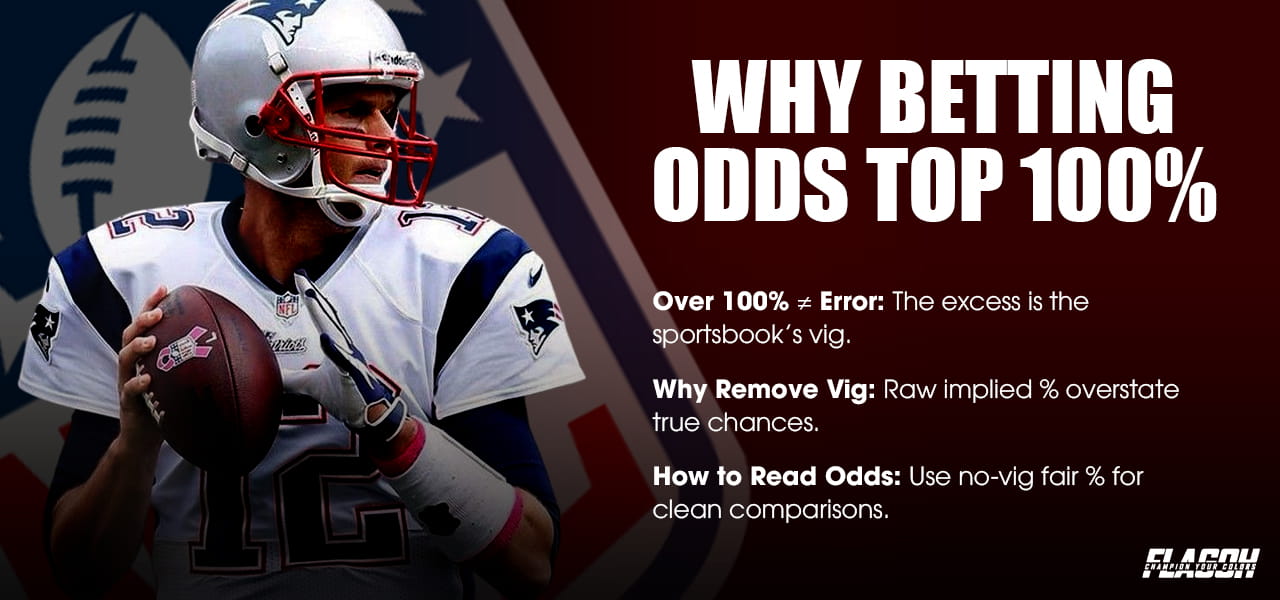
- Implied % can total over 100% because it includes the sportsbook’s vig (margin).
- No-vig fair % removes that margin, so both sides add up to 100% (cleaner comparison).
- A clear, fair % lean means the market favors one team—not that it’s guaranteed to win.
A split around two-thirds vs one-third usually signals a clear favorite—but not certainty.
A Quick Way To Match Your Pick With A Flag Style
A simple way to make your lean feel “real” is to choose NFL flags that mirror the story you believe the game will tell. If you’re leaning toward the favorite, a cleaner, high-contrast design usually matches that “controlled, repeatable” script and stays easy to recognize at a glance. If you’re leaning toward the underdog, a bolder, more statement-forward look can feel more fitting—just keep the layout uncluttered, so it still reads clearly from across the space. Either way, the best choice is the one that looks sharp in a quick photo and stays readable without you needing to explain what it is.
Best Flag Picks for Seahawks vs Patriots Fans
This section helps you turn a Seahawks vs Patriots lean into a flag choice that feels intentional, so your setup supports the moment without distracting from the game.
The Best All-Around Flag Setup for Most Fans
If you want the easiest “looks good in most setups” choice, start with readability. High-contrast designs and clean layouts tend to look sharper from across a room or yard, and they usually hold up better in quick photos than busy designs with lots of small text. Pay attention to finishing details too—edges that look reinforced and attachment points that feel sturdy help the flag hang neatly and stay presentable over repeated use.
The Best Choice When You Care Most About Durability and Readability
When durability matters most, prioritize flags described as outdoor-ready and choose a design that stays recognizable at a glance. A Seattle Seahawks Flag or a New England Patriots Flag will look its best when the main mark is clear, and the layout avoids clutter, because that’s what keeps it readable from a distance in real-life conditions. To protect both color and fabric over time, let it dry fully before storage so moisture doesn’t lead to dulling, odor, or unnecessary stress.
The best pick is the one that fits your space and still looks “right” when the game gets loud—simple, clear, and easy to live with after the final whistle.
Line Movement That Matters Before Kickoff
If you’re trying to answer who will win the Super Bowl, don’t judge the market from a single screenshot. Line movement—how the spread, total, and moneyline shift from open to current—often tells you whether confidence is strengthening, cooling, or reacting to real new information as kickoff gets closer.
Opening Vs Current Numbers And What They Signal
Odds become much more useful when you focus on how they change over time, not just the price you saw once. In a typical Super Bowl market, you’ll usually track three related numbers because they each describe a different piece of the same story: the spread, which reflects the expected margin between the teams; the total, which reflects the market’s expectation for combined scoring; and the moneyline, which reflects the price of each team simply winning the game.
When those numbers move from the opener to the current line, they’re often reacting to new information—so the direction of movement can tell you whether confidence is building, cooling, or shifting as kickoff gets closer.
The Updates That Move Markets Most
Not all “news” carries the same weight, and the market tends to react hardest to information that changes a team’s ability to execute its core game plan. Quarterback availability or clear limitations can re-price an entire matchup on its own, especially if it affects mobility, decision speed, or the offense’s willingness to push the ball downfield. After that, the most influential updates usually come from the trenches—offensive line issues and pass-rush injuries—because pressure and protection can swing drive success quickly in a one-game sample. Key secondary absences, particularly a top corner or a coverage leader, also matter because they can change how defenses call coverages and how often they can take away explosive plays. Beyond injuries, the market responds best to credible roster news with confirmation (not rumor cycles), and you’ll also see movement when early prices get corrected as sharper opinions and new information settle after the opener.
Best Practices For Tracking Odds Responsibly
If you want to use odds without getting misled, treat them like a live measurement rather than a headline. Stick to one consistent sportsbook or odds feed so you’re comparing like with like, and always note the timestamp because Super Bowl lines can shift quickly as new information hits. When news breaks, avoid reacting to rumor spirals; it’s usually smarter to wait for official injury designations and reliable reporting before treating anything as “priced in.” Finally, don’t over-interpret tiny line wiggles as if they’re major signals—meaningful moves tend to follow meaningful inputs, like quarterback status, trench injuries, key coverage changes, or weather conditions that alter expected game script. In practice, the easiest way to stay honest is to save one timestamped reference line and compare everything to that, instead of chasing every screenshot you see online.
Track line movement the smart way: use one consistent source, note timestamps, and only react to moves tied to real inputs (QB status, trenches, coverage injuries, or weather). That keeps you from mistaking noise for certainty.
Why The Market Leans Seahawks And How The Patriots Can Win
This section explains what the market is “pricing in” when Seattle is favored—and what a realistic Patriots win path looks like if the game tilts on a few high-leverage moments. Think of it as a script check: repeatable edges for the favorite, and a narrower but believable route for the underdog. At FlagOh, we use this script lens to explain what the market is pricing—repeatable edges for the favorite and a narrower upset path for the underdog.
The Seahawks Win Script
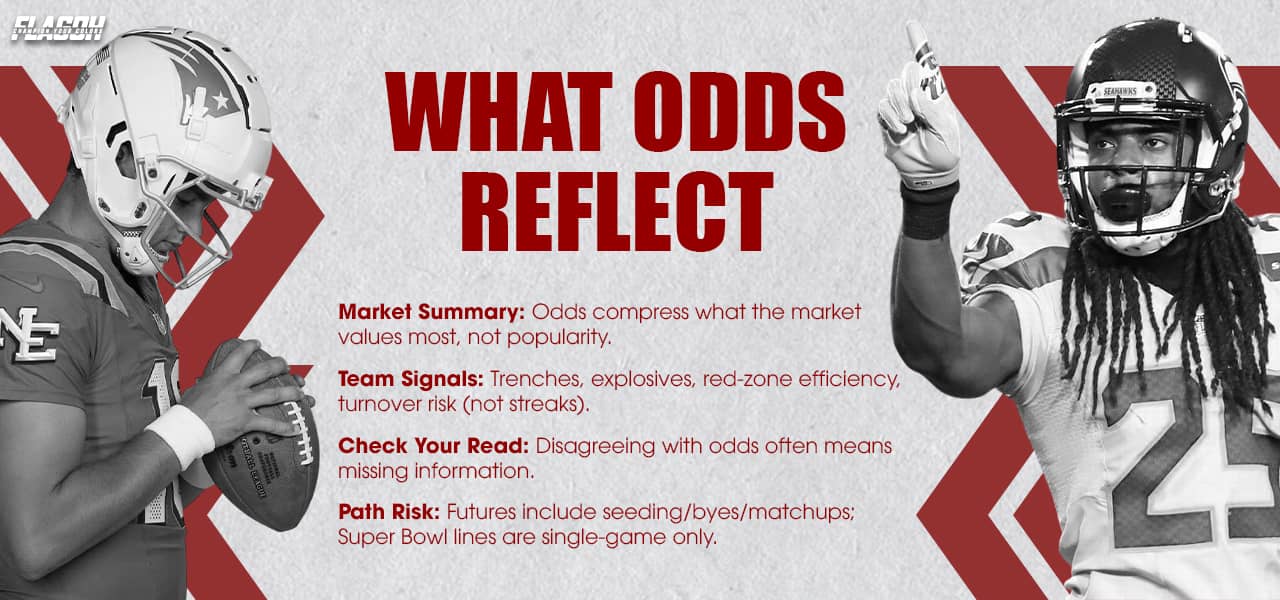
When the market prices Seattle as the favorite, it’s usually rewarding a “cleaner path” to winning that doesn’t rely on one perfect sequence of events. In simple terms, the favorite script is built around Seattle being able to generate pressure without constantly blitzing (so the coverage structure stays intact), protect well enough to avoid drive-killing sacks, and keep the offense on schedule with sustained possessions that slowly tilt field position their way. If that foundation holds, Seattle doesn’t need to live on low-percentage explosive plays to score; it can win across multiple game scripts because it’s less dependent on chaos and more dependent on repeatable advantages.
The Patriots Upset Script
If New England is priced as the underdog, the market is implying a narrower—but still realistic—win path that hinges on keeping the game from swinging on negative plays. The upset script usually starts with limiting sacks and giveaways so the underdog doesn’t fall behind the sticks, then winning a small set of high-leverage moments that decide close games—red zone possessions, end-of-half drives, and a few critical third downs. From there, the underdog often needs one extra edge to “steal” the math, such as a field-position swing, a special teams moment, or a takeaway at the right time. If Seattle’s edge is built on trench control, New England’s clearest route is to neutralize that pressure—through quick-game timing, smart protection help, and a game flow that reduces explosive volatility and keeps the margin for error tight.
What Could Cool The Favorite Or Flip The Lean
Late in the week, the market usually cools off—or flips—when multiple inputs stack on the same side: A real quarterback limitation, a major offensive line issue (especially tackle or center), a key coverage defender ruled out, a pass-rush downgrade that changes pressure expectations, or weather (especially wind) that compresses scoring and reduces volatility. If none of those change materially, the favorite’s price often holds.
Quick Answers: Fans Ask About Super Bowl Odds
If you’re asking who will win the Super Bowl, these quick answers help you read the odds the right way—so you understand what the moneyline is pricing, what no-vig really means, and why line movement matters before you lock in a lean.
What does a plus moneyline mean in plain English?
A plus moneyline (like +190) shows how much profit a $100 example stake would return if the underdog wins. It’s a shorthand for “the market sees this team as less likely,” before you convert it into a percentage.
What does a minus moneyline mean in plain English?
A minus moneyline (like -230) shows how much you’d risk to win $100 profit on the favorite. It reflects a higher-priced chance of winning, not certainty.
How do I convert Super Bowl odds into implied probability?
Use +A → 100/(A+100) and -A → A/(A+100). Then, if you want a cleaner comparison, normalize the implied chances into no-vig fair chances so they total 100%.
Why do implied probabilities add up to more than one hundred percent?
Because the prices include the sportsbook’s margin (often called vig or overround). That “extra” above 100% is why raw implied probability isn’t the same as true probability.
What is no-vig fair probability, and why should I use it?
No-vig fair probability removes the margin by normalizing both implied percentages so they sum to one hundred percent. It’s a cleaner apples-to-apples way to see how the market values each team, even though it still doesn’t guarantee the outcome.
Are odds the same as true probability?
Not exactly. Odds are that market prices are influenced by margin and information flow, and sometimes sentiment. No-vig is cleaner than raw implied probability, but it’s still a market estimate—not a certainty.
What moves Super Bowl odds the most late in the week?
Quarterback status, major offensive line and pass-rush injuries, and key secondary absences tend to move the price most. Best practice is to rely on official injury designations and reputable reporting, not rumor cycles.
What does line movement usually signal?
Line movement is most useful for showing what new information the market is reacting to and whether confidence is building or cooling. You don’t need every sportsbook—one consistent source with timestamps is enough to track direction.
Use this FAQ as a fast reference: translate the moneyline into implied probability, lean on no-vig fair chances for cleaner comparisons, and pay attention only to the updates that truly move markets late in the week. Done right, the odds won’t “predict” the winner—but they will keep your pick grounded in what’s being priced right now.
If you’re using odds to answer who will win the Super Bowl, keep it simple: convert the moneyline to percentages, trust no-vig fair chances for the cleanest lean, and only adjust when real news moves the line. Then pick the script that makes sense—and bring it to game day with FlagOh.