
 Arizona Cardinals Flag
 Atlanta Falcons Flag
 Baltimore Ravens Flag
 Buffalo Bills Flag
 Carolina Panthers Flag
 Chicago Bears Flag
 Cincinnati Bengals Flag
 Cleveland Browns Flag
 Dallas Cowboys Flag
 Denver Broncos Flag
 Detroit Lions Flag
 Green Bay Packers Flag
 Houston Texans Flag
 Indianapolis Colts Flag
 Jacksonville Jaguars Flag
 Kansas City Chiefs Flag
 Las Vegas Raiders Flag
 Los Angeles Chargers Flag
 Los Angeles Rams Flag
 Miami Dolphins Flag
 Minnesota Vikings Flag
 New England Patriots Flag
 New Orleans Saints Flag
 New York Giants Flag
 New York Jets Flag
 Philadelphia Eagles Flag
 Pittsburgh Steelers Flag
 San Francisco 49ers Flag
 Seattle Seahawks Flag
 Tampa Bay Buccaneers Flag
 Tennessee Titans Flag
 Washington Commanders Flag
 Arizona Diamondbacks Flag
 Atlanta Braves Flag
 Baltimore Orioles Flag
 Boston Red Sox Flag
 Chicago Cubs Flag
 Chicago White Sox Flag
 Cincinnati Reds Flag
 Cleveland Guardians Flag
 Colorado Rockies Flag
 Detroit Tigers Flag
 Houston Astros Flag
 Kansas City Royals Flag
 Los Angeles Angels Flag
 Los Angeles Dodgers Flag
 Miami Marlins Flag
 Milwaukee Brewers Flag
 Minnesota Twins Flag
 New York Mets Flag
 New York Yankees Flag
 Oakland Athletics Flag
 Philadelphia Phillies Flag
 Pittsburgh Pirates Flag
 San Diego Padres Flag
 San Francisco Giants Flag
 Seattle Mariners Flag
 St. Louis Cardinals Flag
 Tampa Bay Rays Flag
 Texas Rangers Flag
 Toronto Blue Jays Flag
 Washington Nationals Flag
 Atlanta Hawks Flag
 Boston Celtics Flag
 Brooklyn Nets Flag
 Charlotte Hornets Flag
 Chicago Bulls Flag
 Cleveland Cavaliers Flag
 Dallas Mavericks Flag
 Denver Nuggets Flag
 Detroit Pistons Flag
 Golden State Warriors Flag
 Houston Rockets Flag
 Indiana Pacers Flag
 LA Clippers Flag
 Los Angeles Lakers Flag
 Memphis Grizzlies Flag
 Miami Heat Flag
 Milwaukee Bucks Flag
 Minnesota Timberwolves Flag
 New Orleans Pelicans Flag
 New York Knicks Flag
 Oklahoma City Thunder Flag
 Orlando Magic Flag
 Philadelphia 76ers Flag
 Phoenix Suns Flag
 Portland Trail Blazers Flag
 Sacramento Kings Flag
 San Antonio Spurs Flag
 Toronto Raptors Flag
 Utah Jazz Flag
 Washington Wizards Flag
 Anaheim Ducks Flag
 Arizona Coyotes Flag
 Boston Bruins Flag
 Buffalo Sabres Flag
 Calgary Flames Flag
 Carolina Hurricanes Flag
 Chicago Blackhawks Flag
 Colorado Avalanche Flag
 Columbus Blue Jackets Flag
 Dallas Stars Flag
 Detroit Red Wings Flag
 Edmonton Oilers Flag
 Florida Panthers Flag
 Los Angeles Kings Flag
 Minnesota Wild Flag
 Montreal Canadiens Flag
 Nashville Predators Flag
 New Jersey Devils Flag
 New York Islanders Flag
 New York Rangers Flag
 Ottawa Senators Flag
 Philadelphia Flyers Flag
 Pittsburgh Penguins Flag
 San Jose Sharks Flag
 Seattle Kraken Flag
 St. Louis Blues Flag
 Tampa Bay Lightning Flag
 Toronto Maple Leafs Flag
 Vancouver Canucks Flag
 Vegas Golden Knights Flag
 Washington Capitals Flag
 Winnipeg Jets Flag
News
NFL Super Bowl MVP Odds Betting Guide From FlagOh
If you’ve ever opened a sportsbook app right before the Super Bowl and stared at the NFL Super Bowl MVP odds in confusion, you’re not alone. The lines seem to move all week, every betting site shows slightly different prices, and every TV analyst seems to have a different “lock” for the award. This guide is built to calm that chaos.
At FlagOh, we believe being a fan is about more than just watching the game – it’s about understanding what the numbers are really saying. We’ll walk you through who the market favors for the Pete Rozelle Trophy, how the MVP odds are built, what history says about quarterbacks versus everyone else, and how to size small, sensible bets. Whether you are a seasoned sharp or just following along for fun, you will get:
- A live-inspired odds table with real pre-game examples.
- A historical breakdown of winners by position and role.
- Simple strategy steps to make confident decisions.
By the end of this post, you won’t just be guessing which prices are fair—you’ll understand the story behind the numbers. Let’s dive in.
Disclaimer: This article is for information and entertainment only. Odds change quickly, may differ by sportsbook and location, and nothing here is personalized betting or financial advice. Always check the latest lines at licensed operators in your jurisdiction, and please bet responsibly.
NFL Super Bowl MVP Odds 2025 Market Snapshot
The quickest way to understand the market is to look at where the money is going. For the 2025 season (Super Bowl LIX), the odds paint a clear picture of the hierarchy.
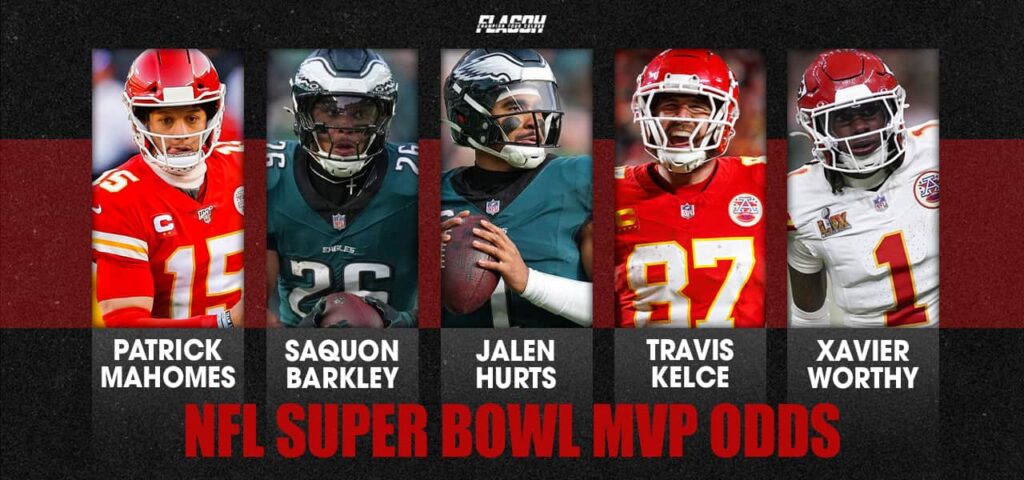
MVP Odds Table From Favorites To Long Shots
For context, most major US sportsbooks agree on a tight group of contenders. Here is an illustrative snapshot of how the NFL Super Bowl MVP odds look across the market during the playoffs (American odds and implied probabilities):
| Player | Team | Position | Example Odds | Implied Probability |
| Patrick Mahomes | Kansas City Chiefs | QB | +105 | ≈ 48.8% |
| Saquon Barkley | Philadelphia Eagles | RB | +240 | ≈ 29.4% |
| Jalen Hurts | Philadelphia Eagles | QB | +375 | ≈ 21.1% |
| Travis Kelce | Kansas City Chiefs | TE | +1500 | ≈ 6.2% |
| Xavier Worthy | Kansas City Chiefs | WR | +3000 | ≈ 3.2% |
| A.J. Brown | Philadelphia Eagles | WR | +3200 | ≈ 3.0% |
| Chris Jones | Kansas City Chiefs | DT | +6000 | ≈ 1.6% |
| Jalen Carter | Philadelphia Eagles | DT | +6000 | ≈ 1.6% |
Example prices based on projected lines from regulated sportsbooks; actual odds will vary.
Implied probability includes the bookmaker’s margin.
What this table tells you in 10 seconds:
The market views this largely as a two-horse race between the quarterbacks. The steep drop-off after the QBs (from around +400 out to +1500 and beyond) reminds us how difficult it is for a skill player to beat a quarterback in the voters’ eyes. While names like Puka Nacua or T.J. Watt are talented, the math suggests they need a perfect game script to win.
Favorites, Contenders, and Long Shots Explained
Regardless of the specific names in any given year, you can mentally group the MVP odds into three distinct “bands” of risk and reward:
- The Favorites (< +400): These are almost exclusively the starting quarterbacks of the two teams. They win the award most often because the ball is in their hands on every play. The trade-off is the payout; a win here doubles your money, but rarely more.
- The Contenders (+400 to +1500): This group includes elite skill players—the WR1s or star Running Backs. Here, you are trading lower win probability for a much more attractive payout.
- The Long Shots (≥ +1500): These are the lottery tickets. Defensive stars, tight ends, or RB2s fall here. They need a “headline game”—multiple touchdowns or a game-changing turnover—to steal the spotlight.
Real-world translation:
A $20 bet on a favorite like Stafford (+160) profits about $32. That same $20 on a long shot like T.J. Watt (+4500) profits $900. The payout is massive, but that kind of deep underdog is roughly ten to twenty times harder to land based on probability. That trade-off is the heart of the betting market.
What These Odds Mean in Real Probability
American odds can look like intimidating algebra, but the math is simple. Positive odds (like +105) simply tell you how much profit you make on a $100 bet.
More importantly, you can convert them to percentages. A price of +105 implies roughly a 48.8% chance of winning. A long shot at +3000 implies just a 3.2% chance. Keep in mind, these are “implied” probabilities that include the sportsbook’s fee (the vig). Your true chance of winning is always slightly lower.
The takeaway: Don’t just see a big “plus” number as free money. Treat it as a tiny, specific chance at a huge reward.
How NFL Super Bowl MVP Odds Work
If you are new to futures betting, the movement of the lines can feel random. Here is what is actually happening behind the scenes.
Odds Formats and Payout Examples
You might see odds displayed in different formats depending on your settings.
- American: +375 (Bet $100 to win $375).
- Decimal: 4.75 (Bet $1 to return $4.75 total).
- Fractional: 15/4 (Win 15 units for every 4 staked).
They all describe the same payout. If you are betting small stakes, say $10 on a player at +375, you would profit $37.50 for a total return of $47.50. Many disciplined bettors use “units” (where 1 unit = 1% of their bankroll) to keep their spending consistent, regardless of how tempting the big numbers look.
What Moves the Lines Before Kickoff
MVP odds are living numbers; they breathe and react to news.
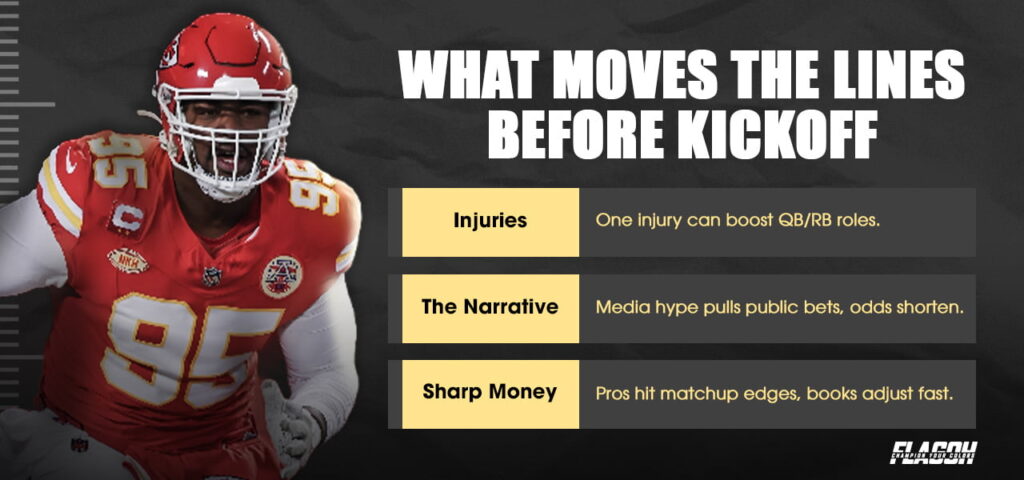
- Injuries: A hamstring tweak to a star receiver doesn’t just hurt his odds; it might shorten the odds of the quarterback (who now has to do more) or the running back (who might get more carries).
- The Narrative: Public money often chases stories. If the media spends two weeks talking about a veteran’s “last ride,” casual fans will bet on him, driving his price down (and making him less valuable to bet on).
- Sharp Money: Professional bettors analyze matchups in the trenches. If they see a weakness in the offensive line, they might hammer the odds of a pass rusher, causing books to adjust the price for everyone else.
Should you bet early? If you like a popular favorite, usually yes, before the public money arrives. If you like a long shot, waiting might let you see more injury reports.
How Live Odds Change During a Game
Once the ball is kicked off, the market becomes a rollercoaster. A single long touchdown can cut a receiver’s odds from +3000 to +900 in seconds. Conversely, an early interception can turn a favorite into an underdog instantly.
While live betting is exciting, it is highly volatile. The markets move faster than you can research. It is best treated as entertainment or a way to “hedge” your pre-game bets, rather than a primary strategy.
Super Bowl MVP Favorites And Long Shots
Now that you understand the mechanics, let’s look at the players themselves. Who historically dominates this award?
Why Quarterbacks Dominate The Super Bowl MVP
There is no escaping the data: Quarterbacks have won the Super Bowl MVP award 34 times in the first 59 games. That is well over 50%. In the modern era, that rate is even higher.
The reason is simple. The ball runs through the QB on every play. Even if a receiver has a great game, the quarterback gets credit for throwing those yards. Unless the QB plays poorly, the default vote usually goes to the signal-caller of the winning team. This is why you will rarely find a starting QB with odds longer than +250.
How Skill Players Can Win The Super Bowl MVP
Non-QBs absolutely can win, but the bar is set much higher.
- Wide Receivers: Typically need 100+ yards and at least one, often two, touchdowns. Think Cooper Kupp or Julian Edelman.
- Running Backs: Need high volume and scoring. They usually need to dominate the game on the ground and catch passes.
- Defenders: This is the hardest path. A defensive MVP usually requires a low-scoring game (where the offense struggles) and a “splash play” like a strip-sack or a pick-six (think Von Miller or Ray Lewis).
Finding Value In Super Bowl MVP Odds
Real value often lies in “mispriced usage.” If a Running Back gets 8 carries in the first quarter but hasn’t scored yet, his live odds might still be long. But the usage tells you the team is committed to him. That is a value bet—spotting the opportunity before the touchdown happens.
What History Tells Us About Today’s Odds
History doesn’t predict the future, but it gives us guardrails.
Winners by Position: Looking at the archives, Quarterbacks are the undisputed kings. Wide Receivers are a distant second, followed by Running Backs and Linebackers. Crucially, only one player in history (Chuck Howley) has ever won MVP while playing for the losing team. Modern voting guidelines and media habits also lean heavily toward the winning quarterback, which makes upset MVP stories even rarer.
The Golden Rule: If you are betting on a player to win MVP, you are implicitly betting on his team to win the Super Bowl.
How Often Do Long Shots Win?
- Favorites (QBs): Win >55% of the time.
- Mid-Range (WRs/RBs): Win ~25-30% of the time.
- Long Shots (Defense/ST): win less than 15% of the time.
If you strictly bet on long shots because you like the big payouts, understand that you will lose far more often than you win. The “smart money” often builds a portfolio: a solid bet on the favorite to cover costs, sprinkled with small “pizza money” bets on a long shot for the thrill.
How to Bet NFL Super Bowl MVP Odds in 3 Smart Steps
You don’t need a complex algorithm to bet smarter. Just follow this framework.
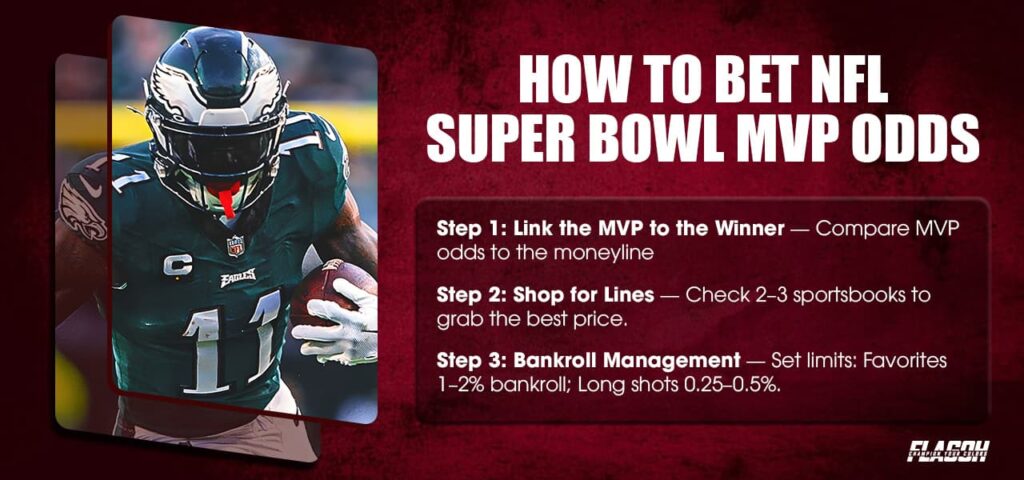
Step 1: Link the MVP to the Winner
Since the winner comes from the winning team, compare the MVP odds to the Moneyline. If the Chiefs are -125 to win the game, and Mahomes is +105 to win MVP, the odds are very correlated. Sometimes, betting the QB is just a better way to bet on the team winning.
Step 2: Shop for Lines
Never settle for the first price you see. One book might have Drake Maye at +180, while another has him at +205. On a $50 bet, that difference is $12.50 in free profit for the same outcome. Always check 2-3 licensed sportsbooks to ensure you aren’t leaving money on the table.
Step 3: Bankroll Management
Decide your budget before you open the app. A healthy split might look like this:
- Favorites: 1-2% of your bankroll.
- Long Shots: 0.25% – 0.5% of your bankroll.
This keeps you in the game without risking your entire Super Bowl budget on a defensive tackle scoring a touchdown. It also leaves room in your budget for other fun parts of Super Bowl night, from props and pizza to a few new team flags for the living room.
Understanding NFL Super Bowl MVP odds changes how you watch the game. You stop seeing just plays and start seeing narratives, value, and probability. Whether you place a wager or just use this guide to sound smarter at the watch party, remember to enjoy the spectacle. Check the lines, trust your gut, and if you want your living room to look as sharp as your analysis, visit FlagOh to gear up with game-day flags and banners for the Big Game.