
 Arizona Cardinals Flag
 Atlanta Falcons Flag
 Baltimore Ravens Flag
 Buffalo Bills Flag
 Carolina Panthers Flag
 Chicago Bears Flag
 Cincinnati Bengals Flag
 Cleveland Browns Flag
 Dallas Cowboys Flag
 Denver Broncos Flag
 Detroit Lions Flag
 Green Bay Packers Flag
 Houston Texans Flag
 Indianapolis Colts Flag
 Jacksonville Jaguars Flag
 Kansas City Chiefs Flag
 Las Vegas Raiders Flag
 Los Angeles Chargers Flag
 Los Angeles Rams Flag
 Miami Dolphins Flag
 Minnesota Vikings Flag
 New England Patriots Flag
 New Orleans Saints Flag
 New York Giants Flag
 New York Jets Flag
 Philadelphia Eagles Flag
 Pittsburgh Steelers Flag
 San Francisco 49ers Flag
 Seattle Seahawks Flag
 Tampa Bay Buccaneers Flag
 Tennessee Titans Flag
 Washington Commanders Flag
 Arizona Diamondbacks Flag
 Atlanta Braves Flag
 Baltimore Orioles Flag
 Boston Red Sox Flag
 Chicago Cubs Flag
 Chicago White Sox Flag
 Cincinnati Reds Flag
 Cleveland Guardians Flag
 Colorado Rockies Flag
 Detroit Tigers Flag
 Houston Astros Flag
 Kansas City Royals Flag
 Los Angeles Angels Flag
 Los Angeles Dodgers Flag
 Miami Marlins Flag
 Milwaukee Brewers Flag
 Minnesota Twins Flag
 New York Mets Flag
 New York Yankees Flag
 Oakland Athletics Flag
 Philadelphia Phillies Flag
 Pittsburgh Pirates Flag
 San Diego Padres Flag
 San Francisco Giants Flag
 Seattle Mariners Flag
 St. Louis Cardinals Flag
 Tampa Bay Rays Flag
 Texas Rangers Flag
 Toronto Blue Jays Flag
 Washington Nationals Flag
 Atlanta Hawks Flag
 Boston Celtics Flag
 Brooklyn Nets Flag
 Charlotte Hornets Flag
 Chicago Bulls Flag
 Cleveland Cavaliers Flag
 Dallas Mavericks Flag
 Denver Nuggets Flag
 Detroit Pistons Flag
 Golden State Warriors Flag
 Houston Rockets Flag
 Indiana Pacers Flag
 LA Clippers Flag
 Los Angeles Lakers Flag
 Memphis Grizzlies Flag
 Miami Heat Flag
 Milwaukee Bucks Flag
 Minnesota Timberwolves Flag
 New Orleans Pelicans Flag
 New York Knicks Flag
 Oklahoma City Thunder Flag
 Orlando Magic Flag
 Philadelphia 76ers Flag
 Phoenix Suns Flag
 Portland Trail Blazers Flag
 Sacramento Kings Flag
 San Antonio Spurs Flag
 Toronto Raptors Flag
 Utah Jazz Flag
 Washington Wizards Flag
 Anaheim Ducks Flag
 Arizona Coyotes Flag
 Boston Bruins Flag
 Buffalo Sabres Flag
 Calgary Flames Flag
 Carolina Hurricanes Flag
 Chicago Blackhawks Flag
 Colorado Avalanche Flag
 Columbus Blue Jackets Flag
 Dallas Stars Flag
 Detroit Red Wings Flag
 Edmonton Oilers Flag
 Florida Panthers Flag
 Los Angeles Kings Flag
 Minnesota Wild Flag
 Montreal Canadiens Flag
 Nashville Predators Flag
 New Jersey Devils Flag
 New York Islanders Flag
 New York Rangers Flag
 Ottawa Senators Flag
 Philadelphia Flyers Flag
 Pittsburgh Penguins Flag
 San Jose Sharks Flag
 Seattle Kraken Flag
 St. Louis Blues Flag
 Tampa Bay Lightning Flag
 Toronto Maple Leafs Flag
 Vancouver Canucks Flag
 Vegas Golden Knights Flag
 Washington Capitals Flag
 Winnipeg Jets Flag
Team History & Fan Culture
NFL Super Bowl MVP Odds: How to Read the Board
If NFL Super Bowl MVP odds look “QB-heavy” every year, there’s a reason—and it’s not just hype. This FlagOh guide breaks the market into a quick snapshot, explains what the numbers imply, and shows the game scripts that let a WR, RB, or defender jump the line. Odds can shift fast, so use this as a fan-first way to track the MVP story as it unfolds. This guide focuses on how fans read the MVP board—tiers, game scripts, and how credit is typically assigned—rather than trying to predict an exact winner.
Super Bowl MVP Odds Snapshot
The easiest way to understand the market is to treat it like a ranking of narratives. The board is saying: “If this team wins, which player is most likely to get the credit?” Think of the odds board as a quick ranking of who gets credited if a team wins.
How To Read The Snapshot In 10 Seconds
To read the snapshot in 10 seconds, start with the top 3–6 names—those are your immediate “MVP watch list” for how the market expects the game story to unfold. Next, notice whether the board clusters by position: if it’s mostly quarterbacks, the market is pricing a QB-shaped script where efficient passing, red-zone execution, and late drives usually decide the vote.
Then find the first non-QB on the list, because that’s often the “break-the-default” option—someone who can win only if a specific game script hits (like a feature RB controlling the pace or a WR landing a signature moment). Finally, compare teammates: when there’s a big gap between players on the same team, it usually signals that one player can win MVP even without the other having a perfect box score, which helps you understand who the market thinks will get the credit if that team wins.
Favorites Vs Contenders Vs Long Shots
Instead of obsessing over every number, bucket the board:
|
Tier |
Typical Positions |
What Usually Has To Happen |
What Fans Should Watch |
|
Favorites |
Starting QBs |
Clean game + winning team narrative |
Red-zone efficiency, 3rd downs, late drives |
|
Contenders |
WR1/RB1/Elite TE |
Big usage + 1–2 headline plays |
Target share, explosive plays, TD opportunities |
|
Long Shots |
Defense/ST/Secondary weapons |
Low-scoring game + signature moment |
Turnovers, sacks, defensive TDs, short fields |
The One Rule The Market Keeps Pricing In
Most MVP winners come from the winning team, so MVP odds are strongly tied to “who wins the game.” That’s why the shortest prices often live with the most visible stars on the teams the market expects to lift the trophy.
As a fan, this is useful even if you never bet: it tells you whose highlights are most likely to dominate the postgame conversation.
This snapshot is the market’s MVP story in one glance: build a watch list from the top names, flag the first non-QB as the script play, and remember MVP usually follows the winning team.
What NFL MVP Odds Actually Mean
Odds look like numbers, but they’re really shorthand for probability and market behavior.
American Odds And Implied Probability
A quick mental model:
- Positive odds (like +800) generally mean “bigger payout, smaller chance.”
- Negative odds (like -120) are more common in game lines, less common in MVP boards, but they mean “smaller payout, bigger chance.”
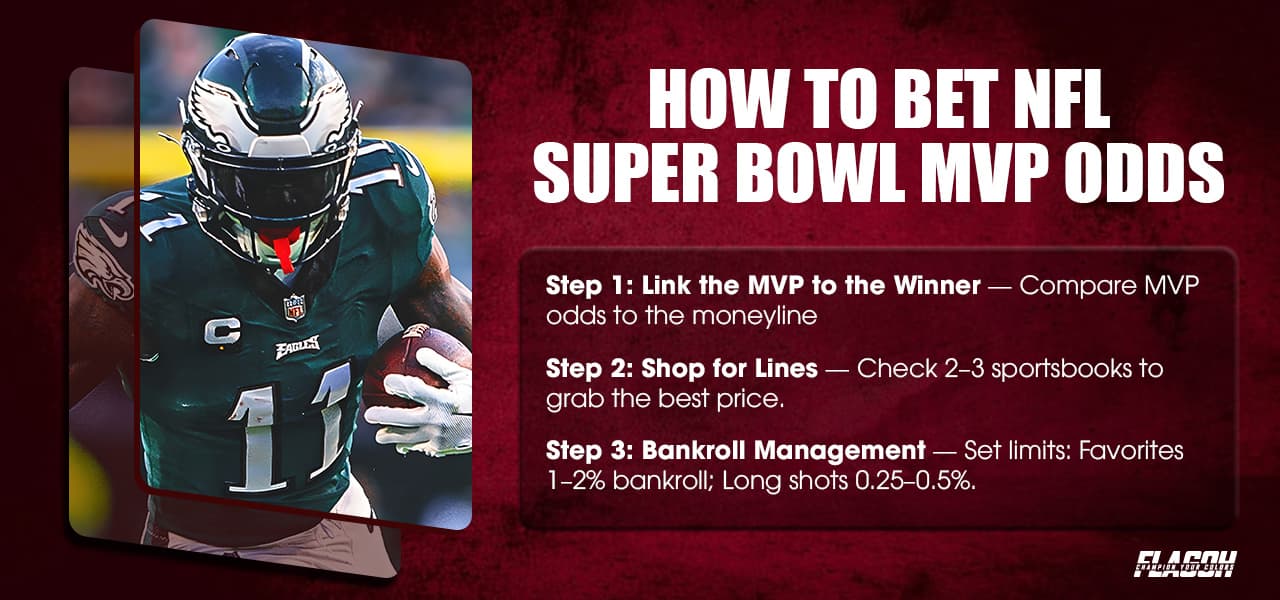
If you want a simple conversion: For +X odds, implied probability is roughly: 100 / (X + 100)
Example: +400 ≈ 100 / 500 = 20%
Don’t worry about being exact—your goal is to compare relative chances.
Why Implied Probability Isn’t The “True Chance”
Implied probability isn’t a clean, neutral forecast of what will happen, because sportsbooks bake a margin into the price, and the market itself is influenced by people—not just performance. It’s pricing today’s award storyline, not measuring the game in a lab.
Odds can shorten simply because a storyline becomes popular and attracts more attention, even if nothing on the field actually changed. On top of that, Super Bowl MVP is a narrative award: a player can play extremely well and still lose the spotlight to a teammate whose stats or signature moments feel more “award-shaped” to voters. The simplest way to think about implied probability is this: it’s what the market is charging right now for that MVP story, not the true percentage chance in a vacuum.
Why Prices Move
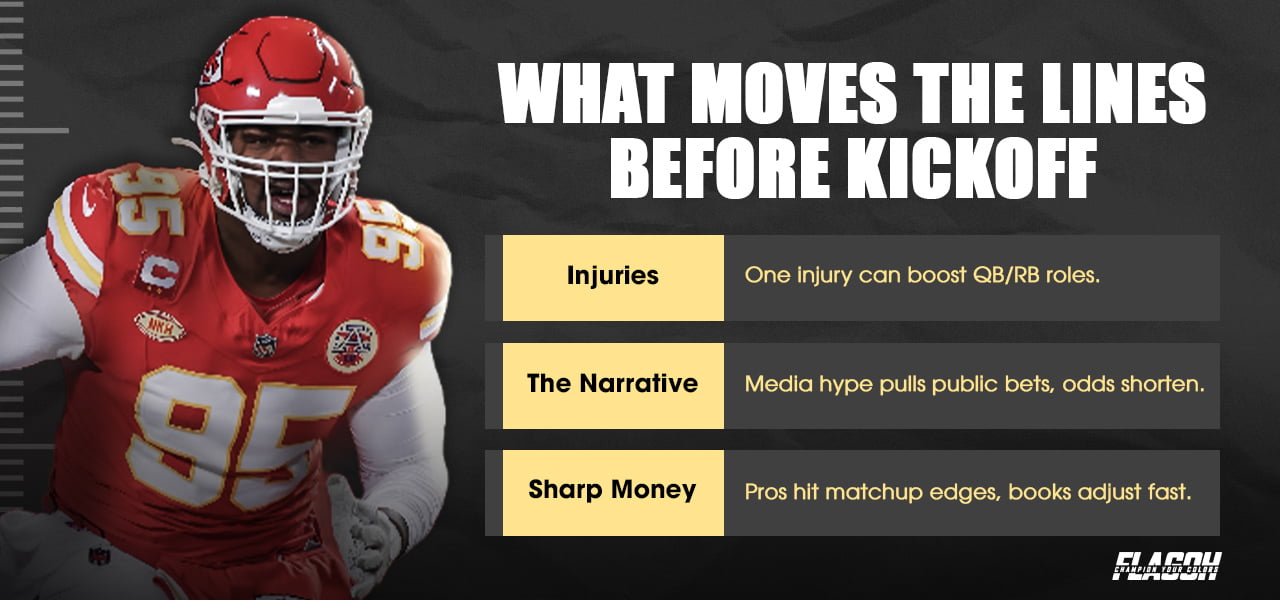
Super Bowl MVP odds move when the story behind the game shifts, and that can happen well before kickoff. Most line movement is the market reacting to new information—or a narrative getting more attention. News like injuries, practice updates, or lineup changes can quickly reframe who’s most likely to be the face of a win. The market also reacts to usage expectations—if it looks like a team will lean run-heavy or funnel targets to one primary receiver, the odds often adjust to reflect that potential script.
Finally, there’s narrative gravity: when media coverage and public conversation lock onto a single angle, money tends to follow it, and prices compress around the players at the center of that storyline.
For fans, the key takeaway is straightforward: odds movement is a real-time signal of which MVP narratives are gaining momentum, even if you’re only using it to build a watch list. At FlagOh, we use this board-first view to keep the MVP discussion grounded in roles, script, and how credit usually gets assigned.
Who Usually Wins Super Bowl MVP
This award often follows the path of least resistance: credit goes to the player who made winning feel inevitable.
Why QBs Dominate Most Years
Quarterbacks sit at the top because they touch the ball on every drive, their impact is easy to summarize, and late-game moments often become the entire MVP argument. Unless a non-QB delivers a louder, cleaner headline, the default credit usually lands on the winning QB
Even when a skill player shines, it’s common for the QB to “own” the headline unless the non-QB performance is undeniably louder. Because it’s a media vote, the cleanest voter narrative often wins.
The Typical Paths For WRs And RBs
Non-QBs can win, but they usually need a clearer headline than the QB.
For a WR, it’s high-volume targets plus a defining score or conversion sequence.
For an RB, it’s game control—steady volume, drive-finishing touchdowns, and a pace that makes the win feel inevitable.
What A Defensive MVP Game Usually Looks Like
Defensive winners typically require:
- A lower-scoring game where offense doesn’t create a single obvious hero.
- A signature moment: strip-sack, pick-six, game-sealing stop, or multiple drive-killing plays.
Defense can win MVP—just not often, because the story has to be unmistakable.
NFL MVP odds are a mix of implied probability and market behavior—not a perfect prediction. Use them to compare relative chances, remember the price includes margin and narrative bias, and watch line movement as a real-time hint about which MVP story is gaining traction.
MVP-Winning Game Scripts To Watch On Super Bowl Night
If you want to “read” the MVP race like a broadcast producer, watch which script the game is becoming.
Shootout Script
When points come in bunches and drives trade answers, the MVP spotlight tilts toward the passing game. When possessions are quick, and scoring is constant, QB favorites usually gain the cleanest MVP path because voters can point to efficiency, touchdowns, and late-game throws as the simplest explanation for why the team won.
This script also elevates big-play receivers, especially if one of them produces the most replayed moment of the night. As a fan, you’ll recognize the shootout pattern through explosive completions, aggressive red-zone passing, and frequent turns that turn every series into an MVP audition.
Control Script
When one team dictates tempo and keeps the other offense cold, MVP credit often follows volume and efficiency. In this game shape, MVP traction usually shifts to a feature RB piling up volume and finishing drives, or a “no-mistakes” QB who stays efficient in the red zone. You’ll spot it when run rate rises and long, steady drives keep producing points.
Chaos Script
When the game flips on turnovers and short fields, one defining play can steal the MVP conversation. That’s when defensive or special-teams long shots become more realistic, because a takeaway or return can define the entire MVP story. You’ll recognize it through high-leverage sacks, takeaways, defensive scores, or a game-changing special-teams moment.
Once you identify whether the game is turning into a shootout, control, or chaos script, the MVP race becomes much easier to read. Shootouts usually favor QBs (and a big-play WR), control games push volume RBs or efficient “no-mistakes” QBs, and chaos opens the door for defense or special teams to steal the spotlight with one defining moment. At the end of each quarter, re-check your top 3–6 watch list and ask which script is winning—shootout, control, or chaos.
MVP Watch-Party Picks
You don’t need a perfect living-room setup—just a few choices that look great on camera and match your “MVP watch list.”
If You’re Backing The Favorite Team: Go Big On Visibility
A clean, high-contrast setup wins in photos:
- One large team flag is the anchor behind the TV or couch.
- One secondary accent (banner or small flag) near the snack table.
- Keep backgrounds simple so logos pop.
Pro tip: if you’re hosting, choose one “main wall” and commit—busy walls make even great flags look cluttered.
If You’re Split Between Two Teams: Dual-Display Setup Ideas
Two-team setups can look intentional (not chaotic) if you separate zones:
- Left/right split wall: One team on each side of the TV.
- Table vs wall: One team banner on the table, one team flag on the wall.
- Neutral center: Keep the center clean and let both sides frame it.
This is also the easiest format for watch-party photos because people naturally stand in the center.
Photo-Ready Corner: Banners, Wall Flags, And Table Accents
Make one “photo corner” for quick group shots:
- A simple backdrop (wall flag or banner).
- One small prop (mini flag, scarf, or team colors).
- A light source facing people (not behind them).
If you want an easy way to theme your party without overdoing it, NFL flags from FlagOh are a straightforward upgrade: they’re visible, instantly recognizable, and they read well on camera.
Keep it simple and photo-ready: use one bold flag as the anchor, add one small accent for balance, and keep the background clean so logos pop—then use a two-zone split or a quick photo corner when needed.
Common Questions About NFL Super Bowl MVP Odds
A quick FAQ to keep your NFL Super Bowl MVP odds clear when the board shifts and the chatter gets loud.
Do MVP Odds Change During The Game?
Yes—live markets can react instantly to touchdowns, turnovers, and momentum. Even without betting, it’s a reminder that MVP is partly a story of timing: one iconic moment can shift the entire conversation.
Can A Defensive Player Realistically Win?
It’s possible, but it usually takes a low-scoring game plus a signature play (or two) that clearly decides the outcome. Defense needs a moment that everyone remembers in one sentence.
Does MVP Almost Always Come From The Winning Team?
In modern voting patterns, MVP is strongly tied to the winning team. As a fan, you can treat MVP odds as “who gets credit if this team wins”.
What Does +1000 / +3000 Mean In Plain English?
They’re positive American odds. In simple terms, bigger “plus” numbers mean a smaller implied chance and a larger payout if it hits. Even if you never wager, you can read it as: “How unlikely does the market think this outcome is?”
Why Do Two Sites Show Different Prices?
Books price risk differently based on what their customers are betting and when news hits. That’s why you’ll see variation—especially when public attention piles onto one narrative.
How Is The Super Bowl MVP Actually Chosen?
A media voting panel selects the MVP, and the choice tends to favor the most visible, game-defining performance. That often aligns with the winning QB—unless someone else clearly steals the spotlight.
Why Do Quarterbacks Sit At The Top Of The Board So Often?
Because they touch the ball constantly, their impact is easiest to summarize. In a close game, the final drive can become the entire MVP argument.
What Stats Matter Most For MVP Conversations?
Touchdowns and high-leverage plays usually matter more than raw yardage. For non-QBs, usage + signature moments (big conversions, game-turning plays) are what make the MVP case feel undeniable.
Use these answers as a reset—so you can track the MVP story with confidence without getting pulled by noise.
Official Super Bowl MVP winners archive (NFL); historical award logs (Pro Football Reference); odds format basics (regulated sportsbook rules/education pages).
NFL Super Bowl MVP odds are a quick map of who’s most likely to get the credit and which game scripts can flip the story. Build a watch list, follow the script, and enjoy the race—then check out NFL flags at FlagOh to bring the big-game energy home.