
 Arizona Cardinals Flag
 Atlanta Falcons Flag
 Baltimore Ravens Flag
 Buffalo Bills Flag
 Carolina Panthers Flag
 Chicago Bears Flag
 Cincinnati Bengals Flag
 Cleveland Browns Flag
 Dallas Cowboys Flag
 Denver Broncos Flag
 Detroit Lions Flag
 Green Bay Packers Flag
 Houston Texans Flag
 Indianapolis Colts Flag
 Jacksonville Jaguars Flag
 Kansas City Chiefs Flag
 Las Vegas Raiders Flag
 Los Angeles Chargers Flag
 Los Angeles Rams Flag
 Miami Dolphins Flag
 Minnesota Vikings Flag
 New England Patriots Flag
 New Orleans Saints Flag
 New York Giants Flag
 New York Jets Flag
 Philadelphia Eagles Flag
 Pittsburgh Steelers Flag
 San Francisco 49ers Flag
 Seattle Seahawks Flag
 Tampa Bay Buccaneers Flag
 Tennessee Titans Flag
 Washington Commanders Flag
 Arizona Diamondbacks Flag
 Atlanta Braves Flag
 Baltimore Orioles Flag
 Boston Red Sox Flag
 Chicago Cubs Flag
 Chicago White Sox Flag
 Cincinnati Reds Flag
 Cleveland Guardians Flag
 Colorado Rockies Flag
 Detroit Tigers Flag
 Houston Astros Flag
 Kansas City Royals Flag
 Los Angeles Angels Flag
 Los Angeles Dodgers Flag
 Miami Marlins Flag
 Milwaukee Brewers Flag
 Minnesota Twins Flag
 New York Mets Flag
 New York Yankees Flag
 Oakland Athletics Flag
 Philadelphia Phillies Flag
 Pittsburgh Pirates Flag
 San Diego Padres Flag
 San Francisco Giants Flag
 Seattle Mariners Flag
 St. Louis Cardinals Flag
 Tampa Bay Rays Flag
 Texas Rangers Flag
 Toronto Blue Jays Flag
 Washington Nationals Flag
 Atlanta Hawks Flag
 Boston Celtics Flag
 Brooklyn Nets Flag
 Charlotte Hornets Flag
 Chicago Bulls Flag
 Cleveland Cavaliers Flag
 Dallas Mavericks Flag
 Denver Nuggets Flag
 Detroit Pistons Flag
 Golden State Warriors Flag
 Houston Rockets Flag
 Indiana Pacers Flag
 LA Clippers Flag
 Los Angeles Lakers Flag
 Memphis Grizzlies Flag
 Miami Heat Flag
 Milwaukee Bucks Flag
 Minnesota Timberwolves Flag
 New Orleans Pelicans Flag
 New York Knicks Flag
 Oklahoma City Thunder Flag
 Orlando Magic Flag
 Philadelphia 76ers Flag
 Phoenix Suns Flag
 Portland Trail Blazers Flag
 Sacramento Kings Flag
 San Antonio Spurs Flag
 Toronto Raptors Flag
 Utah Jazz Flag
 Washington Wizards Flag
 Anaheim Ducks Flag
 Arizona Coyotes Flag
 Boston Bruins Flag
 Buffalo Sabres Flag
 Calgary Flames Flag
 Carolina Hurricanes Flag
 Chicago Blackhawks Flag
 Colorado Avalanche Flag
 Columbus Blue Jackets Flag
 Dallas Stars Flag
 Detroit Red Wings Flag
 Edmonton Oilers Flag
 Florida Panthers Flag
 Los Angeles Kings Flag
 Minnesota Wild Flag
 Montreal Canadiens Flag
 Nashville Predators Flag
 New Jersey Devils Flag
 New York Islanders Flag
 New York Rangers Flag
 Ottawa Senators Flag
 Philadelphia Flyers Flag
 Pittsburgh Penguins Flag
 San Jose Sharks Flag
 Seattle Kraken Flag
 St. Louis Blues Flag
 Tampa Bay Lightning Flag
 Toronto Maple Leafs Flag
 Vancouver Canucks Flag
 Vegas Golden Knights Flag
 Washington Capitals Flag
 Winnipeg Jets Flag
Every Super Bowl week, one question dominates search: who will win the Super Bowl? Odds can point you in the right direction, but they’re easy to misread if you don’t translate them into clean percentages. In this FlagOh walkthrough, you’ll get a fast snapshot table, a simple odds-to-probability conversion, a no-vig comparison, and the key reasons lines move before kickoff on February 8, 2026.
Super Bowl Odds Snapshot For A Fast Read
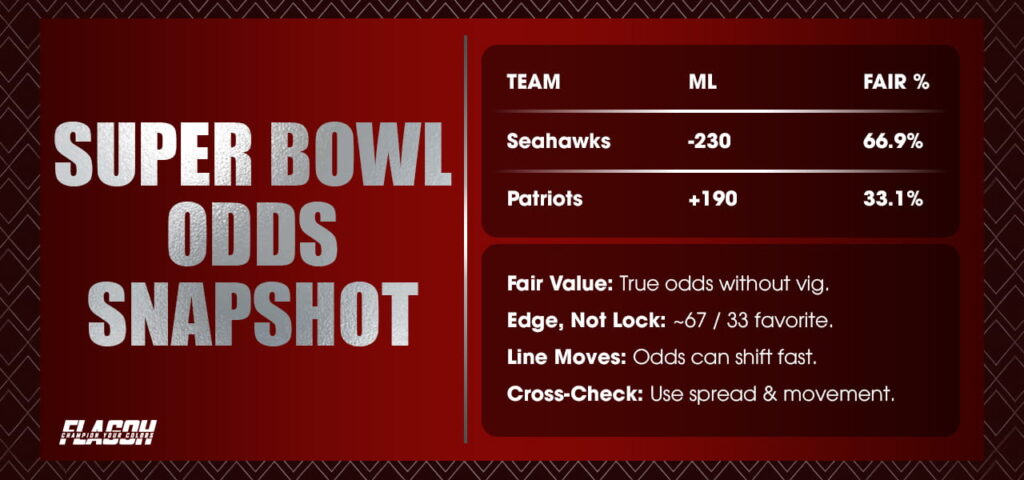
Odds can look like a simple ranking, but they actually encode probability. The snapshot below lets you quickly read the moneyline, translate it into implied percentages, and compare no-vig fair percentages to see how the market is leaning right now.
A Quick Odds Table With Implied And Fair Percentages
Below is a one-glance snapshot based on commonly listed Super Bowl LX moneylines at the time of writing. Last updated: February 2026. Odds can vary by sportsbook and move quickly.
| Team | Moneyline (American) | Implied % (with vig) | No-vig Fair Percentage |
| Seattle Seahawks | -230 | 69.7% | 66.9% |
| New England Patriots | +190 | 34.5% | 33.1% |
What this shows:
- Implied % is the probability baked into the price.
- Fair % removes the sportsbook’s margin so the two sides total 100%, making comparisons cleaner.
How To Read The Table In 20 Seconds
If you only have a moment, read it like this: start with Fair % to see how the market truly values each team after margin. A roughly 67/33 split signals a clear favorite, but not certainty. Then sanity-check that view against the spread and recent line movement to see whether confidence in the favorite is strengthening or softening.
Converting Super Bowl Odds Into Implied Probability
If you want a clean answer to who will win the Super Bowl from the odds, the first step is turning the moneyline into a percentage. This is the quickest way to see what -230 or +190 actually means in plain English. Once you can convert American odds into implied probability, the numbers become much easier to compare and discuss.
American Odds Made Simple
American odds describe profit relative to a $100 baseline.
- +500 means a $100 example stake would return $500 profit if it wins.
- -120 means you’d risk $120 to win $100 profit.
That’s why favorites usually carry a minus sign—you’re paying more for a perceived edge.
Two Fast Conversion Formulas
You only need two formulas to translate odds into percentages:
- Positive odds (+A): implied probability = 100 / (A + 100)
- Negative odds (-A): implied probability = A / (A + 100)
Using the current example:
- -230 → 230 / (230 + 100) = 69.7%
- +190 → 100 / (190 + 100) = 34.5%
Notice the total exceeds 100%. That isn’t a mistake—it’s the built-in margin, also called vig.
Why Implied Probabilities Add Up to More Than 100%
If the percentages add up above 100, you didn’t do the math wrong. This is the built-in margin, and a quick no-vig step will give you a cleaner comparison.
What Vig Means In Simple Terms
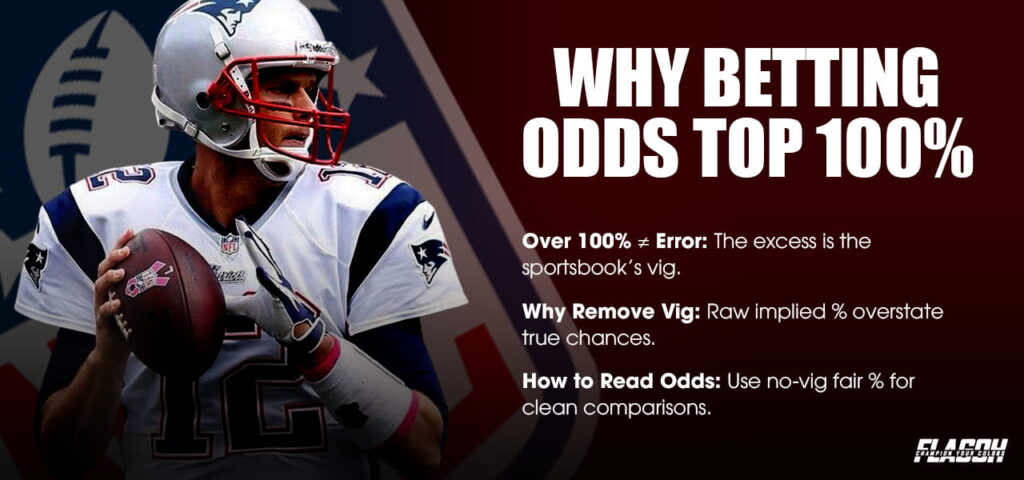
When the implied probabilities add up to more than 100%, the difference is the sportsbook margin, often called vig. In a two-team market like the Super Bowl, this is normal.
In the example above, 69.7% + 34.5% = 104.2%. That extra 4.2% is why raw implied probabilities shouldn’t be treated as “true chances.”
How To Remove Vig For A Fair Percentage
To compare teams fairly, normalize the implied probabilities so they sum to 100%:
- Seahawks: 69.7 / 104.2 = 66.9%
- Patriots: 34.5 / 104.2 = 33.1%
Practical takeaway: when reading who will win the Super Bowl from odds, use no-vig fair % for an apples-to-apples comparison. It won’t predict the outcome, but it removes a major source of distortion.
Track Line Movement And What It Means This Week
Odds are most useful when you watch how they change, not just where they sit. By comparing the opening number to the current price, you can see what the market is reacting to and whether confidence is building or fading as new information comes in.
A Simple Open Versus Current Odds Table
Odds don’t sit still. Tracking open vs current prices tells you how the market is reacting to information.
| Market | Open | Current | What it suggests |
| Spread | Seahawks -3.5 | Seahawks -4.5 | Confidence in the favorite has strengthened |
| Total | 46.5 | 45.5 | The market expects a slightly lower-scoring game |
| Moneyline | — | Seahawks -230 / Patriots +190 | Favorite remains firmly priced |
You don’t need every sportsbook—one consistent source with timestamps is enough to see direction and momentum.
What The Movement Usually Signals
Some updates matter far more than others. The biggest drivers of Super Bowl odds tend to be:
- Quarterback availability
- Offensive line and pass-rush injuries
- Key secondary absences (especially CB1)
- Credible roster news, not rumors
- Market reassessment after the opening line
Best practice: rely on official injury designations and reputable reporting, not speculation.
Why the Seahawks Are Favored (What the Market Is Pricing In)
Odds don’t just say “who’s better”—they hint at *why* the market prefers one side. With Seattle priced as the favorite, the current number suggests the market is assigning them the cleaner path to winning the game, not necessarily a guaranteed win.
The Most Likely “Seahawks Win” Script
Markets typically favor teams that can win in more than one way. In this matchup, pricing implies greater confidence in Seattle’s ability to:
- Create pressure without heavy blitzing (so coverage stays intact)
- Protect the quarterback well enough to avoid drive-killing sacks
- Sustain drives and win field position without relying on low-percentage explosive plays
- Limit turnover volatility (mistakes that flip a one-game sample)
What Would Make the Line Cool Off (or Flip)
If you’re tracking movement this week, these are the updates that most often change the price late:
- Quarterback availability or limitations
- Offensive line injuries (especially tackles and center)
- A key coverage defender ruled out (CB1 / top safety)
- A pass-rusher downgrade that reduces pressure rate
- Weather that pushes the game toward a lower-variance script
Practical read: if none of those change materially, the favorite’s price usually holds. If two or more hit the same side, that’s when you’ll often see the sharper moves.
Why the Seahawks Are Favored
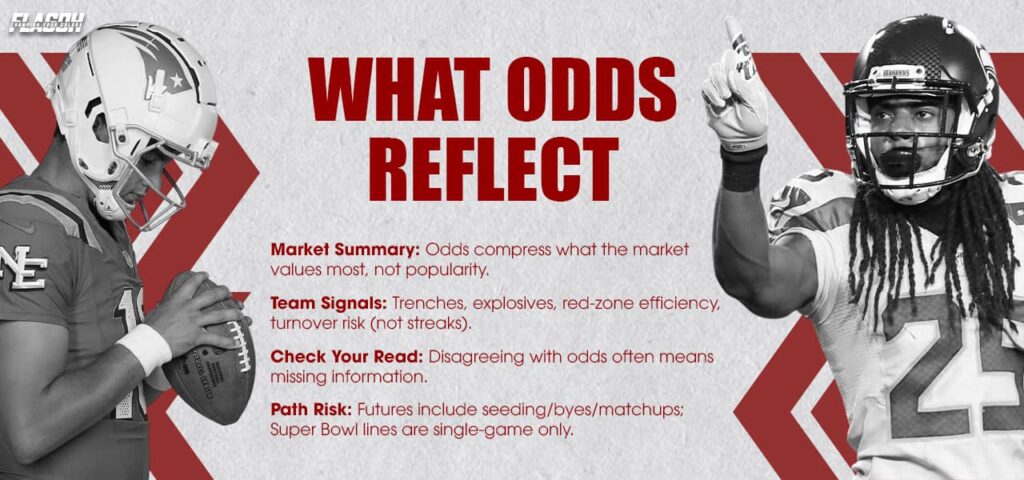
At this point, the moneyline is mostly a compact summary of team quality in a single-game context. Use it as a map of what the market values most—not a guarantee of the result.
Team Quality Signals That Translate To Odds
Odds usually reflect a few repeatable football realities: trench play (pressure vs protection), control of explosive plays, red-zone efficiency, and turnover risk. Markets understand that turnovers swing games—but they also know turnovers are volatile, which is why odds rarely chase short streaks too aggressively.
If your gut feeling strongly disagrees with the odds, the right question isn’t “is the market wrong?” but “what information might I be missing?”
Path Risk: Seeding, Bye, Home Field, Matchups
Earlier futures odds include path risk—seeding, byes, and potential opponents. Once the Super Bowl matchup is set, that path collapses into a single-game price. That’s why conference odds and Super Bowl moneylines answer different questions, even though they’re often confused.
Quick Answers To Common Super Bowl Odds Questions
If you’re skimming or just want the most searched questions in one place, this mini FAQ covers the quick odds basics people ask every Super Bowl week. Use it as a fast reference when you need a clear answer without redoing the math.
Who is favored to win the Super Bowl right now?
Current listings show the Seahawks as the favorite, priced around -230, with the Patriots around +190. Numbers can vary slightly by sportsbook.
What does +190 mean for Super Bowl odds?
+190 means a $100 example stake would return $190 profit if the underdog wins, corresponding to about 34.5% implied probability before removing vig.
How do I convert Super Bowl odds to implied probability?
Use +A → 100/(A+100) and -A → A/(A+100). Then normalize if you want no-vig fair percentages.
Why do implied probabilities add up to more than 100%?
Because prices include margin (vig), the excess over 100% is called overround.
Are odds the same as true probability?
No. Odds are that market prices are influenced by margin and sentiment. No-vig fair % is cleaner, but still not certain.
What moves Super Bowl odds the most?
Quarterback status, major trench injuries, and reliable roster news usually have the biggest impact.
Who will win the Super Bowl this year if I only follow the odds?
Odds favor the listed favorite, but they don’t guarantee the result. Use fair % and stay aware of late news to avoid overconfidence.
If you’re using odds to answer who will win the Super Bowl, keep it simple: translate the moneyline into implied probability, use no-vig fair percentages for clean comparisons, and pay attention only to the updates that reliably move the market. When you’re ready for game day, check out team flag sizes and options from FlagOh to match your pick and your watch-party setup.