
 Arizona Cardinals Flag
 Atlanta Falcons Flag
 Baltimore Ravens Flag
 Buffalo Bills Flag
 Carolina Panthers Flag
 Chicago Bears Flag
 Cincinnati Bengals Flag
 Cleveland Browns Flag
 Dallas Cowboys Flag
 Denver Broncos Flag
 Detroit Lions Flag
 Green Bay Packers Flag
 Houston Texans Flag
 Indianapolis Colts Flag
 Jacksonville Jaguars Flag
 Kansas City Chiefs Flag
 Las Vegas Raiders Flag
 Los Angeles Chargers Flag
 Los Angeles Rams Flag
 Miami Dolphins Flag
 Minnesota Vikings Flag
 New England Patriots Flag
 New Orleans Saints Flag
 New York Giants Flag
 New York Jets Flag
 Philadelphia Eagles Flag
 Pittsburgh Steelers Flag
 San Francisco 49ers Flag
 Seattle Seahawks Flag
 Tampa Bay Buccaneers Flag
 Tennessee Titans Flag
 Washington Commanders Flag
 Arizona Diamondbacks Flag
 Atlanta Braves Flag
 Baltimore Orioles Flag
 Boston Red Sox Flag
 Chicago Cubs Flag
 Chicago White Sox Flag
 Cincinnati Reds Flag
 Cleveland Guardians Flag
 Colorado Rockies Flag
 Detroit Tigers Flag
 Houston Astros Flag
 Kansas City Royals Flag
 Los Angeles Angels Flag
 Los Angeles Dodgers Flag
 Miami Marlins Flag
 Milwaukee Brewers Flag
 Minnesota Twins Flag
 New York Mets Flag
 New York Yankees Flag
 Oakland Athletics Flag
 Philadelphia Phillies Flag
 Pittsburgh Pirates Flag
 San Diego Padres Flag
 San Francisco Giants Flag
 Seattle Mariners Flag
 St. Louis Cardinals Flag
 Tampa Bay Rays Flag
 Texas Rangers Flag
 Toronto Blue Jays Flag
 Washington Nationals Flag
 Atlanta Hawks Flag
 Boston Celtics Flag
 Brooklyn Nets Flag
 Charlotte Hornets Flag
 Chicago Bulls Flag
 Cleveland Cavaliers Flag
 Dallas Mavericks Flag
 Denver Nuggets Flag
 Detroit Pistons Flag
 Golden State Warriors Flag
 Houston Rockets Flag
 Indiana Pacers Flag
 LA Clippers Flag
 Los Angeles Lakers Flag
 Memphis Grizzlies Flag
 Miami Heat Flag
 Milwaukee Bucks Flag
 Minnesota Timberwolves Flag
 New Orleans Pelicans Flag
 New York Knicks Flag
 Oklahoma City Thunder Flag
 Orlando Magic Flag
 Philadelphia 76ers Flag
 Phoenix Suns Flag
 Portland Trail Blazers Flag
 Sacramento Kings Flag
 San Antonio Spurs Flag
 Toronto Raptors Flag
 Utah Jazz Flag
 Washington Wizards Flag
 Anaheim Ducks Flag
 Arizona Coyotes Flag
 Boston Bruins Flag
 Buffalo Sabres Flag
 Calgary Flames Flag
 Carolina Hurricanes Flag
 Chicago Blackhawks Flag
 Colorado Avalanche Flag
 Columbus Blue Jackets Flag
 Dallas Stars Flag
 Detroit Red Wings Flag
 Edmonton Oilers Flag
 Florida Panthers Flag
 Los Angeles Kings Flag
 Minnesota Wild Flag
 Montreal Canadiens Flag
 Nashville Predators Flag
 New Jersey Devils Flag
 New York Islanders Flag
 New York Rangers Flag
 Ottawa Senators Flag
 Philadelphia Flyers Flag
 Pittsburgh Penguins Flag
 San Jose Sharks Flag
 Seattle Kraken Flag
 St. Louis Blues Flag
 Tampa Bay Lightning Flag
 Toronto Maple Leafs Flag
 Vancouver Canucks Flag
 Vegas Golden Knights Flag
 Washington Capitals Flag
 Winnipeg Jets Flag
News
Patriots vs Seahawks Score Prediction Game Scripts
When people search Patriots vs Seahawks before kickoff, they usually want a score prediction that feels realistic. The catch is that the “right” number depends on game script—slow and defensive, balanced, or fast and explosive—so this FlagOh guide uses a simple LOW / BASE / HIGH framework you can confirm quickly after the first few drives.
Quick Game Hub for Kickoff: How to Watch and Key Updates
Before we get into score ranges and game scripts, it helps to lock in the basics that shape everything else. This quick hub covers when and where to watch, what to check on availability, and the three fastest signals that tell you how the scoreboard is likely to move.
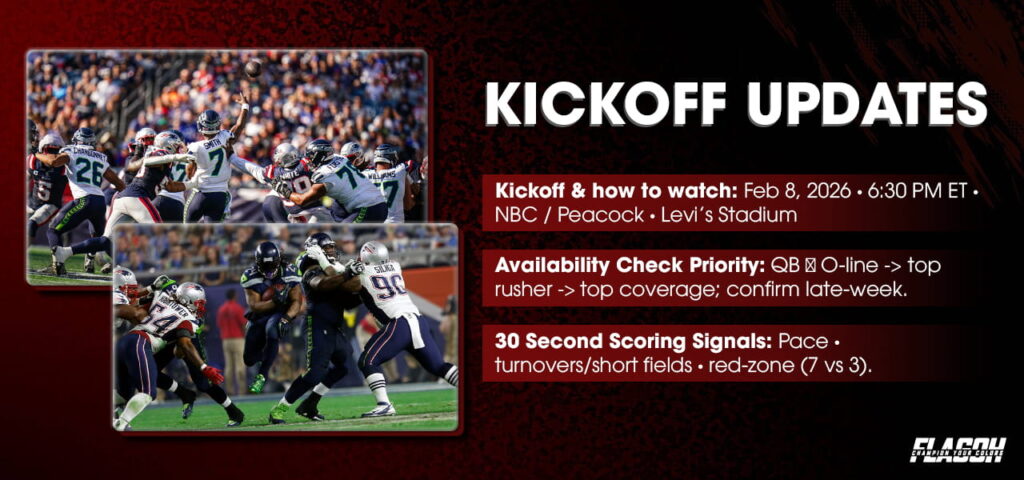
Kickoff + watch info: Super Bowl LX is Sunday, Feb. 8, 2026, at 6:30 p.m. ET, at Levi’s Stadium (Santa Clara, CA), airing on NBC and streaming on Peacock.
UK quick convert: 6:30 p.m. ET is typically 11:30 p.m. GMT, which makes planning a late-night watch much easier.
Injury/availability reality check: Before you trust any score call, prioritize QB → offensive line → top pass rusher → top coverage defender. Early-week participation is often projected/estimated, so treat it as a risk flag until late-week updates confirm it. For example, New England listed Drake Maye (right shoulder) as limited on its initial report.
A simple way to read late-week statuses:
- Out: remove them from your scoring assumptions.
- Doubtful: plan as if they won’t play.
- Questionable: common, often a true game-time call.
30-second scoring checklist: Track only three levers—pace (possessions), short fields (turnovers), and red-zone finishing (7 vs 3). If you have those, your score range stays realistic even when the box score is noisy.
A Realistic Score Range for Patriots vs Seahawks in One Minute
Here’s the most practical answer in one breath:
The most realistic way to call the game is to pick a script, then use a score range: LOW (17–13 to 20–16) if pressure and punts win, BASE (23–20 to 27–24) if drives finish normally, or HIGH (31–27 to 34–30) if chunk plays and TD red-zone rates show up early.
Why the band moves: It’s mostly three levers—pace, short fields, and red-zone finishing (7 vs. 3). If two lean down, live in LOW. If two lean up, drift HIGH.
Best-practice warning: treat early-week injury listings as risk flags, not certainties, and avoid “locks.”
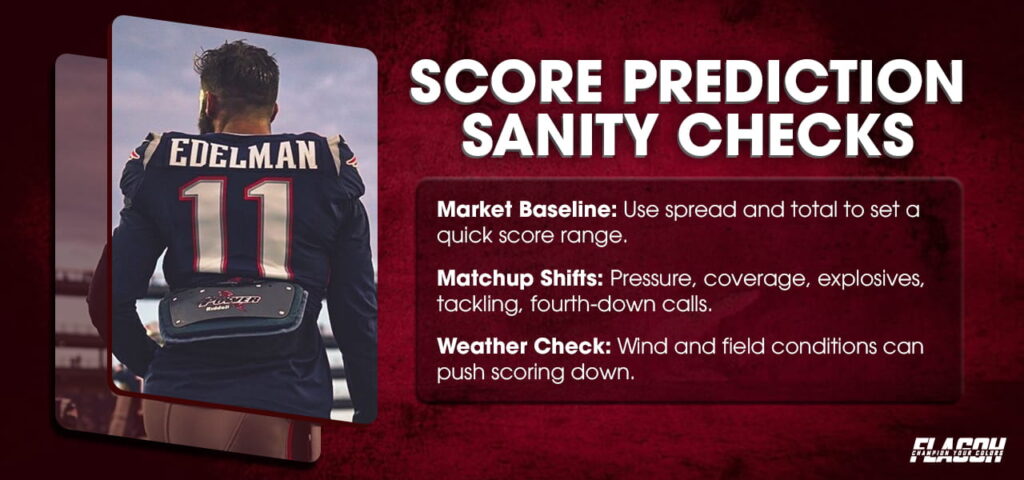
Market baseline (fast reality check): With Seattle around -4.5 and the total around 45.5, the implied midpoint lands roughly in the 25–21 neighborhood. Use that as your BASE anchor, then shift down (LOW) if pressure and punts win, or up (HIGH) if explosive plays and short fields show up early.
The Scenario Table for Patriots vs Seahawks Score Predictions
This table is the core Patriots vs Seahawks prediction framework: match what you’re seeing to a script, then live inside that score band.
| Scenario (Game Script) | Predicted Final Score Range (Example) | What Must Be True (2–3 checks) | Key Trigger to Watch | One Risk (Why It Fails) |
| LOW: Defensive + field position | 17–13 to 20–16 (ex: 19–16) | Slow pace; few explosives; red-zone trips stall into FGs | Pressure arrives without selling out on blitz | One short-field turnover gifts points |
| BASE: Normal pace, mixed finishes | 23–20 to 27–24 (ex: 26–23) | Typical possessions: a few chunk gains; TD/FG mix | Sustained drives + at least one explosive each | Red-zone TD rate spikes → becomes HIGH |
| HIGH: Efficiency spike/shootout | 31–27 to 34–30 (ex: 33–30) | Clean pockets; YAC/missed tackles; aggressive 4th downs | Chunk plays early + easy third-down conversions | Sacks/penalties kill drives → drops to BASE |
Pick fast: After two drives each, choose the band that matches what you’re seeing—pressure + punts = LOW, clean pockets + chunk plays = HIGH, mixed results = BASE.
Sanity Checks That Keep Your Score Prediction Realistic
If you want one clean way to keep your score call grounded, do it in two steps. Use the market to set a starting band, then use matchups and weather to decide whether you should stay put or shift your script.
The Implied Score Method Using the Spread and Total
Implied scoring gives you a quick baseline from the spread and total.
- Implied Favorite ≈ (Total ÷ 2) + (Spread ÷ 2)
- Implied Underdog ≈ (Total ÷ 2) − (Spread ÷ 2)
Example: if the total is 46 and the spread is 3, the implied scores land around 24.5 to 21.5. Lines can vary by sportsbook and move during the week, so treat this as a starting point rather than a fixed forecast. If the implied math looks BASE but pressure is winning, and chunk plays are missing, lean LOW. If completions are easy and big plays show up early, lean HIGH.
The Matchup Checklist That Shifts the Total
Once you’ve got a baseline, run five quick checks that map directly to points.
Start withpass rush versus the offensive line, because pressure changes efficiency and mistake risk. Then look atcoverage versus separation, since easy separation keeps drives alive. Add run fits versus explosives, because steady runs can shorten the game while explosive runs spike totals fast. Watch YAC and tackling, because missed tackles inflate scoring quickly. Finally, track fourth-down choices, because aggressive decisions can create more touchdown chances or hand out short fields the other way.
Weather Signals Using Wind Speed and Field Conditions
For weather, use something measurable. Start with wind in mph. As a practical rule of thumb, when wind pushes into the mid-teens mph or higher, you often see fewer deep attempts and more conservative kicking decisions. If punts pile up or long kicks get passed on, that’s a good reason to shift one script down.
You’ll also hear people bring up past Super Bowl context. It’s fine as a reference point, but don’t treat it like a prediction engine. The more useful lens is what travels to any big stage: protection under pressure, red-zone decision-making, and avoiding short fields.
Game-Day Prep and Flag Gear That Holds Up
If you’re hosting, decorating, or heading to a watch spot, this is the practical gear logic. If you’re choosing a flag for this weekend, FlagOh makes it easy to compare size, fabric, and hanging styles so you’re not guessing what will work on a porch, wall, or window.
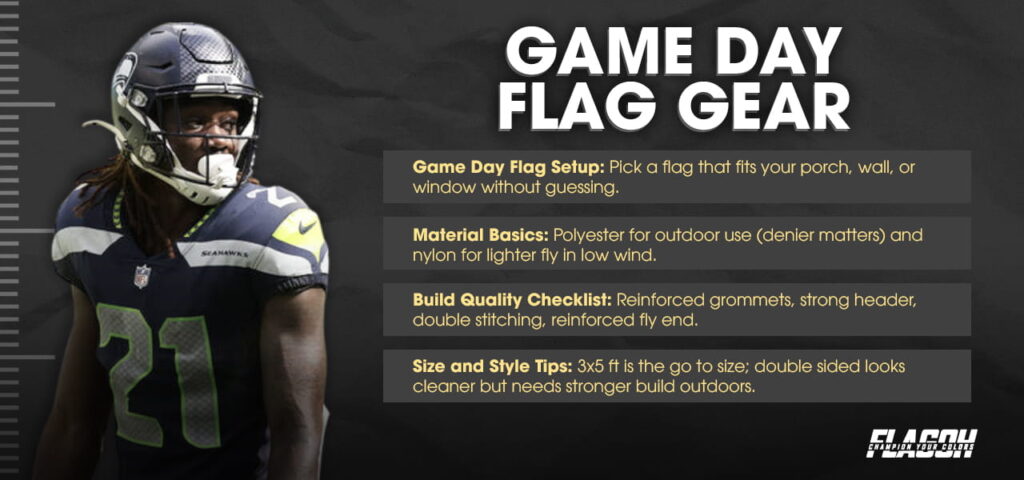
Material basics (outdoor vs indoor):
- Polyester is commonly chosen for frequent outdoor use and is often labeled by denier (like 150D/200D/300D). Higher denier usually means thicker/heavier fabric.
- Nylon is often lighter and flies well in lower winds, but durability depends on weave and finishing.
Build quality checklist:
- Reinforced attachment points (often grommets)
- Strong header construction where it hangs
- Double-stitched hems and a reinforced fly end (the edge that takes the most stress)
For many US/UK home setups, 3×5 ft is the go-to size because it reads clearly without overpowering a porch. If you choose double-sided, it usually looks cleaner from both directions, but it can be heavier and take more wind stress, so build quality matters even more outdoors.
Quick Patriots vs Seahawks FAQs
If you’re skimming for the essentials, these quick answers cover the questions fans ask most before kickoff. Use them as a fast reference for choosing a score script, sanity-checking it with the spread and total, and adjusting in real time once the game shows you its rhythm.
What is the most realistic score range for this matchup?
Use a range tied to a script: LOW (17–13 to 20–16), BASE (23–20 to 27–24), or HIGH (31–27 to 34–30), based on pace, turnovers/short fields, and red-zone finishing.
What time is kickoff, and where can I watch the game?
Super Bowl LX is Feb. 8, 2026, at 6:30 p.m. ET on NBC and streaming on Peacock.
What score range fits a shootout Patriots vs Seahawks game?
If QBs are comfortable, chunk plays show up early, and red-zone TD rates are high, HIGH (31–27 to 34–30) fits.
How much do turnovers usually swing the final score?
Turnovers swing outcomes by stealing possessions and creating short fields; even one giveaway can push BASE toward LOW or HIGH depending on field position.
Why does red-zone touchdown rate matter more than yards?
Because TD (7) vs FG (3) is a 4-point swing. Over multiple trips, that’s the fastest scoreboard change.
How does pace (possessions) change total points?
More possessions create more scoring chances; a faster pace tends to raise totals even with average efficiency.
How does wind (mph) usually change scoring and kicking?
Higher wind often discourages deeper throws and longer kicks, nudging the game toward field position and lower totals.
How should injuries change my score prediction?
Downgrade efficiency if QB/OL are limited and treat early-week listings as monitoring flags, not final Sunday status.
What’s a practical way to update my prediction after the first quarter?
After two drives each, match what you’re seeing to LOW/BASE/HIGH, then stay inside that band.
If you want to keep things simple for Patriots vs Seahawks, pick your game script first, then build your watch-day setup around it. For an easy way to compare flag sizes, materials, and hanging options, explore the game-day collections at FlagOh and choose what fits your space.