
 Arizona Cardinals Flag
 Atlanta Falcons Flag
 Baltimore Ravens Flag
 Buffalo Bills Flag
 Carolina Panthers Flag
 Chicago Bears Flag
 Cincinnati Bengals Flag
 Cleveland Browns Flag
 Dallas Cowboys Flag
 Denver Broncos Flag
 Detroit Lions Flag
 Green Bay Packers Flag
 Houston Texans Flag
 Indianapolis Colts Flag
 Jacksonville Jaguars Flag
 Kansas City Chiefs Flag
 Las Vegas Raiders Flag
 Los Angeles Chargers Flag
 Los Angeles Rams Flag
 Miami Dolphins Flag
 Minnesota Vikings Flag
 New England Patriots Flag
 New Orleans Saints Flag
 New York Giants Flag
 New York Jets Flag
 Philadelphia Eagles Flag
 Pittsburgh Steelers Flag
 San Francisco 49ers Flag
 Seattle Seahawks Flag
 Tampa Bay Buccaneers Flag
 Tennessee Titans Flag
 Washington Commanders Flag
 Arizona Diamondbacks Flag
 Atlanta Braves Flag
 Baltimore Orioles Flag
 Boston Red Sox Flag
 Chicago Cubs Flag
 Chicago White Sox Flag
 Cincinnati Reds Flag
 Cleveland Guardians Flag
 Colorado Rockies Flag
 Detroit Tigers Flag
 Houston Astros Flag
 Kansas City Royals Flag
 Los Angeles Angels Flag
 Los Angeles Dodgers Flag
 Miami Marlins Flag
 Milwaukee Brewers Flag
 Minnesota Twins Flag
 New York Mets Flag
 New York Yankees Flag
 Oakland Athletics Flag
 Philadelphia Phillies Flag
 Pittsburgh Pirates Flag
 San Diego Padres Flag
 San Francisco Giants Flag
 Seattle Mariners Flag
 St. Louis Cardinals Flag
 Tampa Bay Rays Flag
 Texas Rangers Flag
 Toronto Blue Jays Flag
 Washington Nationals Flag
 Atlanta Hawks Flag
 Boston Celtics Flag
 Brooklyn Nets Flag
 Charlotte Hornets Flag
 Chicago Bulls Flag
 Cleveland Cavaliers Flag
 Dallas Mavericks Flag
 Denver Nuggets Flag
 Detroit Pistons Flag
 Golden State Warriors Flag
 Houston Rockets Flag
 Indiana Pacers Flag
 LA Clippers Flag
 Los Angeles Lakers Flag
 Memphis Grizzlies Flag
 Miami Heat Flag
 Milwaukee Bucks Flag
 Minnesota Timberwolves Flag
 New Orleans Pelicans Flag
 New York Knicks Flag
 Oklahoma City Thunder Flag
 Orlando Magic Flag
 Philadelphia 76ers Flag
 Phoenix Suns Flag
 Portland Trail Blazers Flag
 Sacramento Kings Flag
 San Antonio Spurs Flag
 Toronto Raptors Flag
 Utah Jazz Flag
 Washington Wizards Flag
 Anaheim Ducks Flag
 Arizona Coyotes Flag
 Boston Bruins Flag
 Buffalo Sabres Flag
 Calgary Flames Flag
 Carolina Hurricanes Flag
 Chicago Blackhawks Flag
 Colorado Avalanche Flag
 Columbus Blue Jackets Flag
 Dallas Stars Flag
 Detroit Red Wings Flag
 Edmonton Oilers Flag
 Florida Panthers Flag
 Los Angeles Kings Flag
 Minnesota Wild Flag
 Montreal Canadiens Flag
 Nashville Predators Flag
 New Jersey Devils Flag
 New York Islanders Flag
 New York Rangers Flag
 Ottawa Senators Flag
 Philadelphia Flyers Flag
 Pittsburgh Penguins Flag
 San Jose Sharks Flag
 Seattle Kraken Flag
 St. Louis Blues Flag
 Tampa Bay Lightning Flag
 Toronto Maple Leafs Flag
 Vancouver Canucks Flag
 Vegas Golden Knights Flag
 Washington Capitals Flag
 Winnipeg Jets Flag
News
NFL Players With the Most Super Bowl Rings Through History
The quest for a Super Bowl ring has defined every NFL era — from gritty 1960s dynasties to today’s precision teams. Understanding NFL players with the most Super Bowl rings shows how the league evolved, which positions dominate, and why some franchises keep producing champions. Celebrate those legends with premium flags from FlagOh.
How Super Bowl Ring Leaders Emerged Across NFL History
Understanding how Super Bowl ring leaders emerged through coaching, roster stability, and shifting rules is essential to ranking NFL players with the most Super Bowl rings. Celebrate those champions with premium gear from FlagOh.
The Origins — 1960s–1970s: The Rise of the Early NFL Dynasties
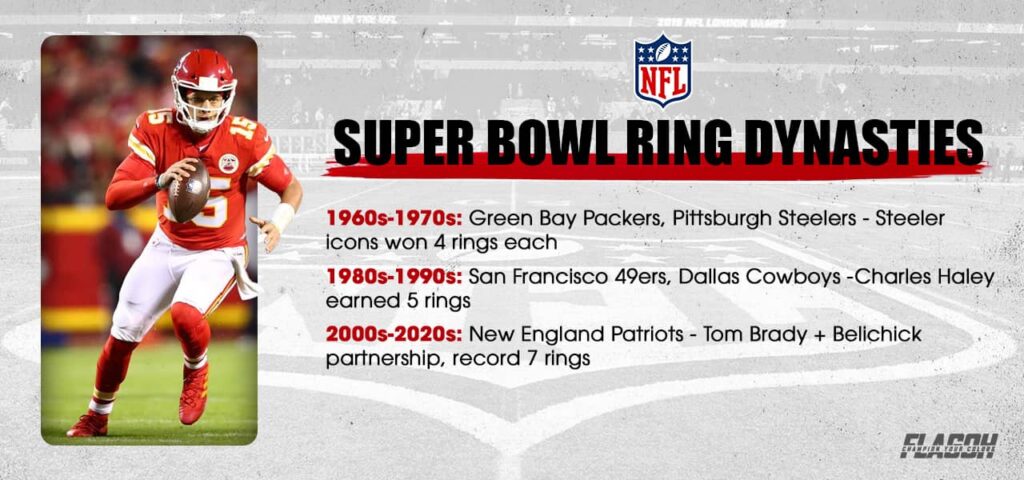
The first generation of Super Bowl champions set the stage for what it meant to build a dynasty. The Green Bay Packers, led by Vince Lombardi, combined innovative strategies, disciplined execution, and a culture of excellence to dominate the 1960s. Shortly after, the Pittsburgh Steelers under Chuck Noll established a blueprint for defensive dominance and team cohesion. Players like Mel Blount, Terry Bradshaw, Franco Harris, and Jack Lambert thrived in an era of roster stability and consistent coaching, capturing four Super Bowl rings in a short span. The limited player movement of the time allowed core units to develop chemistry, making repeated championships possible.
The 1980s–1990s Powerhouses
As the league expanded, power shifted westward. The San Francisco 49ers, guided by Bill Walsh’s West Coast offense, redefined offensive strategy while claiming five Super Bowl titles. The Dallas Cowboys, under Jimmy Johnson and later Barry Switzer, built a dynasty emphasizing speed, versatility, and disciplined preparation. This era also produced Charles Haley, whose unique combination of skill, timing, and versatility made him the only defensive player to earn five Super Bowl rings across two franchises. These teams demonstrated that strategic coaching, adaptable players, and strong front-office management could sustain championship runs even as league competition intensified.
The 2000s–2020s: Modern Dynasties and the Brady–Belichick Era
The modern NFL brought free agency, salary caps, and increased parity, making long-term dominance harder to achieve. Yet the New England Patriots emerged as the definitive dynasty, combining strategic innovation, player development, and consistency. The Brady–Belichick partnership exemplified how leadership, preparation, and adaptability could produce sustained success. Brady’s longevity, precision, and clutch performances in high-stakes games, combined with Belichick’s system-focused approach, led to a historic number of championships and cemented both as icons of a modern dynasty.
The Most Decorated Champions in NFL History
The most decorated champions highlight the legacy of NFL players with the most Super Bowl rings. Tom Brady leads with seven, Charles Haley is the only defender with five, and legends like Bradshaw, Swann, Harris, Lambert, and Blount each earned four, all thriving within dynastic teams and long-term coaching systems.
Tom Brady — The Only Player With Seven Rings
Tom Brady’s record of seven Super Bowl rings is a benchmark that may stand for decades. His six championships with New England and one with Tampa Bay reflect not just individual skill but also an exceptional ability to thrive in different team systems. Brady’s leadership, preparation, and adaptability allowed him to maintain elite performance over an unusually long career, while his poise in critical playoff moments repeatedly turned close games into championship victories. Beyond stats, Brady redefined what it means to be a franchise quarterback and set the standard for longevity and excellence in the NFL.
Charles Haley — Defensive Dominance With Five Rings
Charles Haley’s five Super Bowl rings make him the most decorated defensive player in NFL history. Winning two with the San Francisco 49ers and three with the Dallas Cowboys, Haley was a relentless pass rusher whose presence could alter the course of a game. His ability to excel in multiple defensive schemes and adapt to two championship cultures demonstrates how elite defenders can leave an enduring mark across different franchises. Haley’s rings underscore the impact of timing, opportunity, and versatility in building a multi-championship legacy.
Players With Four Rings — The Elite Group Behind the Legends
A select group of players each earned four Super Bowl rings, with many coming from the Pittsburgh Steelers’ dynasty. Legends like Terry Bradshaw, Lynn Swann, Franco Harris, Jack Lambert, and Mel Blount thrived in a system emphasizing roster stability, disciplined coaching under Chuck Noll, and strong team culture. These players benefited from sustained team excellence, where each ring represents not only personal achievement but also the collective strength of a dynasty built over several seasons. Their careers highlight how consistent systems, deep rosters, and strategic coaching are critical in producing multiple champions.
What Do These Multi-Ring Players Have in Common
Understanding why certain names top the lists of NFL players with the most Super Bowl rings comes down to system continuity for quarterbacks, dominant defensive units that let linebackers and defensive backs collect multiple titles, and specialist roles that teams keep season after season, all driven by franchises with elite coaching, stable rosters, and strong player development. Celebrate these champions and show your team pride with FlagOh.
Quarterbacks:
- Often the face of a dynasty, quarterbacks benefit from system continuity, strong coaching, and leadership roles that influence team success.
- Longevity and consistent performance allow them to accumulate multiple championships over time.
Defensive Players:
- Linebackers and defensive backs frequently appear on multi-title teams because stable, dominant defenses sustain winning streaks.
- Key defensive roles, such as pass rushers or shutdown corners, can directly impact playoff success, contributing to repeated victories.
Special Teams Players:
- Specialists like kickers, punters, and long snappers often stay with a team for many seasons.
- Their consistent presence in game-critical situations can make them repeat contributors on championship rosters.
Offensive Role Players:
- Receivers, tight ends, and linemen who stay with successful franchises can also collect multiple rings.
- Team culture, coaching stability, and fit within a successful system are often more important than individual stardom.
Key Insight:
- Accumulating multiple rings is rarely about talent alone; it requires being in the right position, on the right team, under the right coaching, often over a sustained period.
Teams That Produced the Most Super Bowl Champions
Several franchises stand out for producing multiple Super Bowl champions. Their success was not just luck but the result of consistent systems and culture:
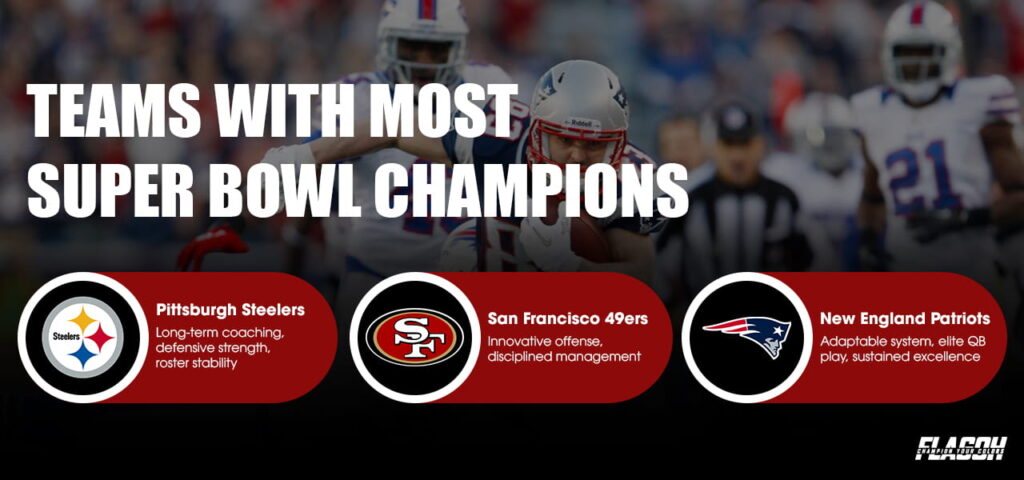
- Pittsburgh Steelers
- Built on long-term coaching under Chuck Noll.
- Focused on defensive strength and roster stability, producing multiple four-ring players.
- San Francisco 49ers
- Dominated through innovative offensive schemes and disciplined team management.
- Developed players who could perform at a championship level year after year.
- New England Patriots
- Maintained a culture of adaptability and sustained excellence under Bill Belichick.
- Combined elite quarterback play with strong coaching and deep rosters to create repeated champions.
These franchises share key traits: elite coaching, player development programs, and long-term roster continuity. Such foundations allowed players to consistently compete for and win championships, creating an environment where multiple legends earned several rings.
Comparing NFL Players With the Most Super Bowl Rings
Comparing the game’s top winners requires more than tallying rings. Tom Brady’s record of seven championships reflects uncommon longevity, sustained elite play in high-pressure games, and the outsized impact a franchise quarterback can have on outcomes. That combination of health, clutch performance, and being in consistently competitive systems makes his mark unusually hard to match.
Charles Haley’s five rings tell a different story. His achievement underscores how a dominant role player can ride multiple dynasties to repeated success. Winning that many titles with more than one franchise is rare because it requires both individual excellence and timing — joining the right roster at the right moment.
Players with four rings were often part of tightly built dynasties where coaching, roster continuity, and culture produced repeat champions. Today’s league, with free agency and salary caps, makes long runs like those harder to sustain, so identical dynasties are less likely to reappear. That is why fair comparisons weigh era, team structure, and a player’s role as much as raw ring counts.
Common Questions on NFL Ring Leaders and Champions
Here are common questions about NFL ring leaders. Few players have won four or more Super Bowls; some, like Brady and Haley, won with multiple teams. Practice squad members may receive rings, dynasties are rarer today, and some rings can sell for hundreds of thousands of dollars.
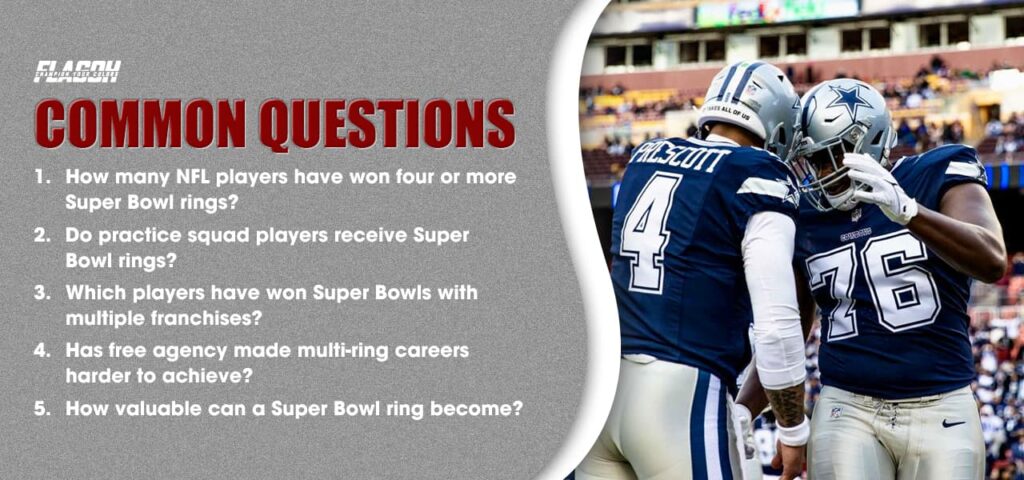
How many NFL players have won four or more Super Bowl rings?
Only a small group of fewer than 15 players in league history have reached four or more rings.
Do practice squad players receive Super Bowl rings?
Yes, most teams award rings to practice squad members, but the design and value may differ.
Which players have won Super Bowls with multiple franchises?
A handful of players, including Tom Brady and Charles Haley, have won titles with more than one team.
Has free agency made multi-ring careers harder to achieve?
Yes, increased parity and roster turnover make long dynasties far less common today.
How valuable can a Super Bowl ring become?
Depending on rarity and player history, some rings have sold for tens or even hundreds of thousands of dollars.
Super Bowl rings do more than sparkle; understanding NFL players with the most Super Bowl rings maps the league’s evolution, from Tom Brady with seven championships to the Pittsburgh steel curtain era and the dynasties of San Francisco and New England. Honor these legends and show team pride by shopping for custom team display pieces fromFlagOh.