
 Arizona Cardinals Flag
 Atlanta Falcons Flag
 Baltimore Ravens Flag
 Buffalo Bills Flag
 Carolina Panthers Flag
 Chicago Bears Flag
 Cincinnati Bengals Flag
 Cleveland Browns Flag
 Dallas Cowboys Flag
 Denver Broncos Flag
 Detroit Lions Flag
 Green Bay Packers Flag
 Houston Texans Flag
 Indianapolis Colts Flag
 Jacksonville Jaguars Flag
 Kansas City Chiefs Flag
 Las Vegas Raiders Flag
 Los Angeles Chargers Flag
 Los Angeles Rams Flag
 Miami Dolphins Flag
 Minnesota Vikings Flag
 New England Patriots Flag
 New Orleans Saints Flag
 New York Giants Flag
 New York Jets Flag
 Philadelphia Eagles Flag
 Pittsburgh Steelers Flag
 San Francisco 49ers Flag
 Seattle Seahawks Flag
 Tampa Bay Buccaneers Flag
 Tennessee Titans Flag
 Washington Commanders Flag
 Arizona Diamondbacks Flag
 Atlanta Braves Flag
 Baltimore Orioles Flag
 Boston Red Sox Flag
 Chicago Cubs Flag
 Chicago White Sox Flag
 Cincinnati Reds Flag
 Cleveland Guardians Flag
 Colorado Rockies Flag
 Detroit Tigers Flag
 Houston Astros Flag
 Kansas City Royals Flag
 Los Angeles Angels Flag
 Los Angeles Dodgers Flag
 Miami Marlins Flag
 Milwaukee Brewers Flag
 Minnesota Twins Flag
 New York Mets Flag
 New York Yankees Flag
 Oakland Athletics Flag
 Philadelphia Phillies Flag
 Pittsburgh Pirates Flag
 San Diego Padres Flag
 San Francisco Giants Flag
 Seattle Mariners Flag
 St. Louis Cardinals Flag
 Tampa Bay Rays Flag
 Texas Rangers Flag
 Toronto Blue Jays Flag
 Washington Nationals Flag
 Atlanta Hawks Flag
 Boston Celtics Flag
 Brooklyn Nets Flag
 Charlotte Hornets Flag
 Chicago Bulls Flag
 Cleveland Cavaliers Flag
 Dallas Mavericks Flag
 Denver Nuggets Flag
 Detroit Pistons Flag
 Golden State Warriors Flag
 Houston Rockets Flag
 Indiana Pacers Flag
 LA Clippers Flag
 Los Angeles Lakers Flag
 Memphis Grizzlies Flag
 Miami Heat Flag
 Milwaukee Bucks Flag
 Minnesota Timberwolves Flag
 New Orleans Pelicans Flag
 New York Knicks Flag
 Oklahoma City Thunder Flag
 Orlando Magic Flag
 Philadelphia 76ers Flag
 Phoenix Suns Flag
 Portland Trail Blazers Flag
 Sacramento Kings Flag
 San Antonio Spurs Flag
 Toronto Raptors Flag
 Utah Jazz Flag
 Washington Wizards Flag
 Anaheim Ducks Flag
 Arizona Coyotes Flag
 Boston Bruins Flag
 Buffalo Sabres Flag
 Calgary Flames Flag
 Carolina Hurricanes Flag
 Chicago Blackhawks Flag
 Colorado Avalanche Flag
 Columbus Blue Jackets Flag
 Dallas Stars Flag
 Detroit Red Wings Flag
 Edmonton Oilers Flag
 Florida Panthers Flag
 Los Angeles Kings Flag
 Minnesota Wild Flag
 Montreal Canadiens Flag
 Nashville Predators Flag
 New Jersey Devils Flag
 New York Islanders Flag
 New York Rangers Flag
 Ottawa Senators Flag
 Philadelphia Flyers Flag
 Pittsburgh Penguins Flag
 San Jose Sharks Flag
 Seattle Kraken Flag
 St. Louis Blues Flag
 Tampa Bay Lightning Flag
 Toronto Maple Leafs Flag
 Vancouver Canucks Flag
 Vegas Golden Knights Flag
 Washington Capitals Flag
 Winnipeg Jets Flag
News
NFL Divisional Round Predictions: 60-Second Picks
Updated for Divisional Round kickoff week. Lines and inactives can shift—re-check the latest updates before locking picks. Playoff news moves fast, so NFL divisional round predictions can go stale in minutes. This FlagOh guide starts with a 60-second picks snapshot, then shows the one or two factors that can change a game-day read. Fans searching for NFL divisional predictions usually want a fast answer that still holds up at kickoff. How we’re building these picks: we prioritize playoff-stable edges—pressure vs protection, red-zone finishing, explosive-play paths, and late-week injury context—over full-season narratives or “lock” language.
60-Second Picks Snapshot
If you’re short on time, start here. This section is a quick snapshot of who we’re picking, how confident we are, and the one factor that could change the read before kickoff.
Answer-First Picks Table
| Matchup | My Pick | Confidence | Key Stat Edge | 1 Risk | Spread/Total (snapshot) |
| Bills (6) vs Broncos (1) | Broncos | Medium | No. 1 seed at home controls pace | Josh Allen’s late-game variance | Broncos -1.5; Total 45.5 |
| Texans (5) vs Patriots (2) | Patriots | Medium | Low total favors field position & red zone | One explosive can flip it | Patriots -3; Total 40.5 |
| 49ers (6) vs Seahawks (1) | Seahawks | Medium | Seed edge + control profile | A big spread can still play close | Seahawks -7; Total 44.5 |
| Rams (5) vs Bears (2) | Rams | Medium | Market backs LA even on the road | Cold/tempo raises variance | Rams -3.5; Total 48.5 |
If all you want is a fast answer, this table does the job. If you want to understand why these picks make sense—and when they stop making sense—keep reading.
How to Read Confidence
We keep confidence simple. High means a clear path with few moving parts. Medium means there’s one real swing factor—an injury cluster, a quarterback on the report, or a tempo matchup that can turn quickly. Low is when multiple uncontrollable variables stack up.
All four games sit in the medium range because Divisional Round football lives in the “one play decides it” zone more often than people like to admit.
Quick Warnings
Check inactives about 90 minutes before kickoff and refresh the line one last time. That’s where good picks usually get overtaken by late updates. As for spreads, numbers like 3 and 7 matter more than small half-point moves because they’re common NFL margins. A line crossing those numbers is worth a second look; most other movement is just noise.
How to use this guide: start with the table, then re-check inactives ~90 minutes before kickoff. If a line crosses key numbers (3 or 7) on real news, treat it as a signal to re-evaluate.
The Method Behind These NFL Divisional Round Predictions
Before we get into the game-by-game picks, here’s the quick method we use to keep everything consistent. It’s designed to stay practical on playoff week, when injuries, weather, and late line movement can change the story fast.
The 5-Point Quick Edge Checklist
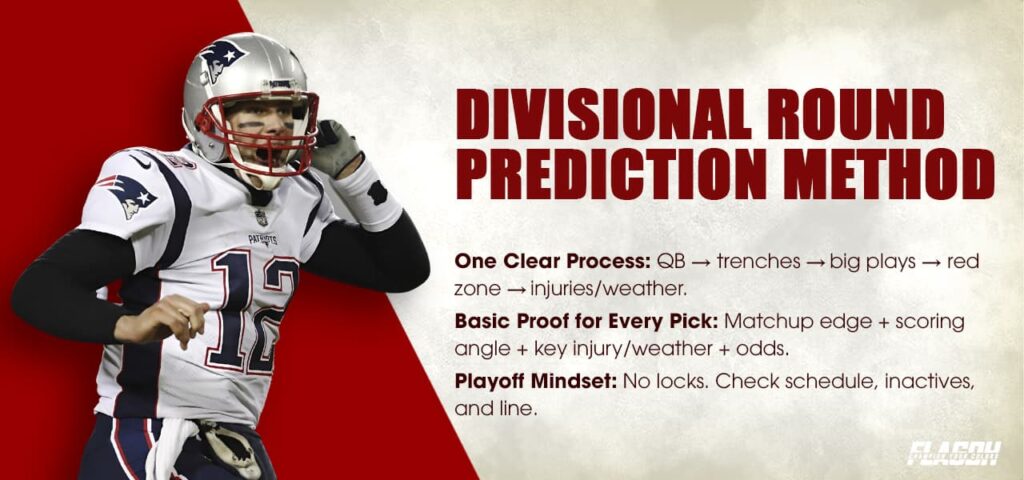
We read every playoff game through the same lens, so emotion doesn’t creep in. First comes the quarterback—decision-making under pressure matters more in January than arm talent alone. Next is the trench battle: who can create pressure without blitzing, and who can protect well enough to stay on schedule.
From there, we look at explosive plays, not as a stat dump but as a question: which team can score without needing 12 perfect plays? Red-zone finishing comes next, because touchdowns versus field goals decide tight playoff games. Injuries and weather come last, not because they’re unimportant, but because they work best as confidence modifiers, not primary arguments. For example, if wind spikes late, we downgrade deep-shot reliance and care more about red-zone finishing than raw yardage.
What We Require Before Making a Pick
Every pick in this article is backed by the same baseline: one trench or pressure point, one explosive or red-zone angle, one injury or weather note if relevant, and an odds snapshot with timing context. Playoff football has variance—turnovers especially—so there’s no “lock” language here. The goal is probability, not certainty.
Verify in 30 Seconds
For a quick safety check, confirm the schedule, inactives, and the current line. That covers the updates that most often change a Divisional Round read.
It’s also the quickest way to sanity-check NFL playoff predictions, divisional round, without opening ten tabs.
AFC Divisional Round Predictions
The AFC matchups this week feel like two different tests of discipline. One game is about controlling pace and surviving late-game variance, while the other is shaped by a low-total script where field position and red-zone execution matter more than style points.
Bills at Broncos — My Pick: Broncos
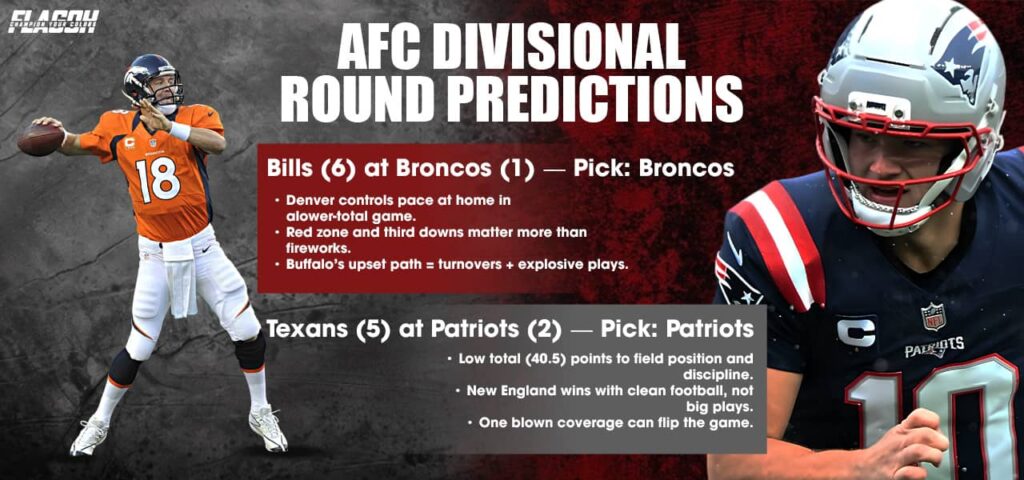
This is a game about control more than fireworks. Denver, as the No. 1 seed at home, is in the best position to dictate pace. With the total sitting in the mid-40s, this matchup profiles as a red-zone and third-down game rather than a track meet. In those spots, we tend to trust the team that can force longer drives and limit easy scores.
The reason confidence doesn’t climb higher is simple: Josh Allen. Some quarterbacks can flip a well-read game in a single drive. If you’re backing Denver, you’re trusting the floor of the matchup, not pretending the ceiling doesn’t exist.
If Buffalo pulls the upset, it likely happens the same way most road playoff upsets do: they win the turnover margin and hit a couple of explosive plays that shorten the field. If the Bills are forced to drive all night, the margin for error tightens fast.
Texans at Patriots — My Pick: Patriots
The first thing I notice here is the total. 40.5 signals a game where field position and red-zone execution matter more than raw offensive efficiency. In low-scoring playoff games, the team that avoids short fields and accepts “ugly wins” usually has the edge.
That’s why we lean Patriots at home. Their winning script doesn’t require highlight drives—just discipline, punts that flip the field, and touchdowns when opportunities appear. Houston absolutely has a path to win, but it depends on playing a very clean game and stealing a short field or two.
The danger spot in any low-total game is a single blown coverage. One explosive touchdown doesn’t just add points; it flips the entire rhythm of the night.
NFC Divisional Round Predictions
The NFC side usually comes down to control versus chaos. These two matchups look different on paper, but both hinge on whether the favorite can play clean football and avoid the few moments that swing a playoff game.
49ers at Seahawks — My Pick: Seahawks
Divisional matchups tend to compress outcomes, and that’s especially true in the playoffs. Seattle, as the top seed, doesn’t need to dominate—just control. That usually means limiting big plays, leaning on defense, and turning red-zone trips into touchdowns rather than field goals.
The large spread doesn’t increase confidence for us; it just hints at how the market views the overall matchup. The actual game can still feel tight deep into the fourth quarter. If San Francisco wants to steal this one, the formula is straightforward: slow the pace and win in the red zone to keep it a one-score game as long as possible.
Rams at Bears — My Pick: Rams
When a team is favored on the road in the playoffs, it’s usually because the market sees them as the cleaner operation. That’s how we read this matchup. With a higher total, we’re more comfortable backing the team we trust to create points without relying on turnovers.
Chicago’s upset path is real, though. Takeaways plus a few explosive plays can erase efficiency gaps quickly. The reason this stays at medium confidence is tempo and weather—anything that makes the game sloppier increases variance, and variance favors underdogs.
Upset Alerts and Late-Game Flip Factors
Upsets in the Divisional Round aren’t mysterious. Buffalo flips Denver by winning turnovers and manufacturing short fields. Houston flips New England by forcing red-zone stalls and stealing possessions. San Francisco keeps Seattle uncomfortable by slowing the game and maximizing limited chances. Chicago flips Los Angeles by pairing takeaways with explosive scores.
As for when to actually change a pick, it usually takes one of three things: a surprise inactive at quarterback, offensive line, or corner; a meaningful jump in wind that affects the passing and kicking game; or a significant line move tied to real news rather than speculation.
A Note on Score Predictions
You’ll see score types here instead of exact numbers. Saying “24–20 type” or “23–17 type” describes the shape of the game—pace, red-zone weight, explosive reliance—without pretending precision exists where it usually doesn’t in January.
Once you’ve locked your pick after the final inactive check, the next step is simple: set up your watch space so it feels like game day.
Game-Day Flags
If you’re setting up for kickoff, a flag is one of the fastest ways to make the space feel like game day. Here’s what actually matters when you choose one and hang it so it looks clean, holds up in the weather, and stays easy to manage—exactly how we think about outdoor builds at FlagOh.
Flag Materials That Hold Up on Game Day
If you’re flying a flag on game day, the print isn’t the only thing that matters. Polyester is popular for bold color and durability, while nylon tends to fly lighter in the wind. Outdoor use always brings UV fade over time, so many fans hang flags during the game and take them down afterward.
Construction details matter more than most people expect. Reinforced headers, double stitching, and the right mounting choice—grommets or a sleeve—make a big difference. Standard sizes like 3×5 ft for house flags or 12×18 in for garden flags are easiest to work with.
Fast Setup, Clean Look
The simplest setups usually look the best. One clean mounting point, hung straight, creates more game-day energy than cluttered décor. It’s quick, intentional, and works whether you’re hosting or just watching with family.
What Fans Ask About Divisional Round Picks
Before you lock in your picks, here are the quick questions fans ask every Divisional Round. These answers are meant to clear up the common “last-minute doubts” so you can decide faster and avoid second-guessing right before kickoff.
How do you make NFL divisional round predictions quickly?
By starting with a picks table, then filtering each game through quarterback play, trench matchups, explosive potential, red-zone execution, and injury or weather context.
What stats matter most in the divisional round?
Pressure versus protection, explosive plays, and red-zone finishing usually define how these games break.
How much do injuries change playoff picks?
They matter most at quarterback, offensive line, and cornerback. A single change there can lower confidence immediately.
Does wind affect passing and totals?
Yes. Wind disrupts deep throws and kicking more reliably than temperature alone and increases variance.
What do spread, moneyline, and total mean?
Moneyline is simply who wins. Spread balances teams with points. The total is the combined score of both teams.
When should I check inactives on game day?
About 90 minutes before kickoff, then again if late news breaks.
Why do key numbers like 3 and 7 matter?
They’re common NFL margins, so lines moving across them are more meaningful than minor shifts.
What are common upset signs in the divisional round?
Underdogs winning the turnover battle, finishing drives in the red zone, and controlling the pace.
What flag material is best for windy game days?
A sturdy build with reinforced stitching and the right mounting method matters more than fabric alone.
To use NFL divisional round predictions well, lock your pick after the final inactive check. Then, when you’re ready for game-day atmosphere, explore FlagOh for flags built to match your space and local weather.