
 Arizona Cardinals Flag
 Atlanta Falcons Flag
 Baltimore Ravens Flag
 Buffalo Bills Flag
 Carolina Panthers Flag
 Chicago Bears Flag
 Cincinnati Bengals Flag
 Cleveland Browns Flag
 Dallas Cowboys Flag
 Denver Broncos Flag
 Detroit Lions Flag
 Green Bay Packers Flag
 Houston Texans Flag
 Indianapolis Colts Flag
 Jacksonville Jaguars Flag
 Kansas City Chiefs Flag
 Las Vegas Raiders Flag
 Los Angeles Chargers Flag
 Los Angeles Rams Flag
 Miami Dolphins Flag
 Minnesota Vikings Flag
 New England Patriots Flag
 New Orleans Saints Flag
 New York Giants Flag
 New York Jets Flag
 Philadelphia Eagles Flag
 Pittsburgh Steelers Flag
 San Francisco 49ers Flag
 Seattle Seahawks Flag
 Tampa Bay Buccaneers Flag
 Tennessee Titans Flag
 Washington Commanders Flag
 Arizona Diamondbacks Flag
 Atlanta Braves Flag
 Baltimore Orioles Flag
 Boston Red Sox Flag
 Chicago Cubs Flag
 Chicago White Sox Flag
 Cincinnati Reds Flag
 Cleveland Guardians Flag
 Colorado Rockies Flag
 Detroit Tigers Flag
 Houston Astros Flag
 Kansas City Royals Flag
 Los Angeles Angels Flag
 Los Angeles Dodgers Flag
 Miami Marlins Flag
 Milwaukee Brewers Flag
 Minnesota Twins Flag
 New York Mets Flag
 New York Yankees Flag
 Oakland Athletics Flag
 Philadelphia Phillies Flag
 Pittsburgh Pirates Flag
 San Diego Padres Flag
 San Francisco Giants Flag
 Seattle Mariners Flag
 St. Louis Cardinals Flag
 Tampa Bay Rays Flag
 Texas Rangers Flag
 Toronto Blue Jays Flag
 Washington Nationals Flag
 Atlanta Hawks Flag
 Boston Celtics Flag
 Brooklyn Nets Flag
 Charlotte Hornets Flag
 Chicago Bulls Flag
 Cleveland Cavaliers Flag
 Dallas Mavericks Flag
 Denver Nuggets Flag
 Detroit Pistons Flag
 Golden State Warriors Flag
 Houston Rockets Flag
 Indiana Pacers Flag
 LA Clippers Flag
 Los Angeles Lakers Flag
 Memphis Grizzlies Flag
 Miami Heat Flag
 Milwaukee Bucks Flag
 Minnesota Timberwolves Flag
 New Orleans Pelicans Flag
 New York Knicks Flag
 Oklahoma City Thunder Flag
 Orlando Magic Flag
 Philadelphia 76ers Flag
 Phoenix Suns Flag
 Portland Trail Blazers Flag
 Sacramento Kings Flag
 San Antonio Spurs Flag
 Toronto Raptors Flag
 Utah Jazz Flag
 Washington Wizards Flag
 Anaheim Ducks Flag
 Arizona Coyotes Flag
 Boston Bruins Flag
 Buffalo Sabres Flag
 Calgary Flames Flag
 Carolina Hurricanes Flag
 Chicago Blackhawks Flag
 Colorado Avalanche Flag
 Columbus Blue Jackets Flag
 Dallas Stars Flag
 Detroit Red Wings Flag
 Edmonton Oilers Flag
 Florida Panthers Flag
 Los Angeles Kings Flag
 Minnesota Wild Flag
 Montreal Canadiens Flag
 Nashville Predators Flag
 New Jersey Devils Flag
 New York Islanders Flag
 New York Rangers Flag
 Ottawa Senators Flag
 Philadelphia Flyers Flag
 Pittsburgh Penguins Flag
 San Jose Sharks Flag
 Seattle Kraken Flag
 St. Louis Blues Flag
 Tampa Bay Lightning Flag
 Toronto Maple Leafs Flag
 Vancouver Canucks Flag
 Vegas Golden Knights Flag
 Washington Capitals Flag
 Winnipeg Jets Flag
News
New York Giants vs New Orleans Saints Stats Breakdown
If you’re searching for New York Giants vs New Orleans Saints stats, you want the numbers fast, and you want them to mean something. This page begins with tables, followed by a brief context that explains the swing. This quick-read format is how we publish matchup breakdowns at FlagOh, with tables first and explanations second.
Quick context: the all-time series has been close overall, so avoid treating any one result as the “identity” of the matchup, which is a good reminder that “curses” aren’t permanent. What is real is how games tilt in New Orleans: noise, pace, and one or two mistakes becoming instant points.
Historical Outliers and Scoring Trends Using Stats Not Myths
If you’re reading New York Giants vs New Orleans Saints stats for context (not just the latest box score), the goal here is simple: separate the rare outliers from the repeatable patterns.
Recent Head-to-Head Meetings from 2018 to 2025
| Year | Site | Final | Total Points | Notable stat hook |
| 2018 | @ Giants | Saints 33–18 | 51 | The Saints pulled away late behind a run-driven second-half surge |
| 2021 | @ Saints | Giants 27–21 (OT) | 48 | Giants stole it in OT after surviving long stretches of pressure/noise |
| 2023 | @ Saints | Saints 24–6 | 30 | Saints’ defense controlled the game (the “seven sacks” headline) |
| 2024 | @ Giants | Saints 14–11 | 25 | A late special-teams/pressure moment decided a one-score grind |
| 2025 | @ Saints | Saints 26–14 | 40 | A turnover avalanche (+5) plus a return TD flipped the script |
What this table really shows isn’t “who always wins.” It’s the range of game types: this matchup can swing from normal scoring to low-scoring chaos when pressure, giveaways, and field position take over.
The 2015 Shootout That Stands Alone
The famous outlier is the 2015 game: Saints 52–49 Giants for 101 total points. That’s the reminder that NFL outcomes can spike into chaos when three things hit at once: pace, explosive plays, and late-game decision-making. It’s also why you shouldn’t treat one extreme result as the “identity” of the matchup.
In other words: 2015 happened—but it’s not the baseline.
The Real Reasons Totals Have Come Down
Recent meetings look nothing like the 2015 track meet. Just scanning the totals above—51, 48, 30, 25, 40—you can see why “Under” talk popped up. But here’s the important part: totals are the end product, not the cause.
The causes that tend to push this matchup downward are practical:
- Protections get simplified
- Late audibles disappear
- Timing becomes the priority
Best-practice warning: don’t treat a five-game totals sample as a system. Different QBs, different play-callers, different roster strengths—same helmets.
What Tends to Hold Up Better Than Totals
If you want the most reliable way to read Giants–Saints without overfitting, track these first:
- Turnover margin (it’s the fastest way a close yardage game becomes a multi-score game)
- Pressure indicators (sacks/negative plays that force punts and shorten drives)
- 3rd down + red zone efficiency (the “stay on the field” + “finish drives” combo)
- Explosive plays (20+ yard swings) (one long TD can break a game that otherwise looks slow)
Those are the metrics that explain why the score landed where it did—whether the total ends up looking like a grind or a shootout.
New York Giants vs New Orleans Saints Stats on One Screen
If you only have 10 seconds for New York Giants vs New Orleans Saints stats, this snapshot is the cleanest read of the 2025 meeting. For a quick read, start with turnover margin and third-down rate, then use red-zone trips to see why drives ended in points or punts.
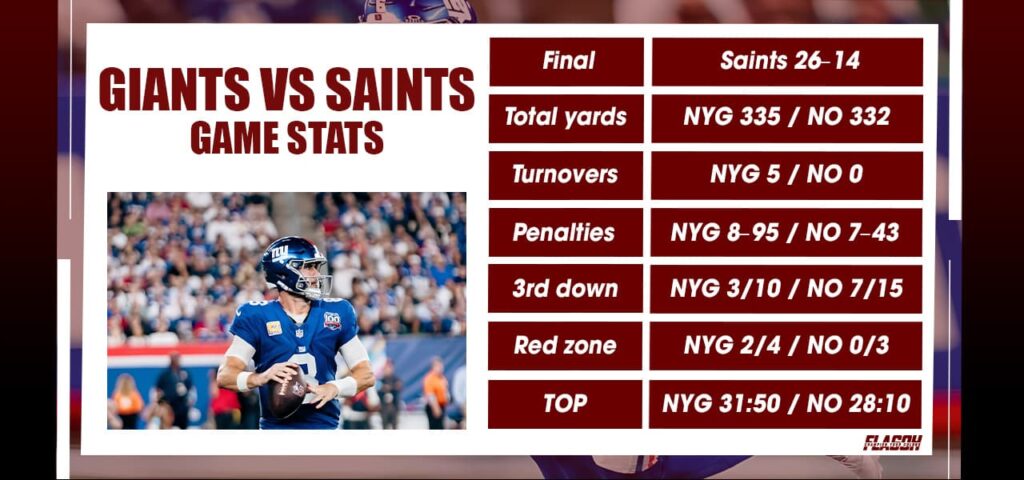
Featured Snippet Table:
| Final | Total yards | Turnovers | Penalties–yds | 3rd down | Red zone | TOP(time of possession) |
| Saints 26–14 | NYG 335 / NO 332 | NYG 5 / NO 0 | NYG 8–95 / NO 7–43 | NYG 3/10 / NO 7/15 | NYG 2/4 / NO 0/3 | NYG 31:50 / NO 28:10 |
How to read this fast (what the stats actually explain): Start with turnover margin, then check third down and red zone to see whether drives ended in points or punts. Use the player leaders below to connect the story to specific plays.
How the 2025 Game Turned Into a Turnover Story
The story of this game isn’t complicated: New York moved the ball enough to keep it interesting, but the Saints kept getting extra possessions and short fields.
QB efficiency snapshot (stat lines that matter)
The clean takeaway: New Orleans protected the ball, and New York didn’t—so the margin disappeared fast.
| QB | Comp% | Yards | TD–INT | Sacks | Rating |
| Jaxson Dart (NYG) | 65.0% | 202 | 2–2 | 1 | 73.1 |
| Spencer Rattler (NO) | 67.7% | 225 | 1–0 | 0 | 99.5 |
The simplest “watch-the-game-again” interpretation: Rattler avoided the killer mistake, while the Giants didn’t have enough margin for error to survive multiple giveaways.
The swing play that turned the whole mood
Every turnover game has a “lever” moment—the one snap where the crowd gets louder, play calls get tighter, and the trailing team starts pressing.
In 2025, it was an 86-yard fumble return TD by Jordan Howden. After that, you could feel the game become less about “who’s moving the ball” and more about “who’s protecting it.”
Situational mini-table (the four lines that decide most close games)
If the total yards look close, these situational numbers explain why the score wasn’t.
| Situation | Giants | Saints |
| Turnovers | 5 | 0 |
| 3rd down | 3/10 | 7/15 |
| Penalties–yds | 8–95 | 7–43 |
| Red zone TD/trips | 2/4 | 0/3 |
If you’re trying to explain why the total yards were nearly identical, these are your reasons.
Why the Superdome Can Disrupt Road Offenses
Indoors, the margin for communication errors shrinks. One late shift or missed protection call can turn a normal drive into a sack, a false start, or a rushed throw.
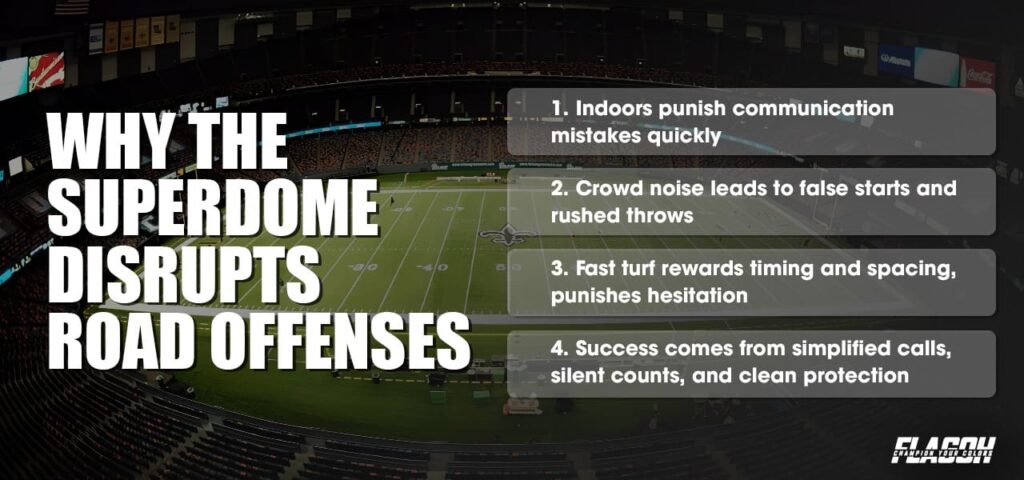
Noise and pre-snap errors (why false starts happen): Indoors, communication errors get punished faster. Offenses lean on silent count mechanics and simpler checks, which can raise the chance of procedural penalties and rushed throws.
Turf speed and timing (why it can feel like a “track”): The faster indoor surface can make timing feel quicker, which rewards clean spacing and punishes hesitation—especially for road offenses adjusting to noise.
Best practices teams use indoors (so this isn’t a myth section)
Good road plans indoors tend to look boring:
- Silent count mechanics drilled all week
- Wristband calls and condensed terminology
- Selective tempo to keep the crowd from timing the snap count.
- Protection rules that favor clarity over complexity
Reality check: the Giants have won in New Orleans before (including an OT win), so don’t treat “Superdome curse” as destiny. Treat it as a context that punishes sloppiness.
2025 Player Leaders and Team Box Score for Fast Scanning
If you came here for the New York Giants vs New Orleans Saints match player stats, this section makes it easy to grab the leaders at a glance without bouncing between five different tabs.
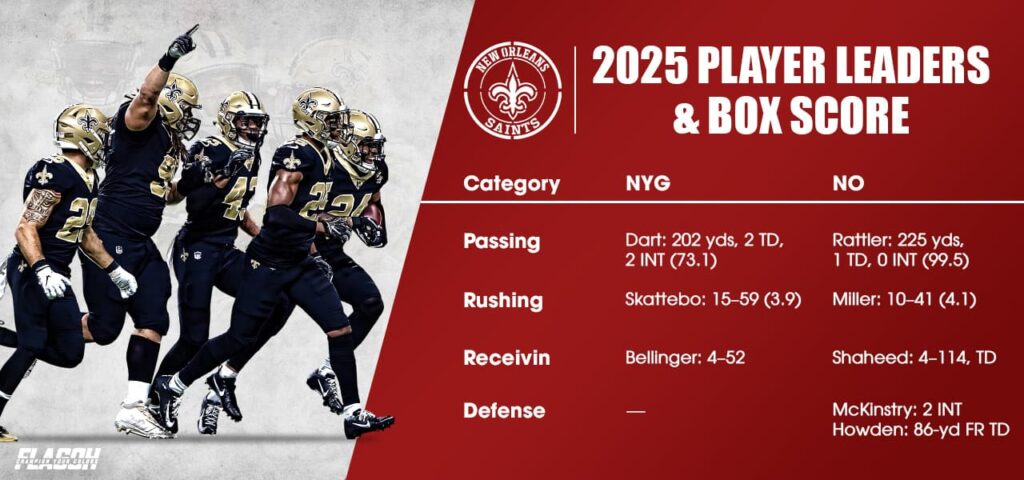
Player leaders (2025)
Passing
| Team | QB | C/ATT | YDS | TD | INT | RTG |
| NYG | Jaxson Dart | 26/40 | 202 | 2 | 2 | 73.1 |
| NO | Spencer Rattler | 21/31 | 225 | 1 | 0 | 99.5 |
Rushing
| Team | Player | CAR | YDS | AVG |
| NYG | Cam Skattebo | 15 | 59 | 3.9 |
| NO | Kendre Miller | 10 | 41 | 4.1 |
Receiving
| Team | Player | REC | YDS | TD | LONG |
| NYG | Daniel Bellinger | 4 | 52 | 0 | 18 |
| NO | Rashid Shaheed | 4 | 114 | 1 | 87 |
Defense (impact)
| Player | Team | Impact note |
| Kool-Aid McKinstry | NO | 2 interceptions |
| Jordan Howden | NO | 86-yard fumble return TD |
Team box score
This adds what the snapshot table doesn’t show cleanly: play volume and pass/rush split.
| Team | Plays | Pass Yds | Rush Yds | Total Yds | Yds/Play |
| Giants | 70 | 199 | 136 | 335 | 4.8 |
| Saints | 62 | 244 | 88 | 332 | 5.4 |
New York Giants vs New Orleans Saints stats come down to a familiar formula in 2025—clean ball security, situational efficiency, and one swing play mattered more than yardage. For a true split-household setup, FlagOh House Divided options let you represent both sides in one clean display.