
 Arizona Cardinals Flag
 Atlanta Falcons Flag
 Baltimore Ravens Flag
 Buffalo Bills Flag
 Carolina Panthers Flag
 Chicago Bears Flag
 Cincinnati Bengals Flag
 Cleveland Browns Flag
 Dallas Cowboys Flag
 Denver Broncos Flag
 Detroit Lions Flag
 Green Bay Packers Flag
 Houston Texans Flag
 Indianapolis Colts Flag
 Jacksonville Jaguars Flag
 Kansas City Chiefs Flag
 Las Vegas Raiders Flag
 Los Angeles Chargers Flag
 Los Angeles Rams Flag
 Miami Dolphins Flag
 Minnesota Vikings Flag
 New England Patriots Flag
 New Orleans Saints Flag
 New York Giants Flag
 New York Jets Flag
 Philadelphia Eagles Flag
 Pittsburgh Steelers Flag
 San Francisco 49ers Flag
 Seattle Seahawks Flag
 Tampa Bay Buccaneers Flag
 Tennessee Titans Flag
 Washington Commanders Flag
 Arizona Diamondbacks Flag
 Atlanta Braves Flag
 Baltimore Orioles Flag
 Boston Red Sox Flag
 Chicago Cubs Flag
 Chicago White Sox Flag
 Cincinnati Reds Flag
 Cleveland Guardians Flag
 Colorado Rockies Flag
 Detroit Tigers Flag
 Houston Astros Flag
 Kansas City Royals Flag
 Los Angeles Angels Flag
 Los Angeles Dodgers Flag
 Miami Marlins Flag
 Milwaukee Brewers Flag
 Minnesota Twins Flag
 New York Mets Flag
 New York Yankees Flag
 Oakland Athletics Flag
 Philadelphia Phillies Flag
 Pittsburgh Pirates Flag
 San Diego Padres Flag
 San Francisco Giants Flag
 Seattle Mariners Flag
 St. Louis Cardinals Flag
 Tampa Bay Rays Flag
 Texas Rangers Flag
 Toronto Blue Jays Flag
 Washington Nationals Flag
 Atlanta Hawks Flag
 Boston Celtics Flag
 Brooklyn Nets Flag
 Charlotte Hornets Flag
 Chicago Bulls Flag
 Cleveland Cavaliers Flag
 Dallas Mavericks Flag
 Denver Nuggets Flag
 Detroit Pistons Flag
 Golden State Warriors Flag
 Houston Rockets Flag
 Indiana Pacers Flag
 LA Clippers Flag
 Los Angeles Lakers Flag
 Memphis Grizzlies Flag
 Miami Heat Flag
 Milwaukee Bucks Flag
 Minnesota Timberwolves Flag
 New Orleans Pelicans Flag
 New York Knicks Flag
 Oklahoma City Thunder Flag
 Orlando Magic Flag
 Philadelphia 76ers Flag
 Phoenix Suns Flag
 Portland Trail Blazers Flag
 Sacramento Kings Flag
 San Antonio Spurs Flag
 Toronto Raptors Flag
 Utah Jazz Flag
 Washington Wizards Flag
 Anaheim Ducks Flag
 Arizona Coyotes Flag
 Boston Bruins Flag
 Buffalo Sabres Flag
 Calgary Flames Flag
 Carolina Hurricanes Flag
 Chicago Blackhawks Flag
 Colorado Avalanche Flag
 Columbus Blue Jackets Flag
 Dallas Stars Flag
 Detroit Red Wings Flag
 Edmonton Oilers Flag
 Florida Panthers Flag
 Los Angeles Kings Flag
 Minnesota Wild Flag
 Montreal Canadiens Flag
 Nashville Predators Flag
 New Jersey Devils Flag
 New York Islanders Flag
 New York Rangers Flag
 Ottawa Senators Flag
 Philadelphia Flyers Flag
 Pittsburgh Penguins Flag
 San Jose Sharks Flag
 Seattle Kraken Flag
 St. Louis Blues Flag
 Tampa Bay Lightning Flag
 Toronto Maple Leafs Flag
 Vancouver Canucks Flag
 Vegas Golden Knights Flag
 Washington Capitals Flag
 Winnipeg Jets Flag
News
Motorsport Flags Meaning by Color, Use, and Racing Series
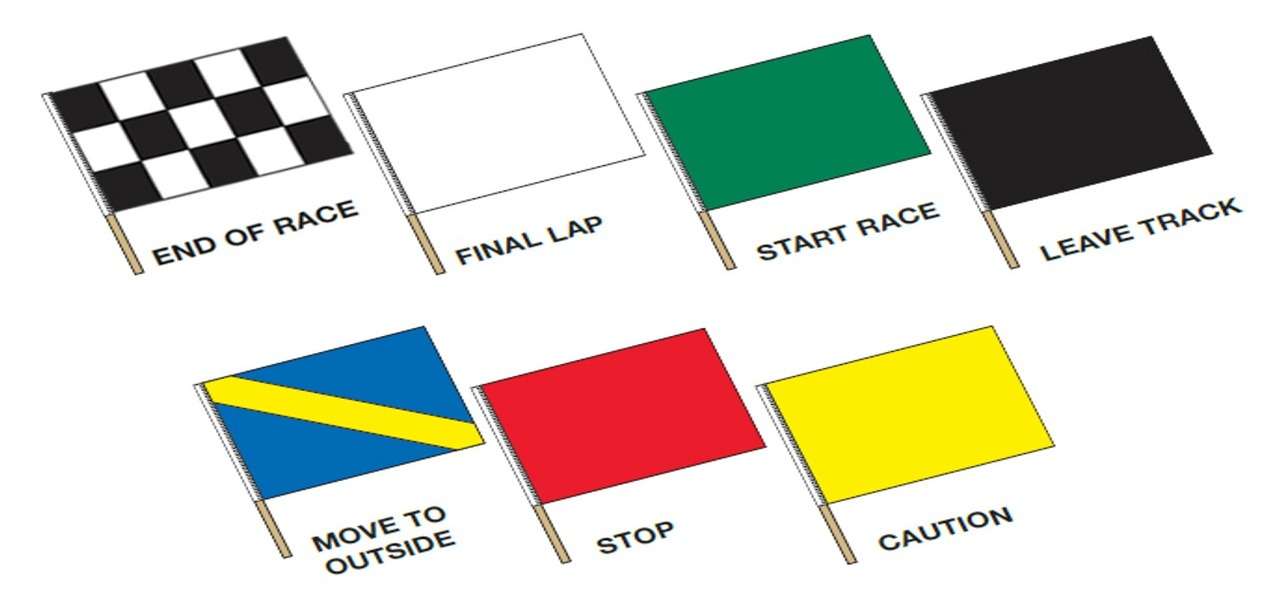
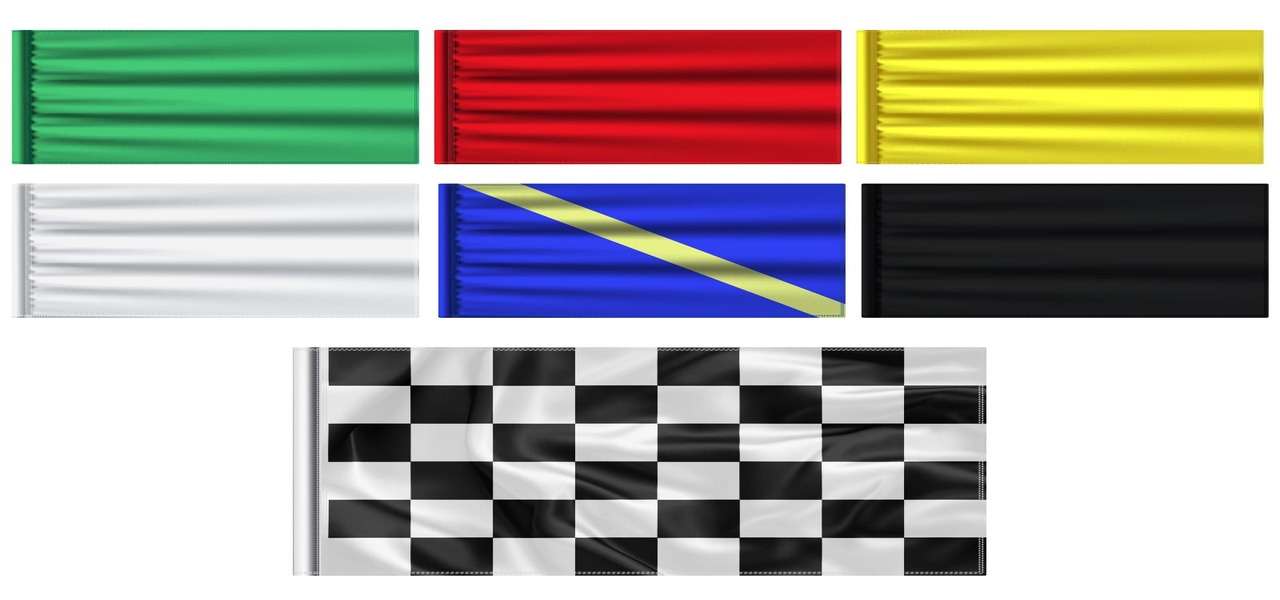
Motorsport flags are visual race-control signals that tell drivers when to keep racing, slow down, stop, yield, or respond to changing track conditions. The most common motorsport flags include green, yellow, double yellow, red, blue, black, white, red-and-yellow striped, and checkered.
While the core meanings are widely recognized, the exact way motorsport flags are enforced can vary across Formula 1, NASCAR, MotoGP, WEC, IndyCar, and other racing series. In this FlagOh guide, you will learn what each flag means, how drivers respond, which signals fans often confuse, and how race control changes from one championship to another.
What Motorsport Flags Are and Why They Still Matter
Motorsport flags remain one of the clearest ways for race control to communicate with drivers during a session. They can warn of danger, confirm clear conditions, order an immediate response, or mark the end of track action. Even in an era of team radio, dashboard alerts, and digital marshal panels, flags still matter because they provide direct visual information that is easy to recognize in real time.
Fans should also understand that a cloth flag, a digital light panel, and a race-control board do not always serve the same purpose. A yellow flag may warn of a local hazard, while a Safety Car board can signal a race-wide neutralization. That distinction makes the motorsport flag much easier to read during a live event.
The Core Motorsport Flags and What Each One Means
Here are the main flags used in racing, along with what each one means in practice.
Green flag
Core meaning: The track is clear, or the session is starting or restarting.
Typical driver response: Resume racing speed and normal overtaking.
Common fan misunderstanding: Some viewers think green only appears at the race start, but it is also used to show that a caution zone has ended.
Where it usually appears: Start sequence, restart points, and the first marshal post after a local caution.
Yellow flag
Core meaning: There is danger ahead.
Typical driver response: Slow down, do not overtake, and be prepared for changing conditions.
Common fan misunderstanding: Fans sometimes assume every yellow means the whole race has been neutralized. In many series, a single yellow is local, not full-course.
Where it usually appears: Corner marshal posts or digital panels near the affected sector.
Double yellow flag
Core meaning: A more serious hazard is ahead, often with a stopped car or marshals near the racing line.
Typical driver response: Reduce speed further and be ready to stop if necessary.
Common fan misunderstanding: Some viewers treat double yellow as just a stronger caution without realizing it signals a much more dangerous situation.
Where it usually appears: At the marshal posts in the sector with the incident.
Red flag
Core meaning: The session or race is stopped.
Typical driver response: Slow immediately and follow instructions from race control.
Common fan misunderstanding: People often think a red flag always ends the race. In many cases, the session may resume later.
Where it usually appears: At all marshal posts, on light panels, and through official race-control systems.
Blue flag
Core meaning: A faster car is approaching, usually to lap a slower one.
Typical driver response: Allow the faster car through safely when required by the series rules.
Common fan misunderstanding: Many new viewers think the blue flag is identical across all championships. It is not. In F1, it is more strictly enforced than in some American racing contexts.
Where it usually appears: Marshal posts, light panels, and sometimes at the pit exit.
Black flag
Core meaning: A driver is disqualified or summoned to the pits for a serious issue or penalty.
Typical driver response: Return to the pit lane as instructed.
Common fan misunderstanding: Fans sometimes confuse a black flag with a general warning. It is far more serious than that.
Where it usually appears: Start-finish area, race-control boards, and official timing systems.
Black and orange flag
Core meaning: The car has a mechanical problem that may be dangerous.
Typical driver response: Pit for repairs immediately.
Common fan misunderstanding: Casual viewers may not realize this flag is often about loose bodywork, fluid leaks, or visible safety defects.
Where it usually appears: Start-finish line and official race-control displays.
Black and white diagonal flag
Core meaning: Warning for unsporting or unacceptable driving behavior.
Typical driver response: Correct behavior immediately or risk a harsher penalty next.
Common fan misunderstanding: Some viewers assume this is a penalty by itself. It is usually a formal warning.
Where it usually appears: Start-finish area and race-control message systems.
White flag
Core meaning: Usually signals a slow vehicle on track, though usage varies by series.
Typical driver response: Expect a speed differential ahead and proceed with caution.
Common fan misunderstanding: Many fans associate the white flag only with the final lap because of American oval racing, but that is not universal.
Where it usually appears: Marshal posts and series-specific signaling points.
Red and yellow striped flag
Core meaning: Reduced grip due to oil, debris, moisture, or another slippery condition.
Typical driver response: Adjust speed and approach the affected area carefully.
Common fan misunderstanding: Viewers sometimes mistake it for a general caution, but it specifically warns about surface conditions.
Where it usually appears: Marshal posts at the relevant section of the track.
Checkered flag
Core meaning: The session has ended.
Typical driver response: Complete the lap under end-of-session procedures.
Common fan misunderstanding: Fans often think the checkered flag always means the end of the full race weekend, but it can also end practice, qualifying, or a stage in some series.
Where it usually appears: Start-finish line.
Signals That Fans Often Confuse with Flags
Not every trackside signal is a traditional flag. Some systems, such as Safety Car boards, Virtual Safety Car procedures, pit boards, and penalty boards, support race control in different ways. Fans often confuse them with standard motorsport flags because they can change strategy and race flow just as strongly.
Safety Car board
The Safety Car board signals that the field is being controlled behind the Safety Car. This is not just a warning about a local sector. It changes the entire race environment and affects gaps, pit strategy, and restarts.
Virtual Safety Car
A Virtual Safety Car, or VSC, slows the field without deploying a physical Safety Car. Drivers must follow a regulated pace or delta. Fans sometimes confuse VSC with a local yellow because both reduce speed, but the VSC applies more broadly.
Full-Course Yellow
Common in some series, the Full-Course Yellow neutralizes the entire field. Unlike a local yellow, it affects the race globally and often changes pit timing and track position strategy.
Code 60
Code 60 is used in some endurance and club-level contexts to impose a strict speed limit across the track or in a specific control area. It is not simply another name for the Safety Car. It is its own neutralization tool.
Slow Zones
Slow Zones are often used in endurance racing to neutralize only part of the track while the rest remains green. This is one of the main reasons endurance racing can look confusing to new viewers. Not every caution affects every section equally.
Pit closed / pit open boards
These boards tell drivers whether the pit lane may be used under current race conditions. They do not signal track danger directly, but they can dramatically affect race strategy and penalties.
Drive-through and stop-go boards
These boards communicate specific penalties. A drive-through requires the car to enter the pit lane and continue without stopping. A stop-go penalty requires a full stop, sometimes for a fixed number of seconds. Fans often notice the penalty after the fact without realizing how clearly it was already signaled.
How Motorsport Flags Differ Across Major Racing Series
The same flag colors may appear across many championships, but the way they are enforced can change from one series to another. That is why fans should learn both the universal meanings and the race-control habits of the championship they follow most closely.
Formula 1 and FIA circuit racing
In Formula 1 and many FIA-governed events, local yellows, double yellows, Safety Car, and Virtual Safety Car are all clearly structured. Blue flags are taken seriously, especially for lapped traffic. F1 viewers should pay close attention to sector indicators, delta-based systems, and the distinction between local caution and race-wide control.
NASCAR
NASCAR uses a race-control style that often feels more centralized and less local than F1. Full-course cautions are a bigger part of the show, and the white flag is famously used to indicate the final lap. NASCAR viewers should watch how cautions bunch the field, reshape pit calls, and influence stage endings and restart dynamics.
MotoGP
MotoGP shares many familiar flag meanings, but bike racing adds extra importance to surface conditions, rider visibility, and immediate hazard response. Wet-weather signals and rider-safety messaging are especially important. Viewers should focus on how track conditions, crashes, and rider exposure influence caution decisions.
WEC and endurance racing
Endurance racing can be more complex because multiple classes share the track, and cautions may be applied selectively. Slow Zones, Code 60 systems, and multi-class traffic make interpretation harder than in shorter single-class formats. WEC viewers should focus on where the caution is active, not just whether one exists.
IndyCar
IndyCar combines road-course and oval traditions, so flag interpretation can feel mixed to newer fans. Full-course yellows matter a lot, restarts are highly strategic, and race-control decisions can be race-defining. Fans should pay special attention to restart procedures and pace management.
Rally and WRC
Rally works differently from circuit racing, so signaling is used less as a constant trackside system and more as situational race control. WRC viewers should keep in mind that the logic changes when competition is spread across stages rather than one permanent circuit.
How to Read Motorsport Flags During a Race
Reading these signals in real time becomes much easier once you know what to watch for during live race conditions.
What to watch first on TV
Start with the broadcast graphic, then match it to what is happening on track. TV usually tells you whether a sector is yellow, whether a Safety Car is deployed, or whether the session has stopped. Once you know the general state, trackside visuals make more sense.
How to read a local yellow versus a full-course neutralization
A local yellow affects only a part of the circuit. Drivers slow in that sector, then resume racing once clear. A full-course neutralization changes the conditions for everyone. That difference matters because it shapes overtaking, pit timing, and tire strategy.
How to tell when a caution zone begins and ends
A caution zone begins where the yellow is shown and ends where the green is displayed again. New viewers often assume the danger lasts until the visible incident has passed, but the official signal points matter more than what the camera shows.
How blue flags are used across different series
Blue flags are most strictly associated with lapped traffic management. In F1, ignoring blue flags can lead to penalties. In other series, the application may be looser or shaped by different race formats. Always read the blue flag through the lens of the series you are watching.
How pit-lane boards affect the race
Pit-lane boards may not look as dramatic as a yellow or red flag, but they can decide race outcomes. A pit-closed board can ruin a strategy call. A drive-through board can destroy track position. Fans who learn to notice these signals understand racing at a deeper level.
Motorsport Flags in Wet Weather, Incidents, and Restarts
When conditions change quickly, race control uses different signals to warn drivers, manage incidents, and handle the restart.
Flags used when the grip changes
When the surface becomes slippery because of rain, oil, or debris, race control may use the red-and-yellow striped flag or broader caution systems depending on severity. The goal is to warn drivers before grip loss becomes an incident.
Flags used after crashes or stalled vehicles
A single yellow may cover a smaller incident. A double yellow or a red flag may be needed if the risk is greater, especially when marshals are exposed, or the car is in a dangerous position.
Restart procedures and why they vary
Restarts differ because each series has its own traditions, technical rules, and competitive philosophy. Some rely on a restart zone. Others use controlled formations or race-control timing. The flag colors may look familiar, but restart execution can be very different.
How marshals and race control communicate escalating danger
Danger is not always communicated in a single step. A local yellow may become a double yellow, then a Safety Car, then a red flag, depending on how the incident develops. That progression is one reason flags remain essential. They allow race control to scale the warning level in real time.
Pit-Lane and Trackside Signaling Explained
Pit-lane and trackside signals do more than guide drivers. They also shape strategy, penalties, and race execution.
Pit entry and pit exit signals
Pit entry and exit are controlled because they involve traffic merging at different speeds. A blue signal at the pit exit, or an official light/board, helps prevent unsafe releases and dangerous rejoins.
Penalty boards
Penalty boards communicate race-control decisions directly to a specific competitor. They are often shown with the car number and the required action. Learning to spot them helps fans understand why a driver suddenly loses positions.
Light panels versus cloth flags
Light panels are easier to see in poor visibility and can be synchronized quickly across the circuit. Cloth flags still provide tradition, immediacy, and visual clarity in many situations. In modern racing, the two systems often work together.
Why pit-lane signaling matters for race outcomes
Pit-lane signals affect strategy, penalties, and clean execution. A driver can lose a podium through a pit-lane infraction just as easily as through a spin or bad tire call. Fans who ignore pit-lane signaling miss a major part of how races are won and lost.
A Brief History of Motorsport Flags
These signals have evolved with the sport, but they remain part of modern race control for good reason.
Where flag signaling began
Flag signaling developed in the early days of racing as a practical way to warn drivers and control sessions before electronic communication existed. It was simple, visual, and effective.
Why certain colors became standard
Colors became standard because they could be recognized quickly and assigned clear meanings. Over time, motorsport organizations formalized those meanings so that competitors and officials could work from shared expectations.
How digital systems changed modern race control
Digital marshal panels, timing systems, and radio communication made race control faster and more precise. They improved coordination across long circuits and in poor visibility. Still, the underlying logic came from the original flag system.
Why traditional flags remain important
Traditional flags remain important because they are universal, instantly understandable, and deeply embedded in motorsport culture. They connect the modern sport to its roots while continuing to serve a real operational purpose.
How Fans, New Viewers, and Trackside Spectators Can Learn Faster
For new viewers, learning a few core patterns can make race signals much easier to follow.
Best way to memorize the core flags
Start with the universal basics: green means clear, yellow means caution, red means stop, blue means yield, and checkered means finish. Once those are automatic, learn the black, white, and striped variants.
What to notice first at a live event
At a live event, watch the marshal posts, light panels, and the reaction of drivers. The cars often tell you a lot. If multiple drivers suddenly lift, stop fighting, or queue differently, a signal has likely changed.
How to avoid common interpretation mistakes
Do not assume one series uses every flag the same way. Do not treat a local yellow like a full-course caution. Do not assume the white flag always means the final lap. Context matters as much as color.
Why each series should be learned on its own terms
Each championship has its own race-control culture. Learning that context helps fans read incidents, penalties, and restarts more accurately. The smartest way to follow motorsport is to combine universal meanings with series-specific habits.
Motorsport Flags FAQ
These quick answers cover the questions readers ask most often about race-control signals and how they are used across different series.
Why do some series enforce blue flags more strictly than others?
Enforcement depends on the rules and race format of each series. In championships with dense traffic management and clear lapping rules, blue flags tend to carry more weight.
Do NASCAR and F1 use the same flags?
They share several core colors, but the application differs. NASCAR relies more on full-course cautions and uses some signals differently in practice and race management.
What happens during a red flag?
During a red flag, the session stops. Drivers must slow immediately and follow race-control instructions. Depending on the series and situation, the event may resume later.
What is the difference between VSC and Safety Car?
A VSC controls speed across the race without deploying a physical Safety Car. A full Safety Car puts an actual car on track and gathers the field behind it.
What does the black and orange flag mean?
It signals a mechanical problem that may make the car unsafe, such as loose bodywork or fluid leakage. The driver is expected to pit for repairs.
Are light panels legally equivalent to flags?
In many modern series, yes, light panels are treated as official race-control signals alongside or in support of traditional flags. The exact legal status depends on the rules of that series.
Which motorsport series uses Code 60?
Code 60 is commonly associated with endurance and club-level racing environments, where it serves as a speed-controlled neutralization method.
By understanding motorsport flags in context, fans can follow cautions, restarts, and race control with far more confidence. This FlagOh guide makes race weekends easier to read from start to finish.