
 Arizona Cardinals Flag
 Atlanta Falcons Flag
 Baltimore Ravens Flag
 Buffalo Bills Flag
 Carolina Panthers Flag
 Chicago Bears Flag
 Cincinnati Bengals Flag
 Cleveland Browns Flag
 Dallas Cowboys Flag
 Denver Broncos Flag
 Detroit Lions Flag
 Green Bay Packers Flag
 Houston Texans Flag
 Indianapolis Colts Flag
 Jacksonville Jaguars Flag
 Kansas City Chiefs Flag
 Las Vegas Raiders Flag
 Los Angeles Chargers Flag
 Los Angeles Rams Flag
 Miami Dolphins Flag
 Minnesota Vikings Flag
 New England Patriots Flag
 New Orleans Saints Flag
 New York Giants Flag
 New York Jets Flag
 Philadelphia Eagles Flag
 Pittsburgh Steelers Flag
 San Francisco 49ers Flag
 Seattle Seahawks Flag
 Tampa Bay Buccaneers Flag
 Tennessee Titans Flag
 Washington Commanders Flag
 Arizona Diamondbacks Flag
 Atlanta Braves Flag
 Baltimore Orioles Flag
 Boston Red Sox Flag
 Chicago Cubs Flag
 Chicago White Sox Flag
 Cincinnati Reds Flag
 Cleveland Guardians Flag
 Colorado Rockies Flag
 Detroit Tigers Flag
 Houston Astros Flag
 Kansas City Royals Flag
 Los Angeles Angels Flag
 Los Angeles Dodgers Flag
 Miami Marlins Flag
 Milwaukee Brewers Flag
 Minnesota Twins Flag
 New York Mets Flag
 New York Yankees Flag
 Oakland Athletics Flag
 Philadelphia Phillies Flag
 Pittsburgh Pirates Flag
 San Diego Padres Flag
 San Francisco Giants Flag
 Seattle Mariners Flag
 St. Louis Cardinals Flag
 Tampa Bay Rays Flag
 Texas Rangers Flag
 Toronto Blue Jays Flag
 Washington Nationals Flag
 Atlanta Hawks Flag
 Boston Celtics Flag
 Brooklyn Nets Flag
 Charlotte Hornets Flag
 Chicago Bulls Flag
 Cleveland Cavaliers Flag
 Dallas Mavericks Flag
 Denver Nuggets Flag
 Detroit Pistons Flag
 Golden State Warriors Flag
 Houston Rockets Flag
 Indiana Pacers Flag
 LA Clippers Flag
 Los Angeles Lakers Flag
 Memphis Grizzlies Flag
 Miami Heat Flag
 Milwaukee Bucks Flag
 Minnesota Timberwolves Flag
 New Orleans Pelicans Flag
 New York Knicks Flag
 Oklahoma City Thunder Flag
 Orlando Magic Flag
 Philadelphia 76ers Flag
 Phoenix Suns Flag
 Portland Trail Blazers Flag
 Sacramento Kings Flag
 San Antonio Spurs Flag
 Toronto Raptors Flag
 Utah Jazz Flag
 Washington Wizards Flag
 Anaheim Ducks Flag
 Arizona Coyotes Flag
 Boston Bruins Flag
 Buffalo Sabres Flag
 Calgary Flames Flag
 Carolina Hurricanes Flag
 Chicago Blackhawks Flag
 Colorado Avalanche Flag
 Columbus Blue Jackets Flag
 Dallas Stars Flag
 Detroit Red Wings Flag
 Edmonton Oilers Flag
 Florida Panthers Flag
 Los Angeles Kings Flag
 Minnesota Wild Flag
 Montreal Canadiens Flag
 Nashville Predators Flag
 New Jersey Devils Flag
 New York Islanders Flag
 New York Rangers Flag
 Ottawa Senators Flag
 Philadelphia Flyers Flag
 Pittsburgh Penguins Flag
 San Jose Sharks Flag
 Seattle Kraken Flag
 St. Louis Blues Flag
 Tampa Bay Lightning Flag
 Toronto Maple Leafs Flag
 Vancouver Canucks Flag
 Vegas Golden Knights Flag
 Washington Capitals Flag
 Winnipeg Jets Flag
News
Mesh vs Vinyl Banner: Which One to Choose
If you are comparing banner materials for an outdoor or indoor display, this guide helps simplify the decision. Mesh vs vinyl banner is explained through real differences in airflow, print clarity, and setup needs, so FlagOh readers can choose the better fit without overcomplicating the process.
Mesh vs Vinyl Banner at a Glance
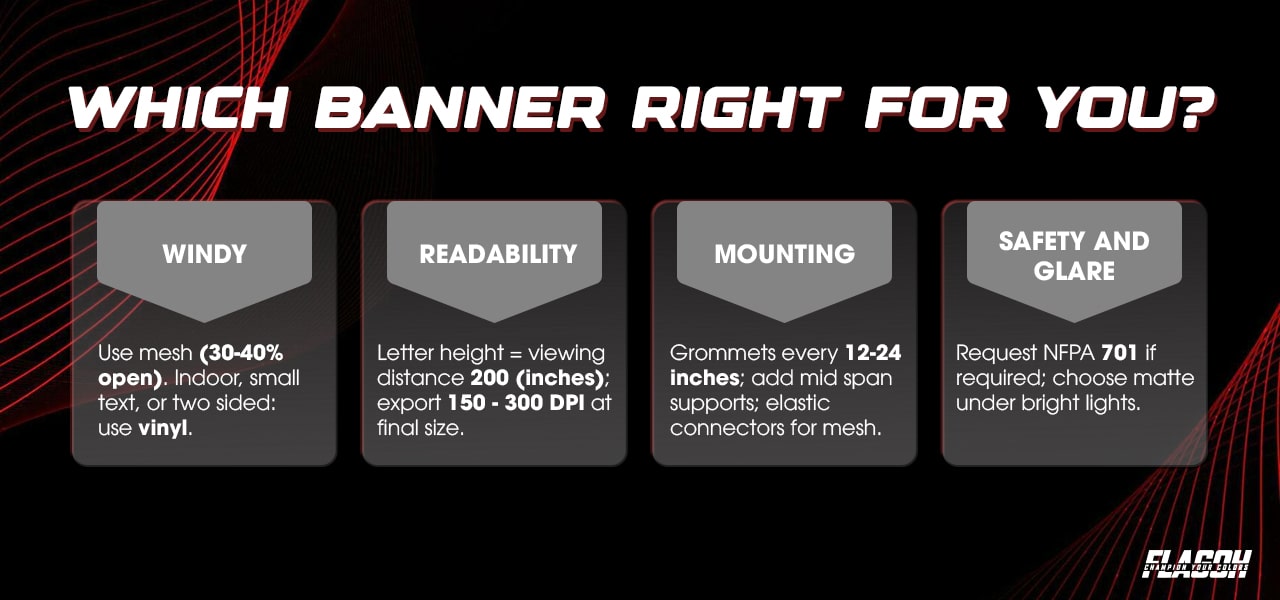
Before getting into specific use cases, it helps to look at the core differences between mesh and vinyl banners. At a glance, the key differences come down to airflow, print detail, and performance under different display conditions.
What a mesh banner is
A mesh banner is made from perforated material with small holes across the surface. Those holes allow air to pass through, which is why mesh is commonly used in exposed outdoor locations. It is a practical choice for fences, event perimeters, open-air venues, and other installations where wind is a real concern.
Because it vents air, the mesh reduces pressure on the banner face and mounting points. That helps lower stress on grommets, edges, and support hardware. Mesh can also help reduce glare outdoors, especially when paired with a matte finish, making it easier to read in bright daylight.
What a vinyl banner is
A vinyl banner is made from a solid material with no perforations. That solid surface supports stronger color density, cleaner print detail, and better background blocking. Vinyl is often preferred for indoor displays or calmer outdoor locations where airflow is less important than presentation quality.
Vinyl is especially useful when the design includes small text, detailed logos, photo-based artwork, or double-sided printing. It also creates a stronger visual barrier, making it helpful for privacy screens and cleaner-looking branded displays.
Quick summary table
|
Factor |
Mesh Banner |
Vinyl Banner |
|
Best use case |
Windy outdoor areas, fences, and exposed event perimeters |
Indoor displays, calm outdoor sites, detailed print jobs |
|
Wind performance |
Better airflow, lower wind load |
Higher wind load, needs stronger support |
|
Print sharpness |
Better for bold graphics and simple messaging |
Better for small text, logos, and fine detail |
|
Privacy |
Moderate |
Stronger blocking and privacy |
|
Double-sided printing |
Limited in most cases |
Better for true double-sided use |
|
Lifespan |
Strong outdoor performance when installed well |
Strong indoor or controlled outdoor performance |
|
Typical installation style |
Elastic ties, reinforced hems, mid-span support |
Strong anchors, rigid support, controlled tension |
How to Choose Between Mesh and Vinyl Banner
Choosing between mesh and vinyl becomes easier when you focus on the conditions that affect real-world performance. In most cases, the best choice depends on where the banner will be placed, how far away it will be viewed, and how much detail the design needs to convey clearly.
Choose based on location
Start with the installation environment before you look at the design. The right material often depends more on where the banner will hang than on how the artwork looks on screen. Ask a few simple questions first. Will the banner be installed on a fence, a wall, or a rigid frame? Will it sit in an exposed outdoor area or in a controlled indoor space? Will it face steady wind, shifting weather, or harsh sunlight?
If the site is open and wind-exposed, airflow should move higher on your priority list. If the banner will be used indoors or in a calmer location, presentation quality may matter more than venting.
Choose based on viewing distance
As viewing distance increases, tiny print refinements matter less than scale, contrast, and hierarchy. That is why mesh can work well for large outdoor banners, while vinyl is usually the better choice for close-up displays that rely on sharper detail.
Choose based on message type
The message itself should also influence the material choice. Some banners only need a bold headline, a large graphic, or a simple brand statement. Others need sponsor logos, event schedules, QR codes, or small print that must remain easy to read.
If the design relies on fine detail, the material has to reproduce it cleanly. If the message is simple and meant to be recognized quickly at a distance, boldness and visibility matter more than fine print control.
Mesh Banner Pros and Cons
Mesh banners offer clear outdoor advantages, but they also come with a few trade-offs.
Main advantages of mesh
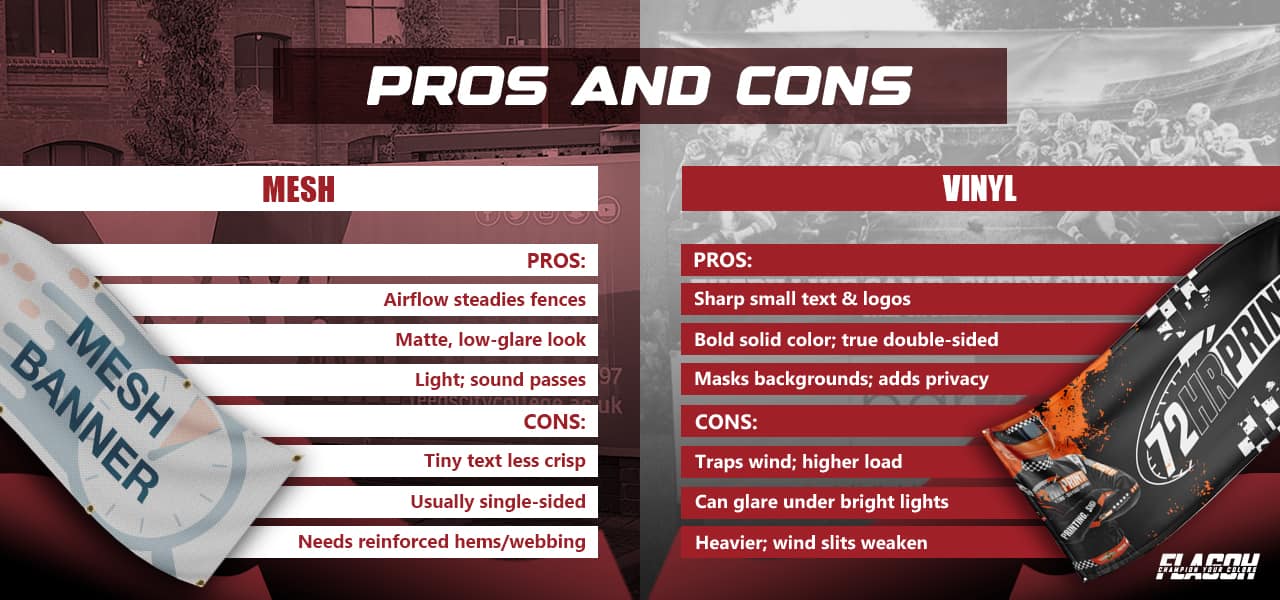
Mesh is built for movement and exposure. Its perforated surface allows air to pass through the material, which reduces strain on the banner and its hardware. That makes it easier to manage in outdoor settings where a solid panel might pull too hard under gusts.
Mesh can also reduce glare in bright daylight, especially when paired with a matte finish. It often works well for large-format graphics where the message is simple, high-contrast, and meant to be seen from farther away. For long outdoor runs, mesh is often easier to handle because it is better suited to demanding site conditions.
Main drawbacks of mesh
The main trade-off with mesh is detail. Because the print sits on a perforated surface, small text, thin lines, and intricate graphics usually look less crisp than they do on vinyl. Mesh can still look strong, but the artwork needs to be adapted so the message remains clear without depending on tiny visual elements.
Mesh also offers less visual blocking, so it is not always the best choice when privacy or a fully solid appearance is important. In most cases, it performs best when the design is bold enough to work with the material rather than against it.
Vinyl Banner Pros and Cons
Vinyl banners deliver a cleaner look, but they also need the right conditions to perform well.
Main advantages of vinyl
Vinyl is the better option when image control matters most. Its solid surface supports cleaner detail, stronger color density, and a more polished finish for close-view graphics. That makes it a strong fit for banners that need to look sharp at short range or in more presentation-driven environments.
Vinyl also creates better background blocking, which helps when the display needs a cleaner, more solid visual presence. If the banner includes tight typography, sponsor logos, photo-based graphics, or double-sided messaging, vinyl usually gives you a more consistent result.
Main drawbacks of vinyl
Vinyl’s biggest weakness is environmental stress. Since it does not vent air, it places more pressure on edges, grommets, ties, and anchors when used in exposed outdoor areas. In windy settings, that means the installation plan becomes much more important.
Vinyl can also produce more glare under direct light, depending on the finish. While it can look rich and bold indoors, it may become harder to read in strong sun or under intense venue lighting if finish and contrast are not handled carefully.
Best Banner Material by Use Case
If you need a faster decision, use these common scenarios as a shortcut before you finalize the artwork or installation plan. The right banner material depends on where and how the banner will be used.
Best for windy outdoor fences: Mesh is usually the better choice because airflow matters more than ultra-sharp print in exposed fence installations.
Best for trade shows and indoor displays: Vinyl is the better fit when viewers are close, and the banner needs cleaner color, sharper detail, and a more polished finish.
Best for sports venues and event perimeters: Use mesh for exposed outdoor perimeter areas and vinyl for more controlled indoor sections where presentation quality matters more than airflow.
Best for privacy screens: Vinyl is usually the stronger option when visual blocking is the priority, though airflow needs may still make mesh the safer choice in exposed outdoor runs.
Best for small text and detailed graphics: Vinyl is the safer material because it holds fine detail, tighter edges, and cleaner typography more reliably.
Best for large graphics seen from far away: Mesh can work very well when the message is bold, high-contrast, and designed for distance rather than close inspection.
Wind, Safety, and Installation Considerations
Wind is not just a comfort or visibility issue. It directly affects structural load, hardware stress, and installation safety.
Why wind matters more than most buyers expect
Wind is not just a visibility or comfort issue. It directly affects structural load and installation safety. A banner often fails not because the material itself is weak, but because the load path was poorly planned, the anchors were not strong enough, or stress was concentrated too heavily at corners and edges.
When wind hits a banner, the force needs to be distributed safely through the material and into the support structure. If that force gets trapped, the result can be torn grommets, stretched edges, broken ties, or anchor failure. That is why site conditions should guide the material decision before artwork preferences do.
Safe setup tips for mesh banners
Mesh performs best when the installation supports its flexibility. Reinforced hems help build a stronger perimeter. Elastic ties or shock cords allow the banner to move slightly and distribute force more evenly. Mid-span support along longer runs can also reduce stress concentration and improve stability.
The goal is not to over-tighten the panel. Mesh should be installed in a way that lets it breathe while still staying controlled and secure.
Safe setup tips for vinyl banners
Vinyl needs more structural support in exposed conditions. Shorter panels are often safer than one long run because they reduce total wind load. Stronger anchors and rigid frame support help transfer force into the structure rather than leaving the banner material to absorb all the stress.
Wind slits are not a real substitute for good planning. If vinyl is needed outdoors in a demanding location, better support, stronger finishing, and smarter panel sizing are usually more effective than shortcut fixes.
Print Quality, Readability, and Color Performance
Print performance depends on more than material alone. Viewing distance, lighting, contrast, and artwork setup all affect how clear the banner looks in real conditions.
Which material gives sharper print
Vinyl generally produces a cleaner and more controlled print surface. That helps with thin lines, smaller typography, fine logos, and more detailed artwork. If the banner needs to look sharp at close range, vinyl usually gives you more room for precision.
Mesh can still look effective, but the design has to be adapted to the material. Bold graphics, simple shapes, and thicker strokes usually perform better than artwork that depends on small details.
How viewing distance affects readability
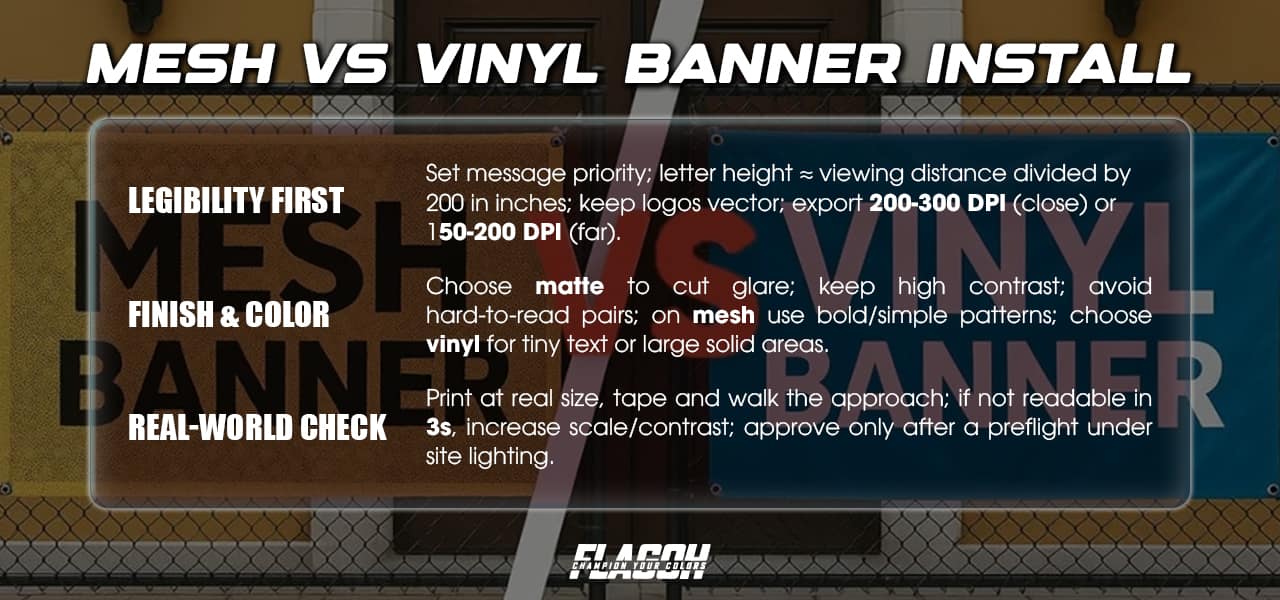
Readability should be judged in real conditions, not only on screen. The farther the banner is viewed from, the more the design depends on large type, stronger contrast, and a clear visual hierarchy. Close-view banners can carry more detail, but they also reveal weak layout choices faster.
A real-size crop test is one of the simplest ways to check whether the banner will read clearly. If the key message is hard to understand at the intended distance, the design needs to be simplified or enlarged before production.
Glare, contrast, and finish
Finish can change how the banner performs under light. Matte surfaces usually reduce glare and improve readability in bright sun or under sports venue lighting. Glossier finishes can make colors look richer, but they may also create reflection that weakens legibility.
Contrast matters just as much as finish. Strong contrast improves fast recognition, scanability, and camera visibility, especially in event settings where people are moving and attention is limited.
Banner Resolution and Artwork Setup
Better print results start with the right file setup and artwork choices.
Recommended DPI range
The right DPI depends on viewing distance, artwork detail, and final banner size. Close-view banners usually need a higher resolution because viewers will notice edges, textures, and fine detail much more easily.
For banners meant to be viewed from farther away, more moderate settings are often enough to preserve readability without making the file unnecessarily heavy.
Vector vs raster files
Logos and typography should stay in vector format whenever possible because vectors scale cleanly and preserve edge sharpness. This matters even more in large-format printing, where artwork may be resized significantly.
Photos are raster-based, so source quality matters. Use high-quality image files and avoid heavy compression. A low-quality file will not look sharper just because it is printed at a larger size.
Design tips for mesh artwork
When designing for mesh, keep the visual structure simple. Use thicker strokes, larger shapes, stronger contrast, and fewer tiny details. If the design depends on precision, either simplify the layout or switch to vinyl.
Many banner issues start with artwork that treats both materials the same way. In reality, mesh and vinyl need different design logic. Building the artwork for the material helps avoid disappointment later.
Cost, Durability, and Maintenance
Cost, durability, and upkeep all depend on how well the material matches the job.
Which material is cheaper upfront
There is no universal cheaper option because pricing changes with size, finishing, print method, and supplier. A banner that looks cheaper upfront can become the more expensive choice if it fails early or needs extra installation support.
That is why the better question is not just which material costs less today, but which one is less likely to create replacement, installation, or performance problems later.
Which material lasts longer in practice
Real lifespan depends on weather exposure, installation quality, handling, storage, and site conditions. Mesh often performs very well outdoors because it manages wind more effectively. Vinyl can also last well, but it usually needs calmer conditions or stronger support when used outside.
Material matters, but installation quality matters just as much. A banner matched correctly to the site usually lasts longer than one chosen mainly for looks.
Which material is easier to clean and maintain
Vinyl is often easier to wipe clean in indoor or low-exposure environments because of its solid surface. That makes it convenient for controlled displays where presentation needs to stay polished. Mesh can be a practical outdoor option because it handles exposed conditions better, though wear and maintenance depend heavily on the site.
The easiest material to maintain is usually the one that fits the environment well from the start.
Common Mistakes When Choosing Banner Material
Most banner problems do not come from the print itself. They come from choosing the wrong material for the site, the artwork, or the installation method.
Choosing vinyl for a windy fence
This is one of the most common banner mistakes. Vinyl may look great in the proof, but on a windy fence, it can turn into a hardware and stress problem quickly. In exposed sites, airflow usually deserves priority over maximum print sharpness.
Using mesh for tiny text
Mesh is not ideal for designs built around fine detail. If the artwork depends on small text, dense sponsor blocks, or scan-critical QR codes, readability can suffer. That is usually a design-material mismatch rather than a print failure.
Ignoring glare and lighting
A banner that looks clear indoors may underperform in bright sunlight or under harsh event lighting. Finish, contrast, and placement all matter. Lighting conditions should always be part of the material decision.
Underbuilding the hardware
Even the right material can fail if the hardware is weak. Poor tie spacing, light anchors, weak hems, or inadequate support can shorten the banner’s useful life quickly. Installation planning should be treated as part of the banner strategy, not as an afterthought.
Approving artwork without an on-site scale test
A simple real-world test can catch many banner problems before production. Place a scaled sample in a similar environment and view it from the actual approach distance. That step often reveals readability, contrast, and layout issues early enough to fix them.
FAQ About Mesh vs Vinyl Banner
Here are the most common questions buyers ask when comparing mesh and vinyl banners.
Is mesh better than vinyl for high-wind areas?
In most cases, yes. Mesh is usually the better option for high-wind areas because it allows air to pass through the material and reduces stress on the installation.
Can vinyl banners be used outdoors?
Yes, vinyl banners can be used outdoors, but they usually need a more stable site or stronger support than mesh in exposed conditions.
Does mesh reduce print quality?
Mesh can reduce fine-detail sharpness compared with vinyl because of its perforated surface. It works best with bold graphics, larger text, and simpler layouts.
Which material is better for double-sided printing?
Vinyl is generally the better choice for true double-sided printing because it offers stronger visual blocking and a cleaner presentation from both sides.
What DPI should I use for a large banner?
The right DPI depends on viewing distance, artwork detail, and final banner size. Close-view banners usually need higher effective resolution, while banners designed to be viewed from farther away can often use more moderate settings without hurting readability.
How far apart should grommets be placed?
Spacing depends on banner size, site exposure, and support method. Larger or more exposed installations usually need stronger edge planning and more thoughtful load distribution.
Do I need fire-safety documentation?
Some venues, events, and municipalities may require fire-safety documentation for banner materials, especially for indoor displays or public event use. If compliance matters for the site, confirm those requirements before printing or installation.
The right choice depends on how and where the banner needs to perform in real conditions. In this mesh vs vinyl banner guide, FlagOh recommends starting with the environment, then the message, and finally the installation setup, so the final result looks right and holds up better over time.