
 Arizona Cardinals Flag
 Atlanta Falcons Flag
 Baltimore Ravens Flag
 Buffalo Bills Flag
 Carolina Panthers Flag
 Chicago Bears Flag
 Cincinnati Bengals Flag
 Cleveland Browns Flag
 Dallas Cowboys Flag
 Denver Broncos Flag
 Detroit Lions Flag
 Green Bay Packers Flag
 Houston Texans Flag
 Indianapolis Colts Flag
 Jacksonville Jaguars Flag
 Kansas City Chiefs Flag
 Las Vegas Raiders Flag
 Los Angeles Chargers Flag
 Los Angeles Rams Flag
 Miami Dolphins Flag
 Minnesota Vikings Flag
 New England Patriots Flag
 New Orleans Saints Flag
 New York Giants Flag
 New York Jets Flag
 Philadelphia Eagles Flag
 Pittsburgh Steelers Flag
 San Francisco 49ers Flag
 Seattle Seahawks Flag
 Tampa Bay Buccaneers Flag
 Tennessee Titans Flag
 Washington Commanders Flag
 Arizona Diamondbacks Flag
 Atlanta Braves Flag
 Baltimore Orioles Flag
 Boston Red Sox Flag
 Chicago Cubs Flag
 Chicago White Sox Flag
 Cincinnati Reds Flag
 Cleveland Guardians Flag
 Colorado Rockies Flag
 Detroit Tigers Flag
 Houston Astros Flag
 Kansas City Royals Flag
 Los Angeles Angels Flag
 Los Angeles Dodgers Flag
 Miami Marlins Flag
 Milwaukee Brewers Flag
 Minnesota Twins Flag
 New York Mets Flag
 New York Yankees Flag
 Oakland Athletics Flag
 Philadelphia Phillies Flag
 Pittsburgh Pirates Flag
 San Diego Padres Flag
 San Francisco Giants Flag
 Seattle Mariners Flag
 St. Louis Cardinals Flag
 Tampa Bay Rays Flag
 Texas Rangers Flag
 Toronto Blue Jays Flag
 Washington Nationals Flag
 Atlanta Hawks Flag
 Boston Celtics Flag
 Brooklyn Nets Flag
 Charlotte Hornets Flag
 Chicago Bulls Flag
 Cleveland Cavaliers Flag
 Dallas Mavericks Flag
 Denver Nuggets Flag
 Detroit Pistons Flag
 Golden State Warriors Flag
 Houston Rockets Flag
 Indiana Pacers Flag
 LA Clippers Flag
 Los Angeles Lakers Flag
 Memphis Grizzlies Flag
 Miami Heat Flag
 Milwaukee Bucks Flag
 Minnesota Timberwolves Flag
 New Orleans Pelicans Flag
 New York Knicks Flag
 Oklahoma City Thunder Flag
 Orlando Magic Flag
 Philadelphia 76ers Flag
 Phoenix Suns Flag
 Portland Trail Blazers Flag
 Sacramento Kings Flag
 San Antonio Spurs Flag
 Toronto Raptors Flag
 Utah Jazz Flag
 Washington Wizards Flag
 Anaheim Ducks Flag
 Arizona Coyotes Flag
 Boston Bruins Flag
 Buffalo Sabres Flag
 Calgary Flames Flag
 Carolina Hurricanes Flag
 Chicago Blackhawks Flag
 Colorado Avalanche Flag
 Columbus Blue Jackets Flag
 Dallas Stars Flag
 Detroit Red Wings Flag
 Edmonton Oilers Flag
 Florida Panthers Flag
 Los Angeles Kings Flag
 Minnesota Wild Flag
 Montreal Canadiens Flag
 Nashville Predators Flag
 New Jersey Devils Flag
 New York Islanders Flag
 New York Rangers Flag
 Ottawa Senators Flag
 Philadelphia Flyers Flag
 Pittsburgh Penguins Flag
 San Jose Sharks Flag
 Seattle Kraken Flag
 St. Louis Blues Flag
 Tampa Bay Lightning Flag
 Toronto Maple Leafs Flag
 Vancouver Canucks Flag
 Vegas Golden Knights Flag
 Washington Capitals Flag
 Winnipeg Jets Flag
News
How to Sew Jersey Fabric: Simple Steps & Solutions
Struggling with wavy seams or bumpy hems? This guide shows how to sew jersey fabric with clear steps and proven settings: pick the right needle and stitch, set up a home machine, cut on the grain, stabilise shoulders, finish flat hems, and press safely. You’ll also get fast fixes for skipped stitches and tunnelling—usable for single jersey, interlock, and poly/spandex. Built from FlagOh field tests, it’s concise, numbers-backed, and ready to use.
How To Sew Jersey Fabric Made Easy Today
How to sew jersey fabric gets straightforward when you follow clear, tested steps: read the knit, choose the right needle and stitch, then cut, sew, press, and finish with simple techniques for smooth seams and flat hems. Written in plain English for home machines, this guide helps you get reliable results the first time.

What Is Jersey Fabric
Jersey is a knit, not a woven. Instead of straight criss-cross threads, it’s built from tiny loops, which is why it stretches and drapes softly. You’ll see it in cotton, viscose/rayon, or polyester, often with a touch of spandex so it springs back and holds its shape. Let the built-in stretch guide needle and stitch choice.
There are two everyday types. Single jersey is the classic T-shirt knit—light, smooth, and the raw edges like to curl. Interlock is a double knit—thicker, more stable, and less prone to curling. Sports jerseys are usually polyester/spandex for durability and recovery. As a weight guide, most T-shirts sit around 150–170 GSM, casual dresses 180–210 GSM, and leggings 200–240 GSM for better coverage and stability.
Jersey Sewing In Eight Steps
Step 1 — Prewash & relax the fabric:
Wash before cutting, then let the fabric rest flat so the knit relaxes. Mark a small test square, wash once, and re-measure to learn the true shrink.
Step 2 — Read the fabric, then pick the needle:
If test seams leave tiny holes or “ladders,” switch to a softer-tip stretch/ballpoint and install a fresh needle. Use smooth polyester thread that snaps cleanly without fuzz.
Step 3 — Match stitch to the job:
Use a stretchy seam for areas that move (side seams, cuffs) and a calmer topstitch for show lines. Anchor starts/ends by pulling thread tails to the wrong side and knotting instead of heavy backstitching.
Step 4 — Guide, don’t pull:
Keep one hand lightly flattening in front of the foot and the other supporting behind. Start on a scrap “leader” to stop bird-nesting, and use a hump-jumper (a small leveller for thick joins) over bulky joins.
Step 5 — Square the grain, then cut:
Let the selvedge hang to find true grain, then tape the selvedge edge to your cutting mat so pieces stay square. For pairs, lay right sides together and mirror-cut; a sheet of freezer paper pressed on top makes curls behave and peels off clean.
Step 6 — Reinforce only where needed:
Stitch knit stay tape or clear elastic flat (don’t stretch it) along the shoulders before closing the seam. For pockets or zips, fuse a slim strip of tricot inside the seam allowance so the body stays soft.
Step 7 — Prepare hems with “memory”:
Press the fold so the edge holds its shape; let it cool.
Step 8 — Press to set, then cool:
Lift-and-press through a cloth and let pieces cool flat under a clapper or a heavy book to lock the shape. Steam from the wrong side on curves (like necklines) so the contour stays round and crisp.
Set Up Your Machine For Jersey Sewing Today
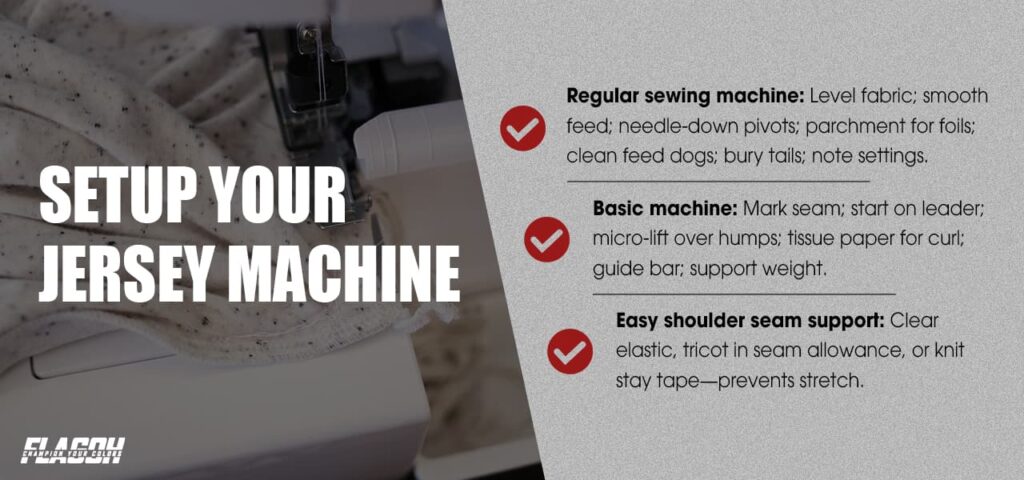
To dial in how to sew jersey fabric, support the fabric, keep the feed smooth, and let the machine move the knit. Use small helpers—scrap leader, parchment, guide bar—to keep the feed even.
Sew Jersey On Regular Machines
- Keep the fabric level with the needle plate (tray/box support) to prevent drag and waves.
- Feed thread cleanly: use a stand or upright spool; wind bobbins slowly and not too full.
- Control the line: needle-down pivots; fingernail as a mini edge guide; “stitch-in-the-ditch” at joins.
- Reduce stick & lint: baking parchment under the foot for foiled prints; brush feed dogs mid-session.
- Finish neatly: pull thread tails to the wrong side and knot/bury; log your successful “recipe”.
Sew Jersey On Basic Machines
- Mark the seam line if guides are sparse; sew on the line for accuracy.
- Glide over bulk: start on a paper leader; micro-lift the presser foot as the hump passes.
- Tame curl/tunnel: light starch or a strip of tissue/freezer paper; tear away after stitching.
- Keep hems even: use a quilting guide bar or tape a card strip as a fence.
- Support the project so it doesn’t drag on the table while you sew.
Reinforce Jersey Shoulder Seams
Shoulder seams take the most pull, so support them before joining the front and back. Lay a clear elastic flat along the shoulder line and stitch without stretching, or press a slim strip of tricot interfacing inside the seam allowance. A narrow knit stay tape also works.
Dial in a smooth feed, keep the fabric level, and let the machine—not your hands—do the work; when seams lie flat, and spring back, your setup is right. Keep a scrap at the needle to test small tweaks and note the “recipe” that fits your machine. For a handy reference, our store’s setup card puts these settings on a single, printable page.
Basic Ironing Techniques For Jersey Fabric
Clean pressing is what turns good sewing into great sewing. In any practical guide to how to sew jersey fabric, setting gentle heat and controlled steam, shaping curves on a ham or seam roll, blocking panels back to square, and protecting prints with a barrier layer keeps the stretch intact and finish mark-free.
Set the heat and steam
Let the iron fully warm up, then give it a few test puffs so steam flows evenly. Shape curves (necklines, armholes) over a tailor’s ham or seam roll and steam from the wrong side, so the curve sets without shine.
For panels that feel a bit skewed after washing, block them: lay flat, mist lightly, square the edges by hand, and let them dry in place. On printed or foiled jerseys, protect the surface with baking parchment or a Teflon sheet while steaming to avoid sticking
Simple care tips while ironing
Keep the soleplate clean—a quick wipe prevents marks on light knits. Use silk organza as a see-through pressing layer when you need to watch the seam line. After each press, lock the shape with a clapper (or a heavy book) until cool; this sets hems and bands neatly. To avoid ridge imprints, press over a seam roll so allowances sink into the gap. If edges want to curl, finger-press them flat with a light mist first, then set with the iron.
Keep it crisp—press steadily with a cloth barrier so the surface stays clean. A compact checklist and gentle-on-fabric accessories are available at FlagOh. Always test heat on a scrap or inside seam, protect prints with a barrier sheet, and follow your iron/machine manual.
Care And Storage For The Jersey After You Sew
Learn how to sew with jersey knit, then protect the result with smart care: wash, press, and store well. Those everyday moves at the washer, the ironing board, and the closet keep seams lively and hems in line.
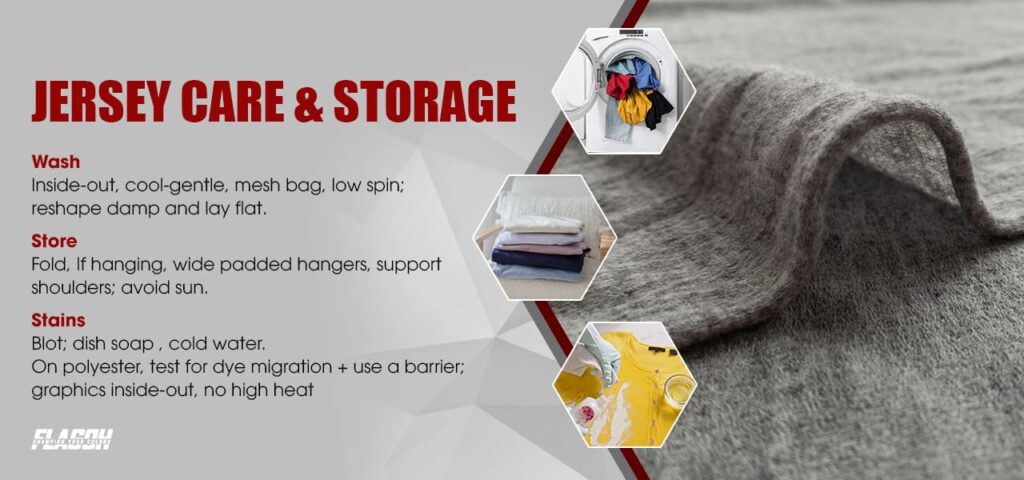
- Wash & dry the right way: Turn garments inside-out and use a cool, gentle cycle with mild detergent. A mesh bag limits rubbing and pilling. Keep spin ≤ 800 rpm to avoid stretch; reshape while damp and lay flat to dry. If you need the dryer, use low heat briefly, then finish flat.
- Store so it keeps its shape: Fold rather than hang to avoid shoulder bumps. If you must hang, use wide, padded hangers and support the shoulder seam. Keep pieces out of direct sun, and rotate fold lines to prevent set-in creases. Remove light pilling with a fabric shaver, gently.
- Stains, prints, and patches: Polyester can show dye migration at higher heat—test a hidden corner and use a protective sheet during pressing. Blot stains quickly; use a drop of dish soap for oily marks and cold water for protein stains, then rinse well. For printed or HTV numbers and patches, wash inside-out, skip high heat, and never press the graphic directly. If a transfer lifts, re-seal from the wrong side through a press cloth with light heat and brief pressure.
Keep it gentle, cool washes, flat drying, light pressing, and folding instead of hanging. For a compact care card and a quick storage checklist you can print and keep by your machine, FlagOh has you covered.
Common Questions About Sewing Jersey Fabric
Short answers to the key choices in how to sew jersey fabric: stitch type, needle size, and machine settings—stitch type, needle size, and setup—make the biggest difference. This Q&A gives fast, clear answers so you can pick the right settings and fix common issues on the spot.
What stitch should I use on jersey?
Zigzag L 2.5–3.0 mm / W 0.5–1.0 mm or the “lightning” stitch so seams stretch without breaking.
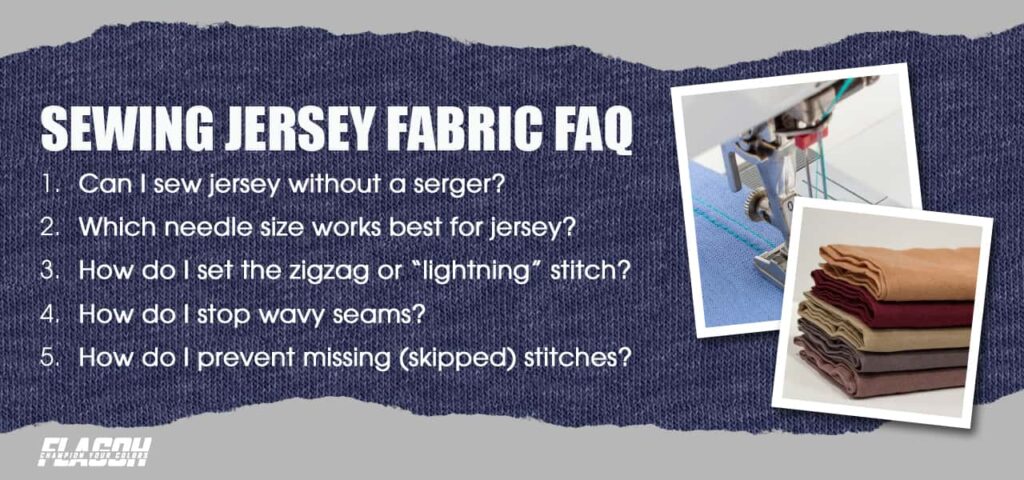
Can I sew jersey without a serger?
Yes. A regular machine with zigzag/lightning and a twin-needle hem works well. A serger is faster, but not required.
Which needle size works best for jersey?
Start with 75/11 stretch for light-medium knits; move to 80/12 for thicker jersey. Change needles often to avoid skips.
How do I set the zigzag or “lightning” stitch?
Begin at L 2.5–3.0 mm / W 0.5–1.0 mm. If seams pop, widen the width slightly; if wavy, shorten a bit and reduce foot pressure.
How do I stop wavy seams?
Lower presser-foot pressure, support the fabric, and (on serger) set DF (differential feed) 1.3–2.0. A walking foot helps.
How do I prevent skipped stitches?
Install a new 75/11 stretch needle, rethread, widen zigzag a touch, and avoid pulling the fabric while sewing.
Keep notes of what works, change needles often, test on a scrap before each project, and let the machine feed the fabric while you guide with light hands. Sewing jersey comes down to a few steady habits: understand the knit, set up the machine for stretch, guide the fabric instead of pulling, finish calmly, and care for the garment so it keeps its shape. Follow the eight steps, use the simple setup checks, and lean on the fixes you’ve practised—soon, how to sew jersey fabric will feel routine, not tricky. For a quick reference, FlagOh offers a printable settings card and a one-page care guide to keep by your machine.