
 Arizona Cardinals Flag
 Atlanta Falcons Flag
 Baltimore Ravens Flag
 Buffalo Bills Flag
 Carolina Panthers Flag
 Chicago Bears Flag
 Cincinnati Bengals Flag
 Cleveland Browns Flag
 Dallas Cowboys Flag
 Denver Broncos Flag
 Detroit Lions Flag
 Green Bay Packers Flag
 Houston Texans Flag
 Indianapolis Colts Flag
 Jacksonville Jaguars Flag
 Kansas City Chiefs Flag
 Las Vegas Raiders Flag
 Los Angeles Chargers Flag
 Los Angeles Rams Flag
 Miami Dolphins Flag
 Minnesota Vikings Flag
 New England Patriots Flag
 New Orleans Saints Flag
 New York Giants Flag
 New York Jets Flag
 Philadelphia Eagles Flag
 Pittsburgh Steelers Flag
 San Francisco 49ers Flag
 Seattle Seahawks Flag
 Tampa Bay Buccaneers Flag
 Tennessee Titans Flag
 Washington Commanders Flag
 Arizona Diamondbacks Flag
 Atlanta Braves Flag
 Baltimore Orioles Flag
 Boston Red Sox Flag
 Chicago Cubs Flag
 Chicago White Sox Flag
 Cincinnati Reds Flag
 Cleveland Guardians Flag
 Colorado Rockies Flag
 Detroit Tigers Flag
 Houston Astros Flag
 Kansas City Royals Flag
 Los Angeles Angels Flag
 Los Angeles Dodgers Flag
 Miami Marlins Flag
 Milwaukee Brewers Flag
 Minnesota Twins Flag
 New York Mets Flag
 New York Yankees Flag
 Oakland Athletics Flag
 Philadelphia Phillies Flag
 Pittsburgh Pirates Flag
 San Diego Padres Flag
 San Francisco Giants Flag
 Seattle Mariners Flag
 St. Louis Cardinals Flag
 Tampa Bay Rays Flag
 Texas Rangers Flag
 Toronto Blue Jays Flag
 Washington Nationals Flag
 Atlanta Hawks Flag
 Boston Celtics Flag
 Brooklyn Nets Flag
 Charlotte Hornets Flag
 Chicago Bulls Flag
 Cleveland Cavaliers Flag
 Dallas Mavericks Flag
 Denver Nuggets Flag
 Detroit Pistons Flag
 Golden State Warriors Flag
 Houston Rockets Flag
 Indiana Pacers Flag
 LA Clippers Flag
 Los Angeles Lakers Flag
 Memphis Grizzlies Flag
 Miami Heat Flag
 Milwaukee Bucks Flag
 Minnesota Timberwolves Flag
 New Orleans Pelicans Flag
 New York Knicks Flag
 Oklahoma City Thunder Flag
 Orlando Magic Flag
 Philadelphia 76ers Flag
 Phoenix Suns Flag
 Portland Trail Blazers Flag
 Sacramento Kings Flag
 San Antonio Spurs Flag
 Toronto Raptors Flag
 Utah Jazz Flag
 Washington Wizards Flag
 Anaheim Ducks Flag
 Arizona Coyotes Flag
 Boston Bruins Flag
 Buffalo Sabres Flag
 Calgary Flames Flag
 Carolina Hurricanes Flag
 Chicago Blackhawks Flag
 Colorado Avalanche Flag
 Columbus Blue Jackets Flag
 Dallas Stars Flag
 Detroit Red Wings Flag
 Edmonton Oilers Flag
 Florida Panthers Flag
 Los Angeles Kings Flag
 Minnesota Wild Flag
 Montreal Canadiens Flag
 Nashville Predators Flag
 New Jersey Devils Flag
 New York Islanders Flag
 New York Rangers Flag
 Ottawa Senators Flag
 Philadelphia Flyers Flag
 Pittsburgh Penguins Flag
 San Jose Sharks Flag
 Seattle Kraken Flag
 St. Louis Blues Flag
 Tampa Bay Lightning Flag
 Toronto Maple Leafs Flag
 Vancouver Canucks Flag
 Vegas Golden Knights Flag
 Washington Capitals Flag
 Winnipeg Jets Flag
News
How Many Major League Baseball Players Are There On Rosters
Baseball runs on numbers, but one basic question still stumps a lot of fans: how many Major League Baseball players are there at any given time? Ask around, and you’ll hear 26, 40, or 780—and in their own way, they’re all right. At FlagOh, we break down the 2025 roster math, the hidden “iceberg” of players behind the dugout, and the global mix of talent so you can see the league more clearly—whether you’re managing a fantasy lineup or choosing which flags to fly.
Understanding MLB Rosters And The Real Player Numbers
To truly answer the question “how many Major League Baseball players are there?”, we first need to define what “being a Major Leaguer” means. Are we counting the guys in the dugout tonight, or everyone with a contract?
Key MLB Player Numbers For The 2025 Season
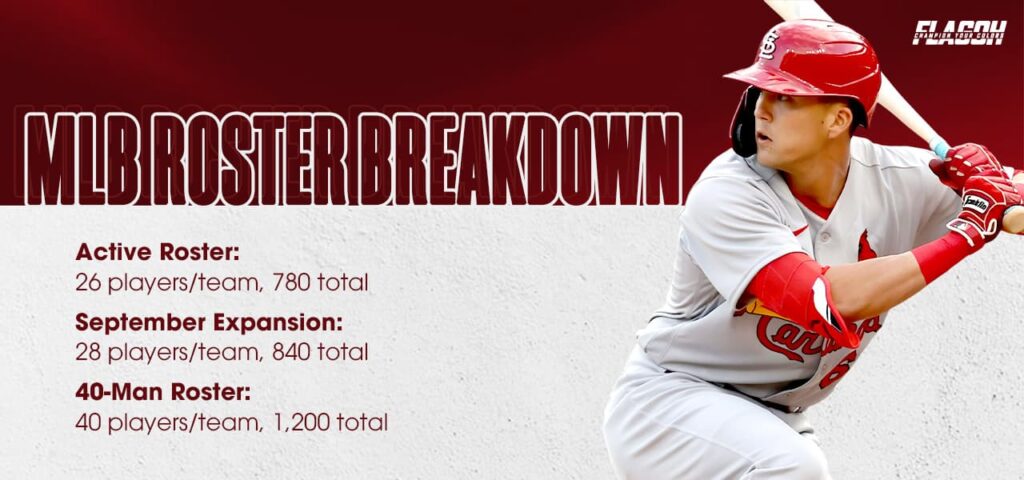
If you just want the quick numbers to settle a debate, here’s the breakdown for the 2025 season.
| Roster Category | Players Per Team | League Total (30 Teams) | Who Counts? |
| Active Roster | 26 | 780 | The players suited up in the dugout today. |
| September Expanded | 28 | 840 | Active count from Sept 1st to season end. |
| Reserve List | 40 | 1,200 | Active players + top prospects & IL. |
| Historical Total | N/A | ~23,615 | Every player to debut since 1876. |
In simple terms, MLB roster size is 26 players per team for most of the regular season, which is why a lot of fans say there are 780 players in MLB at once.
Active And Forty-Man Rosters Throughout The Season
The “Active Roster” is what you see on TV. As of the 2025 season, the current number of MLB players on active rosters is strictly capped.
- The 26-Man Rule: From Opening Day until August 31st, each of the 30 clubs carries 26 active players. This creates a league-wide baseline of 780 players.
- The 13-Pitcher Limit: To prevent games from dragging on with endless pitching changes, teams are limited to 13 pitchers. This means the split is almost always 13 pitchers and 13 position players.
- September Call-Ups: On September 1st, rosters expand slightly to 28 players. This adds 60 more players to the league pool (2 per team), bringing the active total to 840.
But the iceberg goes much deeper than the 26 names you see on game day. The 40-man roster includes the active 26 plus 14 reserve players. These players possess Major League contracts and Rule 5 Draft protection, though they are typically stationed in Triple-A or on the Injured List. In total, about 1,200 players hold active Major League contracts.
Why This Guide Explains MLB Player Numbers Better
Most search results will just give you the number “780” and stop there. But that ignores the reality of the game. A team doesn’t just use 26 players all year. Injuries happen. Trades happen. Slumps happen.
The “Restricted List,” the “60-Day Injured List,” and the “Paternity List” all create roster spots that allow teams to bring up new talent without technically exceeding the limits. Understanding this churn is key for collectors and fans who want to know why a player might disappear from the lineup—or why a new name suddenly needs a jersey (or a custom flag) in your collection.
Season Totals and All-Time Numbers
The number of players available on a single day is 780, but far more players appear across a full season. A better way to think about the MLB player pool is to look at how many unique players appear in at least one game.
How Many Players Actually Take the Field in a Full MLB Season
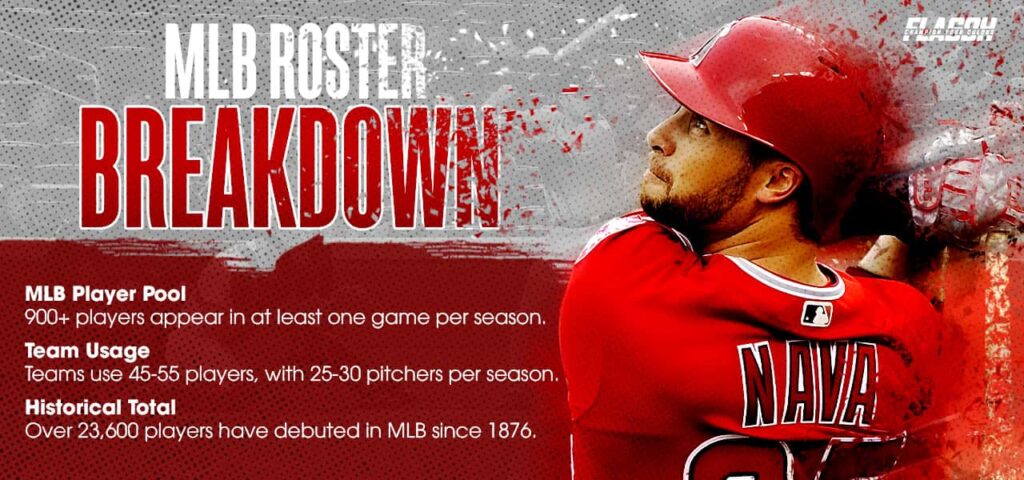
Because of the physical grind of 162 games, the active roster is a revolving door. In a typical recent season, well over 900 different players appear in at least one MLB game, so the true answer to how many players play in MLB each year is hundreds more than the simple 780 you get from counting roster spots.
This means that nearly double the number of “active slots” are used throughout the year. For fans, this creates a constant stream of rookies making debuts—and new opportunities to support rising stars.
How Many Players Does One Team Use Over 162 Games
On a micro level, a single team rarely sticks to its Opening Day 26. The average MLB team uses between 45 and 55 players per season. Pitching staffs are especially volatile; it is not uncommon for a team to cycle through 25-30 different pitchers in a single year as they navigate arm fatigue and injuries. If you’ve ever watched your team burn through a new reliever every other week, you’ve already seen how quickly those names cycle in and out of the box score.
How Many People Have Ever Played in Major League Baseball
If we zoom out to the history books, the number becomes staggering. Since the National League was founded in 1876, the total number of MLB players in history (as of the end of the 2024 season) is approximately 23,615. Historical databases such as Baseball-Reference put the total in the low 23,000s, and that figure creeps up every year as new debuts are added and older records are updated.
This includes Hall of Famers like Babe Ruth and Shohei Ohtani, but also the thousands of “Cup of Coffee” players—guys who played just one single game in the big leagues. At FlagOh, we celebrate the history of the game with retro-inspired designs that honor the legends who helped push that total past 23,000 names.
MLB Players By Country, Age, And Career Length
Baseball is arguably the most diverse of America’s major sports. Looking at how many MLB players come from outside the United States is key to understanding the modern, globalized version of the game.
U.S. and International Players: From the Dominican Republic to Japan
According to MLB’s official Opening Day 2025 roster release, about 27.8% of Major League players were born outside the United States. That worked out to 265 international players out of a pool of 954 total rostered players (including active, injured, restricted, and suspended lists).
- Dominican Republic: ~100+ players (The largest group outside the U.S.).
- Venezuela: ~60+ players.
- Cuba: ~20+ players.
- Others: Puerto Rico, Mexico, Japan, Canada, South Korea, Colombia, and Curaçao.
This international influence is why the World Baseball Classic has become such a massive event. Fans aren’t just cheering for a laundry; they are cheering for heritage.
Tip: Is your favorite player from the D.R., Venezuela, or Japan? Show your support by displaying a premium, double-stitched Country Flag alongside your team gear. It’s the ultimate way to represent the global game.
Typical Debut Age and How Long an MLB Career Really Lasts
The average MLB player debuts around age 24 or 25. However, staying in the league is harder than making it. The average career length is roughly 3 to 4 years. For every veteran playing into their late 30s, there are dozens of players who play for two seasons and are replaced by the next wave of talent from the minor leagues.
Why Short Careers Help Explain the Huge All-Time Player Count
This high turnover rate is exactly why the total number of MLB players in history is so high. The “churn” of the bottom 5-10 spots on a roster means that hundreds of new players enter the history books every single year.
MLB Player Numbers Compared With Other Leagues
To put the baseball headcount in perspective, let’s look at how it stacks up against other major sports.
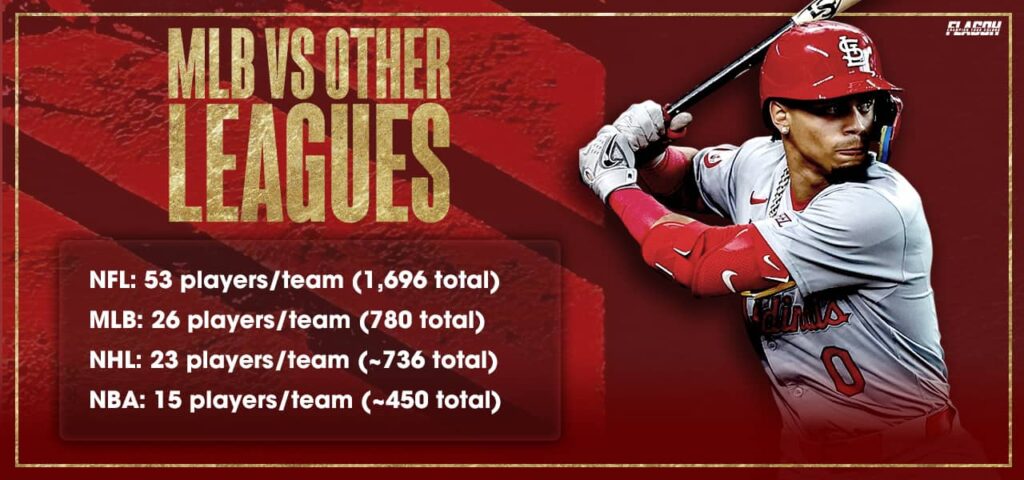
MLB vs NFL, NBA, and NHL: Roster Sizes and Total Players
- NFL: 53 active players per team (League total: ~1,696).
- MLB: 26 active players per team (League total: 780).
- NHL: 23 active players per team (League total: ~736).
- NBA: 15 active players per team (League total: ~450).
While the NFL has more players per team, MLB seasons are significantly longer (162 games vs 17), requiring a deeper reservoir of talent in the farm system (Minor Leagues) to sustain the active roster.
Why Baseball Needs So Many Players: Schedule, Pitching, and Injuries
Baseball is unique because it is played almost every day. This places immense strain on pitchers. No other sport requires a team to have 13 highly specialized athletes (pitchers) who do nothing but throw the ball, separate from the offense. This specialization is the main driver behind the roster rules we see today.
What These Comparisons Mean for Prospects and Career Odds
With only 780 active spots available worldwide, making it to the MLB is statistically one of the hardest feats in sports. Less than 0.5% of high school baseball players will ever be drafted, and only a fraction of those will crack the 26-man roster.
What These Numbers Mean for Fans, Fantasy, and Collecting
Knowing how many MLB players are in the league isn’t just trivia—it’s practical insight that shapes how you watch, analyze, and connect with the game.
How Many Major League Baseball Players Matter for Fantasy Baseball
In a standard 12-team fantasy league, roughly 300 to 350 players are “rostered” at any given time. This means less than half of the league’s active players are fantasy-relevant. Identifying the gems who rise from the 40-man roster into that top tier is how leagues are won.
From Player Counts to Cards, Jerseys, and Wall Setups
For collectors, the high churn rate creates scarcity. Rookie cards and debut jerseys capture a specific moment in time. When a player gets that “Call-Up” from the 40-man roster, their merchandise value spikes.
Turning Your Favorite Names Into Game-Day Flags and Décor
Whether you’re tracking the 26 guys in the dugout or honoring one of the more than 23,000 players in MLB history, fandom is about display.
We help you turn those numbers into something you can see every day.
- Represent the 27.8%: Browse our International Flag Collection to fly the flag of your favorite player’s homeland.
- Customize Your Fan Cave: Use our POD service to create a custom flag with your lucky number or favorite team colors.
- Durable Quality: Our flags are made from heavyweight polyester with brass grommets, built to last through extra innings and outdoor seasons.
By now, you’ve seen that the answer to the question “how many Major League Baseball players are there?” depends on the lens: roughly 780 on active rosters at once, 900+ taking the field over a season, and more than 23,000 who’ve played in the big leagues across history. The real question is which of those names deserves a permanent spot in your space—and that’s where FlagOh comes in, helping you turn a handful of favorite players into flags and décor that match your own version of the game.