
 Arizona Cardinals Flag
 Atlanta Falcons Flag
 Baltimore Ravens Flag
 Buffalo Bills Flag
 Carolina Panthers Flag
 Chicago Bears Flag
 Cincinnati Bengals Flag
 Cleveland Browns Flag
 Dallas Cowboys Flag
 Denver Broncos Flag
 Detroit Lions Flag
 Green Bay Packers Flag
 Houston Texans Flag
 Indianapolis Colts Flag
 Jacksonville Jaguars Flag
 Kansas City Chiefs Flag
 Las Vegas Raiders Flag
 Los Angeles Chargers Flag
 Los Angeles Rams Flag
 Miami Dolphins Flag
 Minnesota Vikings Flag
 New England Patriots Flag
 New Orleans Saints Flag
 New York Giants Flag
 New York Jets Flag
 Philadelphia Eagles Flag
 Pittsburgh Steelers Flag
 San Francisco 49ers Flag
 Seattle Seahawks Flag
 Tampa Bay Buccaneers Flag
 Tennessee Titans Flag
 Washington Commanders Flag
 Arizona Diamondbacks Flag
 Atlanta Braves Flag
 Baltimore Orioles Flag
 Boston Red Sox Flag
 Chicago Cubs Flag
 Chicago White Sox Flag
 Cincinnati Reds Flag
 Cleveland Guardians Flag
 Colorado Rockies Flag
 Detroit Tigers Flag
 Houston Astros Flag
 Kansas City Royals Flag
 Los Angeles Angels Flag
 Los Angeles Dodgers Flag
 Miami Marlins Flag
 Milwaukee Brewers Flag
 Minnesota Twins Flag
 New York Mets Flag
 New York Yankees Flag
 Oakland Athletics Flag
 Philadelphia Phillies Flag
 Pittsburgh Pirates Flag
 San Diego Padres Flag
 San Francisco Giants Flag
 Seattle Mariners Flag
 St. Louis Cardinals Flag
 Tampa Bay Rays Flag
 Texas Rangers Flag
 Toronto Blue Jays Flag
 Washington Nationals Flag
 Atlanta Hawks Flag
 Boston Celtics Flag
 Brooklyn Nets Flag
 Charlotte Hornets Flag
 Chicago Bulls Flag
 Cleveland Cavaliers Flag
 Dallas Mavericks Flag
 Denver Nuggets Flag
 Detroit Pistons Flag
 Golden State Warriors Flag
 Houston Rockets Flag
 Indiana Pacers Flag
 LA Clippers Flag
 Los Angeles Lakers Flag
 Memphis Grizzlies Flag
 Miami Heat Flag
 Milwaukee Bucks Flag
 Minnesota Timberwolves Flag
 New Orleans Pelicans Flag
 New York Knicks Flag
 Oklahoma City Thunder Flag
 Orlando Magic Flag
 Philadelphia 76ers Flag
 Phoenix Suns Flag
 Portland Trail Blazers Flag
 Sacramento Kings Flag
 San Antonio Spurs Flag
 Toronto Raptors Flag
 Utah Jazz Flag
 Washington Wizards Flag
 Anaheim Ducks Flag
 Arizona Coyotes Flag
 Boston Bruins Flag
 Buffalo Sabres Flag
 Calgary Flames Flag
 Carolina Hurricanes Flag
 Chicago Blackhawks Flag
 Colorado Avalanche Flag
 Columbus Blue Jackets Flag
 Dallas Stars Flag
 Detroit Red Wings Flag
 Edmonton Oilers Flag
 Florida Panthers Flag
 Los Angeles Kings Flag
 Minnesota Wild Flag
 Montreal Canadiens Flag
 Nashville Predators Flag
 New Jersey Devils Flag
 New York Islanders Flag
 New York Rangers Flag
 Ottawa Senators Flag
 Philadelphia Flyers Flag
 Pittsburgh Penguins Flag
 San Jose Sharks Flag
 Seattle Kraken Flag
 St. Louis Blues Flag
 Tampa Bay Lightning Flag
 Toronto Maple Leafs Flag
 Vancouver Canucks Flag
 Vegas Golden Knights Flag
 Washington Capitals Flag
 Winnipeg Jets Flag
News
Do NFL Players Get New Jerseys Every Game? | FlagOh
If you’re curious about the process behind NFL jerseys—and find yourself asking “Do NFL players get new jerseys every game?”—the answer is more nuanced than it seems. Most jerseys are professionally cleaned and repaired for reuse, but understanding how they’re maintained matters to fans, collectors, and shoppers comparing game-worn to retail. At FlagOh, we break down the standards and practices, what triggers a replacement, and the pro-level care techniques you can use at home.
Do NFL Players Get New Jerseys Every Game?
No, players do not wear new jerseys every game. Teams typically reuse jerseys after a post-game cycle (collect → pre-treat → wash 30–40 °C inside-out → sanitize/dry → inspect → minor repairs → re-issue). New issues happen for blood/major tears, jersey swaps, or special games (throwbacks, Color Rush, playoffs/Super Bowl) with patches.
This policy balances hygiene, legibility, and inventory control. In practice, FlagOh sums this up as “reuse by default; new on damage, swap, or special patches.”
How many NFL jerseys does a player use in a season?
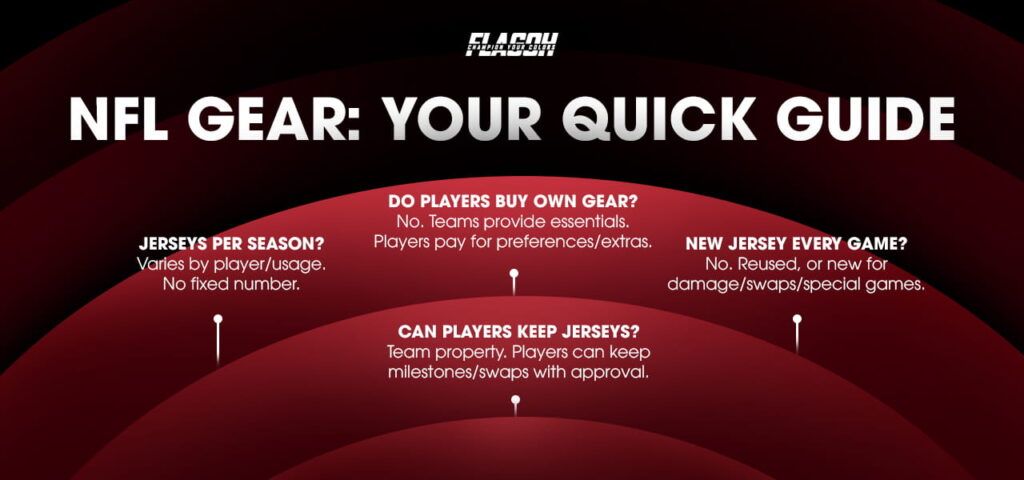
There is no fixed league number. Totals vary by player role, frequency of swaps, visible wear, and special-event games. Starters who swap more often or reach the postseason may cycle through more pieces, while others use fewer thanks to successful repairs and QC. Practice stock is managed separately from game stock and is built for heavier laundering and repair, so it does not inflate game-jersey counts.
Do NFL players get to keep their jerseys?
Usually, game jerseys are team property, not personal gear, so players don’t automatically keep them. That said, teams commonly allow post-game swaps or let a player keep a milestone jersey (e.g., a debut, record, or playoff game) with equipment-staff approval. When a jersey leaves circulation, the club typically issues a replacement and may back-bill the cost internally or cap the number of swaps per season—policies vary by team. Special-uniform or patched jerseys might be archived, auctioned for charity, or sold through official channels. Practice jerseys are managed separately and don’t count as game-worn inventory.
Do NFL players buy their own gear?
No—NFL players generally don’t buy their own on-field gear. Game and practice essentials (jerseys, pants, socks), helmets, shoulder pads, and most protective equipment are team-issued, fitted by the equipment staff, and serviced or replaced as needed. Cleats and gloves are often provided through team allotments or brand deals, though some players choose to buy preferred models, custom plates, or off-season training gear out of pocket. If a player swaps or keeps a game jersey, the club usually covers the replacement (policies vary; some teams may back-bill or cap swaps). Accessories outside league policy (e.g., non-approved visors or personalized add-ons) are typically the player’s responsibility and can draw fines. In short, teams handle the essentials; players pay only for personal preferences and extras.
How Do Teams Decide to Reuse or Issue a New Jersey?
Behind every nameplate is a checklist balancing hygiene, readability, and inventory control. If you’re wondering, “Do NFL players get new jerseys every game?”, this policy framework explains why reuse is the default and fresh issues are the exception. This section shows how teams decide when a jersey is reused or freshly issued.
Weekly lifecycle
Equipment rooms track each jersey through a closed loop: issue → play → collect → launder → inspect → repair → re-issue. Labels/barcodes and kit logs keep inventories tight and reduce unnecessary replacements.
Replacement triggers
- Bio-contamination or damage: blood, seam rips, number/name peeling.
- Commemoratives/patches: captains, memorials, playoffs/Super Bowl, international games.
- Swaps/keepsakes: if a player keeps or swaps the jersey, a new one is issued.
Seasonal Jersey Issuance Framework
- Planning over quotas: Preseason fit sessions, lock sizes, and alterations—there’s no fixed per-player tally.
- Rotation scoring: Staff track a rolling “rotation score” for each jersey based on snaps played, surface type, weather exposure, and photographed abrasion.
- Procurement cadence: Orders align with vendor lead times and decoration turnaround; contingency sets are reserved for flexed prime-time games and international trips.
- Compliance checks: Numeral fonts, stroke widths, and color accuracy are verified with calibrated swatches to protect broadcast readability without over-issuing.
- Short-week and travel ops: Travel packs are staged so a clean, verified set is ready; any piece crossing a wear threshold is pulled for deeper evaluation.
- Bottom line: Issuance adapts to schedule, surfaces, and objective wear data—not an arbitrary “X jerseys per season” rule.
Practice vs game stock
Practice jerseys are built/managed separately. Game stock is tighter, tracked by opponent/date, and scrutinized for legibility and patch accuracy.
Note: Teams differ in procedures. Figures are typical practice ranges, not proprietary league specs. When in doubt, defer to the team’s current equipment policy.
How Are NFL Jerseys Cleaned After Games?
Pro laundry science meets light tailoring. Below is the typical post-game cycle and the thresholds that determine repair versus replace.
Laundry workflow
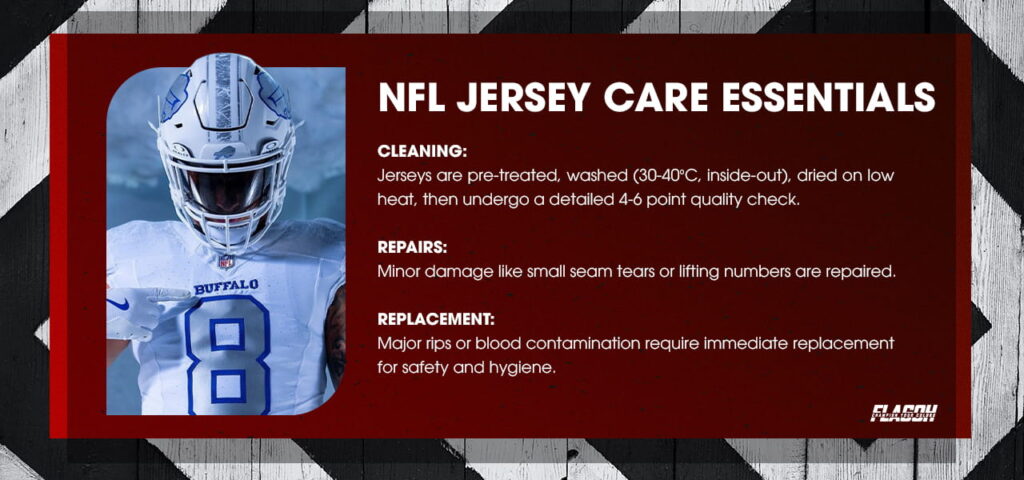
Pre-treat 5–10 min → wash 45–60 min at 30–40 °C (inside-out, enzyme detergent) → dry 20–40 min low heat → QC with 4–6 inspection points (stitch integrity, number edges, stains, odor, patch alignment). These steps mirror FlagOh’s pro-care benchmarks for fan jerseys at home.
Repairs vs replace
| Damage/Condition | Action | Reason | Return-to-Play |
| Blood contamination | New issue | Hygiene compliance | Immediate |
| Seam tear <2 cm | Bar-tack 2.5–3.5 mm | Structural integrity | After QC |
| Number edge lift | Re-press 10–15 s | Legibility | After QC |
| Major panel rip | Replace | Safety & durability | Next issue |
Construction quick-check
- Panel/yoke alignment is straight and reinforced
- Size/ID tags match team scheme and season
- Tackle-twill edges are clean (no fray or lift)
- Numeral/name outline 2.5–3.0 mm for phone-camera clarity
Note: These are typical equipment-room practice ranges, not proprietary league specs.
When Do NFL Players Get a New Jersey?
If you’ve ever wondered, “Do NFL players get new jerseys every game?”, alternates, commemoratives, and post-game swaps are the biggest exceptions—here’s when a brand-new jersey is most likely to appear. As FlagOh explains, teams prioritize hygiene, broadcast legibility, and tight inventory control before issuing a fresh top.
Alternates & patches
Throwbacks, Color Rush, international, salute/memorial, playoffs/Super Bowl can prompt a new issue—to ensure correct colorways, patch sets, and commemorative details are pristine.
Jersey swaps & keepsakes
High-profile post-game swaps or a player keeping a milestone jersey typically trigger a replacement. Teams may back-bill internally; policies vary by club; some teams account for swaps internally (see team equipment interviews).
Auctions & authentication
Retired jerseys may be archived, auctioned, or donated. Buyers should look for COA (Certificate of Authenticity), tamper tags, and photo-matching evidence—key steps to verify game-worn status.
Can Fans Buy Retired Game Jerseys Directly from Teams?
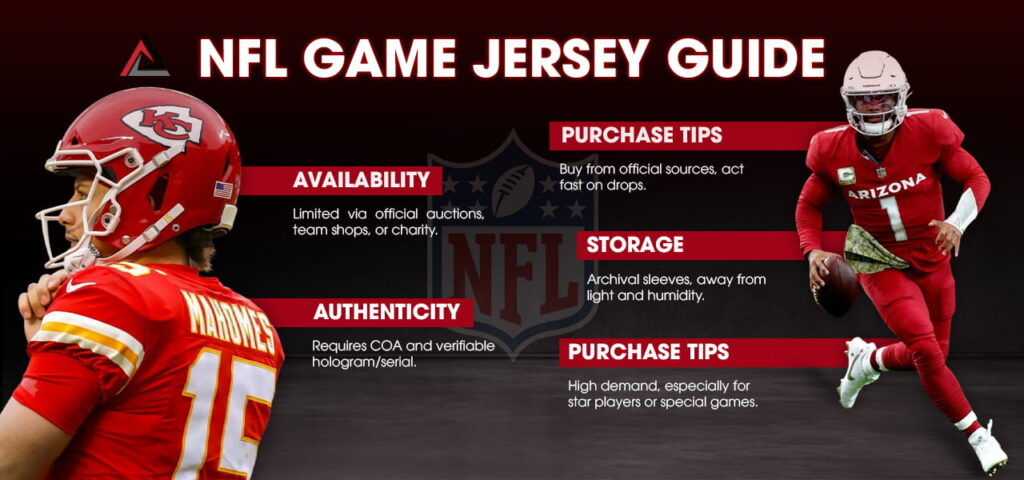
Most of the time, yes—but availability is limited and controlled. Teams and the league release a subset of game-used jerseys through official channels, while many others are repaired and reused, archived, or donated. For drop alerts and buying guidance, FlagOh recommends following team newsletters and verified auction partners.
Where “direct from team/league” sales happen
- League-run or team-run auctions: Time-boxed auctions for game-used items; star players and milestone games draw intense bidding.
- Official team shops / “game-used” programs: Occasional drops online or in-stadium; quantities are small and sell out fast.
- Charity events & fundraisers: One-off releases (often signed), with proceeds benefiting the team or local causes.
What authentic items should include
- A COA (Certificate of Authenticity) from the team/league or their designated authenticator.
- Tamper-evident hologram/serial that can be verified in a database.
- Clear item description (player, opponent/date, uniform type, patches) and, when available, basic photo-match notes.
Pricing, timing, and availability
- Supply is sporadic, and demand is high, especially for star players, playoffs/Super Bowl, throwbacks, and special-patch games.
- Some jerseys are kept by players (swaps/keepsakes) or retired to archives, so not every notable game yields public inventory.
Buyer tips to avoid fakes & frustration
- Stick to official channels or reputable partners; verify COA/hologram serials.
- Act quickly on drops; join team newsletters and follow equipment/community relations updates.
- Confirm return policies, shipping limits, and whether the jersey is photo-matched or simply team-issued.
- Store long-term in archival sleeves/boxes, away from light and humidity.
Key Takeaways About Players’ NFL Jerseys
Use this quick recap to hit the essentials—why reuse is the norm, when a fresh issue appears, how swaps and retired pieces are handled, and how to authenticate and care for your own jersey.
How many NFL jerseys per season?
It varies by player/team, usage, damage, swaps, and events, so there’s no single fixed number.
Who pays after a swap?
Policies vary; teams often account for it internally.
What happens to old jerseys?
Repair/reuse, archive, auction, or donate, depending on condition and significance.
How can I spot game-worn vs retail?
Look for wear patterns, patch alignment, correct construction, and photo-match + COA.
Are jerseys washed instead of replaced?
Yes—pro workflows (AATCC benchmarks) maintain color and fabric integrity.
Care tips in one line?
Cold 30 °C, inside-out, mild detergent, line-dry, no bleach/softeners.
Now you know the real answer to the question “Do NFL players get new jerseys every game?”—reuse is standard with clear exceptions. Ready to apply what you learned? Dive into our resources for care standards and collector checks, and browse pro-inspired jerseys and accessories at FlagOh.